
Installation view of White Knuckle, installed in the Lower Urban Room beneath the library mall.
Salt Lake’s public libraries have in common more rooms than strictly needed, but which are not wasted. Each branch has at least one art gallery, and the main library, which has its own TRAX stop and a row of shops that curl around its plaza like a sleeping cat’s tail, rivals UMOCA in the number of its art exhibition spaces. There’s Art at the Main, one of those shops, located between the library’s two sets of entrance doors. The dedicated gallery on the fourth floor may have the most remarkable setting of any local exhibition space. Another venue on the ground floor shows advanced students’ efforts, while the Children’s Library in the basement boasts a room full of exemplary art and a simulated attic seemingly borrowed from the top of a more conventional building. Then there’s the Lower Urban Room, a long hallway giving access to the rooms beneath the mall, which provides a place for shows like White Knuckle: Artwork by Wasteland. A white knuckle is one of those contronyms English relishes; literally a sign of a tight grip on the one hand, and on the other a symptom of someone barely holding on.
According to the poster, Wasteland includes Allison Joy McKinney, Lucia Borup-Douglas, Celia Thomas, and Hunter Bailey, although the 21 objects in White Knuckle also include three sketches by London Matthews in black oil on white canvas. These may require a moment’s effort to separate the signal from the noise—though once that happens they become unmistakable.
One thing all five artists seem to agree on is that art should be unexpected. It could be argued that too much Utah art falls into predictable patterns of subject matter and technique, an experience that can resemble listening to an evening of testimonies. That hasn’t happened here. In “Think like a Hermit” and “The Path to Enlightenment,” Celia Thomas ennobles the studio sofa as a not only welcome, but necessary station along one of life’s more vital learning curves. Hunter Bailey makes similarly ironic use of grandiose titles, like “Interstitial Wastes That the Righteous See From Carriage and Car,” applying them to slightly modified images of cars and boats that often appear as semi-failed signs of material success. In what might be the show’s apotheosis, Bailey’s “Talking With Each Other About Each Other” features a table lamp in an otherwise dark room, seemingly in a tête-a-tête with what turns out to be its own reflection in a mirror.

Celia Thomas, “Think Like a Hermit”
-
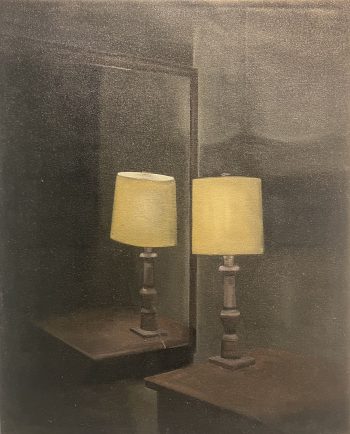
- Hunter Bailey, “Talking With Each Other About Each Other”
-
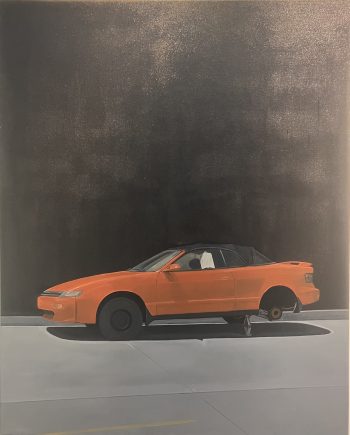
- Hunter Bailey, “A Cursed Prophecy of an Unsettling and Ridiculous Present”
Alison Joy McKinney explores mixed media and rejects convention in “I’m Not Your Robot,” then joins her contemporaries in some new, shared conventions. Lucia Borup-Douglas confirms one time-tested convention with her double name and another with “Cuz 4 Walls Can Creep in on a Motherfucker,” which argues that a car needn’t be in gear to provide an escape.
Half a century has passed since artists began taking stock of their relation to society, noting how it has changed since the likes of John Singer Sargent served their patrons by celebrating their accomplishments. Wasteland’s statement and biographies have little in common with Marlon Brando’s motorcycle outlaw, who when asked what he was rebelling against answered “What’ve ya got?” By contrast, these artists’ résumés and their works reveal engagement with issues including health (their own and society’s), the environment, and a philosophical level of questioning and doubt. They’re actively engaged with a world that never stops disappointing them. They are also capable artists who are finding their own ways to express their predicament, along with ways to show their work without compromise.

An installation view of White Knuckle: Artwork by Wasteland reveals the exhibition’s tonal range, from stark isolation to uneasy intimacy, unfolding along the Lower Urban Room.
White Knuckle, Lower Urban Room, Salt Lake City Library, through Jan. 17.
All images courtesy of the author.

Geoff Wichert objects to the term critic. He would rather be thought of as a advocate on behalf of those he writes about.
Categories: Exhibition Reviews | Visual Arts