

When Jo Roper came to Utah in the early 1960s, she was already an accomplished sculptor. Trained at Southwest Missouri State College and at Cranbrook Academy of Art, she had spent more than a decade teaching, exhibiting, and working across the Southwest, particularly in New Mexico, where she lived and maintained a studio in Montezuma. The commission she received in Salt Lake City—to create a sweeping concrete relief for the city’s new central public library—would result in one of the largest public artworks the city had ever seen. More than 60 years later, with The Leonardo closed and the future of the former library building uncertain, Roper’s sculpture still spans the wall for which it was made, even as her name has slipped out of view.
The U.S. economic boom in the late 1950s and early 1960s fueled a wave of library construction across Utah. Communities large and small—from towns like Parowan, Morgan, and Richfield to larger cities like Ogden and Murray—replaced aging Carnegie buildings or improvised facilities with libraries designed for contemporary use. Articles from the period emphasize open floor plans, centralized circulation desks, dedicated children’s rooms, and the capacity to house rapidly growing collections. The architectural language was consistently modern, favoring clean lines, clarity, and function over historical reference. Universities were also in on the building boom. By 1963, new or expanded libraries were announced or underway at Utah State University, the University of Utah, and Brigham Young University. Taken together, these projects produced a shared modernist vocabulary sprinkled across Utah as a common design language emerged—one that signaled participation in a national conversation about civic architecture.
For nearly sixty years, Salt Lake City’s main library was housed in the Beaux Arts structure on State Street which was later repurposed as the Hansen Planetarium. Funded by mining millionaire John Q. Packard, it opened in 1905, but by the mid-20th century, it was widely regarded as inadequate—overcrowded, poorly suited to modern collections, and unable to meet the needs of a growing city. Newspaper coverage from the late 1950s cataloged deficiencies in space, lighting, seating, and accessibility, while editorials urging a new library framed the project as a measure of Salt Lake City’s cultural maturity. As plans took shape, the project became entangled with broader questions about downtown planning, parking, and circulation. What emerged was not simply a replacement building, but a reconception of the library as a civic center—a place meant to anchor public life alongside government and institutional buildings. When the new Salt Lake City Public Library broke ground on Washington Square in the early 1960s and opened in 1964, it embodied this shift.
Within a few blocks, three major structures in Salt Lake City then in construction—the Public Library, the LDS Church Office Building, and the Wallace F. Bennett Federal Building—formed a trifecta of institutional modernism. Though completed a decade later, the Church Office Building was begun in 1962 and bears the aesthetic imprint of that earlier moment (rather than the heavier Brutalist forms that would soon appear on the University of Utah campus). Nearby, the Federal Building extended this modernist vocabulary into the realm of federal architecture, asserting abstraction, clarity, and monumentality as expressions of governmental authority. Clean-lined and restrained, the new library was conceived as a compact, self-contained modernist volume, defined by its strong horizontal massing of windowless upper walls of precast concrete panels and a folded, overhanging roofline. Together, these buildings projected different forms of civic confidence—municipal, ecclesiastical, and federal—yet relied on a shared architectural language of restraint, abstraction, and permanence.
Art played a central role in this redefinition, not as embellishment but as an extension of architectural intent. On the Church Office Building maps of the world anchored the building’s soaring pinstripe verticality. At the Federal Building, an abstract fountain by sculptor Angelo Caravaglia became one of the city’s most visible—and contested—modernist public artworks, provoking debate over cost, form, and meaning. Inside the new library, Douglas Snow’s mural likewise tested the public’s tolerance for abstraction in civic space. These works signaled a shift: modern art was no longer confined to galleries or campuses, but embedded directly into the city’s most consequential public buildings. Jo Roper’s exterior relief on the new library belongs squarely to this moment. Like Caravaglia’s fountain and Snow’s mural, it emerged from an institutional willingness—however tentative—to treat contemporary art as a civic language.

Born Helen Jo Roper in 1923 in Greene County, Missouri, Roper grew up in Springfield, Missouri and earned a teaching degree at Southwest Missouri State College, graduating in 1946. She later attended Cranbrook Academy of Art, where she earned an MFA in sculpture. Early in her career she taught handicrafts and sculpture, moving fluidly between applied and fine art traditions. In 1954, she accepted a two-year foreign assignment with the U.S. Army’s Special Services as a Recreation Supervisor in arts and crafts, serving in Germany—a formative experience that expanded both her technical range and her understanding of art’s social role.
After returning to the United States, Roper taught at Highlands University in Las Vegas, New Mexico; the University of New Mexico; Texas State College for Women; and later the University of Utah. By the late 1950s she was living and working in Montezuma, New Mexico, exhibiting regularly and affiliated with organizations such as the New Mexico Designer Craftsmen. Her work circulated through venues like the Dick Seeger Design Gallery at the Lloyd Kiva Crafts Center in Scottsdale, and she was included in Craftsmen of the Southwest, published by the American Craftsmen’s Council.
Roper’s arrival in Utah was shaped by circumstance as much as intention. Angelo Caravaglia’s departure for Italy to do bronze work in Italy for a year created an opening at the University of Utah, and Roper was hired to teach sculpture during the fall 1963 and winter 1964 quarters. She arrived just as the library was nearing completion and as institutional leaders were seeking artwork that would be integral to the building itself. It’s unlikely they were familiar with her personal work or more broadly, the abstract visual language she was using. Contemporary accounts indicate that board members expressed uncertainty about the scale and abstraction of her proposal, approving it not through unanimous enthusiasm but through a willingness to proceed despite reservations. Her selection suggests reliance on professional judgment rather than familiarity, and an institutional openness—however cautious—to contemporary art practices shaped beyond Utah.
In February 1964, Roper produced a small maquette for the library’s exterior wall, which was approved and enlarged through a technically demanding process requiring close collaboration with builders and fabricators. The resulting work—a monumental concrete bas-relief stretching more than 60 feet across the building’s exterior—was cast directly into the fabric of the structure. Though it appears almost freestanding, slightly removed from the building, the wall actually frames an entryway, blurring the line between sculpture and architecture.

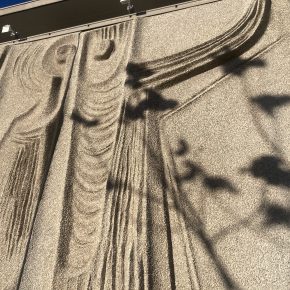


Abstract and rhythmic, the relief relies on texture, repetition, and the play of light and shadow rather than narrative imagery. Unlike freestanding sculpture or interior murals, it cannot be separated from the building that supports it. From the outset, it was meant to weather with the library, to be read not as ornament but as structure. Roper titled the work “People,” a choice that signals her interest not in heroic narrative or civic symbolism, but in the collective presence of everyday life. Though abstracted almost to the point of pattern, the forms suggest clustered figures—compressed, rhythmic, and interdependent—read less as individuals than as a community in motion. Cast in concrete and integrated directly into the library’s exterior wall, the work treats human presence as something structural rather than illustrative: people not depicted as subjects, but as the fabric of civic life itself.
Although Roper completed other public commissions during her career, including abstract figurative works installed in institutional settings, the Salt Lake City library relief appears to be her largest and most substantial project. In the context of early-1960s Utah, it is also notable in ways that were not foregrounded at the time. Large-scale public sculpture integrated directly into architecture was still overwhelmingly entrusted to men, often those embedded within local power structures. Roper, by contrast, arrived as a visiting professor rather than a civic insider.
After completing the project and her teaching stint at the University of Utah, Roper returned to Montezuma, New Mexico, and later moved to Rogers, Arkansas, around 1978, where she lived until her death in 2017 at the age of ninety-three. She continued to teach and exhibit, but without the visibility that accompanies large public commissions. In Utah, her name gradually receded from view, even as her work remained fixed to one of the city’s most prominent modernist buildings.
Meanwhile, the library itself quickly became more than a functional replacement. It emerged as a focal point of civic life—a place where students gathered, families met, and the rhythms of downtown played out around its doors. For more than a generation, it remained simply “the new library,” even as newer proposals were floated and, eventually, another new library was planned and built. The adjective never quite wore off; modernity, once achieved, lingered. That presence registers not only in memory but in art. In an atmospheric sketch of downtown Salt Lake City by George Dibble, the library, and Roper’s freize, appear not as isolated monuments but as part of the city’s lived texture—anchoring a streetscape animated by movement, light, and daily activity. Roper’s abstract language, once cautiously debated, became familiar through repetition, absorbed into the building’s identity and the city’s visual memory.
Today, as the former library building enters another period of uncertainty, that familiarity takes on new weight. Roper’s sculpture endures not because it demanded attention, but because it was allowed to become part of the city itself. Like the library that was long known simply as “new,” it reminds us that modernity, once fully inhabited, becomes history.

All images courtesy of the author.

The founder of Artists of Utah and editor of its online magazine, 15 Bytes, Shawn Rossiter has undergraduate degrees in English, French and Italian Literature and studied Comparative Literature in graduate school before pursuing a career in art.
Categories: Architecture & Design | Before Now | In Plain Site | Visual Arts






Loved this article! Thanks for sharing this Utah story. So interesting the intersections of art + design + architecture in Utah (and everywhere)
I love this story too. I don’t think many people know the history, the confluence of time and talent, and the name of the artist. Thanks.
I always figured it was Caravaglia.
Thanks Shawn. Great history!
This is one of my favorite examples of public art. How accessible? What a gentle way of ignoring a Modernist shibboleth. Are they trees? Or people? Either way, the band of sculptural art stands apart from the plain (but not too plain) rest of the building and provides something worth not just looking past, but looking at. The old Library (before my time here) is a good building, inside and out, and I hope someone comes along with an idea that will keep it standing and open for a few more years.