

Utah Arts Alliance founder Derek Dyer at the Salt Lake Masonic Temple, the venue for the 2026 SLC White Party, which supports Utah Arts Alliance programming and capital projects. Image by Steve Coray.
Some of the most visible arts experiences in Salt Lake City—the SLC White Party, the Urban Arts Festival, and Dreamscapes: Salt Lake City’s Immersive Art Experience—share more than spectacle or scale. They are part of a longer arc of creative entrepreneurship shaped by Derek Dyer, whose work has consistently focused on building events and spaces that support artists not just aesthetically, but materially.
Dyer’s approach has always been deliberately glamorous, aimed at an artistic crowd that values atmosphere, ambition, and polish. But that glamor is underwritten by a practical ethic: paying artists and creative workers, many of whom are also his employees, and treating creative labor as central rather than incidental. From large-scale ticketed events to immersive installations and permanent venues, his projects are structured to provide real opportunities for artists to work, earn, and experiment within a stable framework. Over time, this has created a recognizable ecosystem—one where artists move fluidly between roles as performers, fabricators, technicians, and collaborators.
That commitment eventually took organizational form in the Utah Arts Alliance, which Dyer founded in 2003 and built from the ground up. Through UAA, he has helped establish multiple venues and programs that extend far beyond one-off events, creating ongoing infrastructure for exhibitions, performances, festivals, recording, broadcasting, and immersive art. As Dyer describes it, the organization “makes Salt Lake City a city we want to live in. Gives creative people the ability to create. Everyone has the ability to create and we make spaces that nurture that in people.” The emphasis is less on prestige than continuity and on keeping creative work visible, accessible, and sustainable over time.
Since 2012, the Utah Arts Alliance has been headquartered at the SLC Arts Hub, a former industrial site on the west side of Salt Lake City’s downtown that Dyer helped reimagine as a flexible, artist-centered venue. Designed to accommodate studios, exhibitions, performances, and large-scale gatherings, the space has long functioned as a testing ground for ideas that don’t fit easily into conventional arts venues. Its scale and adaptability make it well suited to ambitious, visually driven work, while its informal structure has allowed artists and organizers to experiment across disciplines.
Dyer has also taken advantage of the nearby Gateway district for two of UAA’s most visible public-facing projects: the Urban Arts Gallery and the Urban Arts Festival. The gallery provides a consistent exhibition platform for local artists working across media, foregrounding accessibility and public visibility rather than curatorial exclusivity. The festival, meanwhile, operates at civic scale—temporarily transforming downtown streets and plazas into a dense mix of visual art, music, performance, and interactive projects.

Dreamscapes 4.0 has returned to The Gateway. Image courtesy of Utah Arts Alliance.
If the Urban Arts Gallery and Urban Arts Festival represent Utah Arts Alliance’s most outward-facing work—bringing art into public circulation at civic scale—Dreamscapes turns that same impulse inward, toward sustained immersion. Conceived as a permanent immersive art environment, it brings large-scale installation work into a format that is accessible to a broad public, while still being artist-driven. Unlike pop-up experiences that arrive fully formed and then disappear, Dreamscapes operates as a living platform, regularly commissioning new work and allowing artists to experiment with narrative, scale, and interaction. It translates the logic of event-making—attention, flow, spectacle—into a year-round venue that rewards repeat engagement.
As Dreamscapes refined a model for permanent, immersive exhibition, it also exposed the limits of existing venues—how much scale, weight, duration, and risk they could realistically absorb. The next step, for Dyer and the Utah Arts Alliance, was not another iteration but an expansion of possibility. That impulse finds its clearest expression in the newest of these projects: the Art Castle. Originally constructed in the early 20th as an LDS chapel and later repurposed as a recording studio used by nationally known musicians, the building carries layers of communal and creative history. UAA’s vision is to adapt that legacy for contemporary use, transforming the site into a flexible venue for large-scale installations, experimental performances, and immersive environments that exceed the limits of conventional galleries. UAA is currently fundraising to complete ADA compliance upgrades at The Art Castel, with the goal of opening to the public later this year. If successful, it has the potential to become a significant community asset, one that expands access to large-format creative work and adds another durable layer to the city’s cultural infrastructure.

The Art Castle, a former neighborhood chapel later used as a recording studio, is being reimagined by Utah Arts Alliance as a space for large-scale installations, performances, and immersive art. Image by Steve Coray.

Inside the Art Castle, a former sanctuary now envisioned as a flexible space for exhibitions, performances, and immersive environments. Image by Steve Coray.
In that sense, the UAA’s upcoming White Party is not simply an annual celebration but a mechanism that helps make projects like the Art Castle possible. On January 10, 2026, the historic Salt Lake Masonic Temple will be transformed into a sequence of immersive environments, each drawing from a different era or symbolic register, from cabaret decadence and disco futurism to mythic archetypes and ancient iconography. Rather than collapsing history into nostalgia or novelty, the event treats time as layered and porous, inviting guests to move across styles and references while remaining anchored in the present moment.
That approach mirrors the mission of Utah Arts Alliance itself. Founded to support independent artists, experimental projects, and community-driven creative spaces, the organization has long operated at the connective tissue of the local arts ecosystem—linking venues, disciplines, and audiences that might otherwise remain siloed. Its involvement in the White Party is not incidental. The event functions as both fundraiser and demonstration: a visible reminder of what happens when artists are given scale, resources, and a public willing to meet them halfway.

Performers entertain the crowd at the SLC White Party, where dance, costume, and theatrical spectacle combine in support of Utah Arts Alliance programming. Photo courtesy of Utah Arts Alliance.

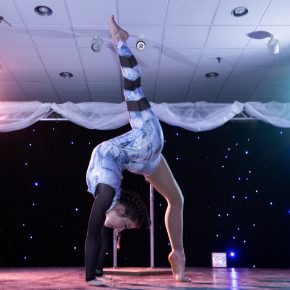

The choice of venue reinforces that intent. The Salt Lake Masonic Temple, with its ceremonial architecture and layered symbolism, becomes more than a backdrop; it becomes an active participant in the evening’s conceptual frame. History is not erased or overwritten but repurposed: rooms opening into other rooms, motifs repeating with variation, bodies moving through spaces once designed for ceremony. The emphasis isn’t on past or future as destinations, but on continuity: how cultural memory is built, sustained, and periodically reworked through shared experience.
Importantly, the event’s charitable dimension is concrete rather than abstract. Proceeds support Utah Arts Alliance’s year-round programming, including studio access, performance opportunities, and platforms for artists working outside commercial circuits. In this sense, the night operates as a redistribution mechanism—converting spectacle, ticket sales, and collective enjoyment into tangible support for ongoing creative work.
What Derek Dyer ultimately demonstrates is that a city’s creative life is sustained not only in studios and galleries, but in the spaces where people gather to enjoy themselves. The music fades, the costumes are packed away, but the structures that make art possible remain—quietly reinforced by an approach to celebration that understands fun as a serious form of investment.

Derek Dyer stands outside the Art Castle, Utah Arts Alliance’s newest project, a historic building being transformed into a large-scale creative venue on Salt Lake City’s west side. Image by Steve Coray.
The SLC White Party takes place on January 10 at the Salt Lake Masonic Temple. Guests are invited to dress in white, with accents drawn from one of the event’s themed eras, and to participate in an environment designed to be experienced collaboratively rather than passively. More information and ticket updates are available via Instagram at @slcwhiteparty.

Hannah McBeth studied art history, classics, and Mediterranean archaeology before getting a Master’s at Cambridge University. She enjoys writing, hiking, and traveling to far-off places. Follow her on Twitter @hannahmcbee.
Categories: Art Professional Spotlight | Visual Arts


That Hannah sure can write!