
Installation view of Instrumentos de silencio with Gonzalo Silva’s “Wandering Thread,” (2025, CD drive, etched plexiglass) in the foreground.
In a new multimedia exhibition, Buenos Aires–based siblings Gonzalo Javier Silva and Susana Isabel Silva examine sound as a cultural technology through a body of work that is varied yet cohesive. They reflect on how sound is made, perceived, recorded, and transmitted across different places and times, using historical systems and materials to show how these technologies shape the circulation of knowledge. An array of textures and a restrained palette—red and orange woven throughout—encourages close looking and rewards repeated visits with small, unfolding details.
Instrumentos de silencio opens with a reference to early systems in which music and computation overlap, using punched and mechanical encoding to translate information into sound, much like a player piano score. The first work encountered along UMOCA’s street-level Ed Space is a large, portrait-oriented paper piece in muted yellow, with raised polyhedral forms stamped with Morse code. “Partitura modular” stems from Susana Silva’s exploration of visual encoding systems, linking early computational punched cards with graphic musical scores. These perforated patterns function as traces of a language in transit, hovering between data, notation, and silence. When translated into cut and folded paper, the coded structure breaks away from the flat surface and extends into physical space.
Another grouped series of 12 square works, rendered in warm tones of red, orange, and white, draws on pre-Columbian systems of visual communication rooted in Andean culture. Tocapu, or t’oqapu, were complex geometric motifs arranged in squares or rectangles that functioned as a sophisticated graphic communication system for the Inca elite. These polychrome designs appeared on high-status garments such as royal tunics, as well as on wooden and ceramic vessels, where they signified political, ethnic, or religious identity. Much of this visual language was disrupted following European arrival. In “Tocapu,” Susana Silva reimagines this legacy by treating the panel as a form of notation rather than image. Rather than reproducing historical symbols, the series is constructed from precisely cut, overlapping paper forms layered across each panel. Through repetition, variation, and alignment, the works establish rhythmic patterns that operate like a silent score, positioning visual structure as a way of organizing time, sequence, and pause.

Susana Silva, “Tocapu,” 2025, CNC and hand-cut paper, 61 x 61 inches.
Moving from ancient systems of communication into the modern period, Silva and Silva reference early recording devices and the physical mechanics of storing information. In Gonzalo Silva’s “Wandering Thread” (2025), printed and etched Plexiglass panels reproduce colonial and modern representations of quipus, the Andean recording system composed of knotted cords that likely conveyed both numerical and narrative information. Incorporating a CD drive, the work draws a direct line between pre-Columbian encoding systems and later mechanical and digital technologies, emphasizing continuity in how information is structured and preserved.
A related work, “Wandering Breath,” further extends this inquiry into systems of storage and reproduction. The object combines computer CD drives with images and objects that span centuries, reflecting on Western attempts to interpret and translate other knowledge technologies. Included is a black-and-white photograph from an architectural excavation of Mexica human remains, alongside a resin 3D print of a discovered object that functions as a playable death whistle, whose ceremonial and musical purpose remains debated. These elements appear alongside a medieval miniature depicting two musicians playing wind instruments, collapsing historical distance and placing scientific documentation, ritual sound and artistic representation into a single mechanical frame.
-
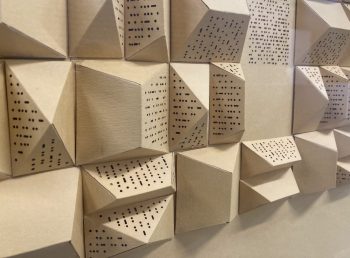
- Susana Silva, Partitura modular, 2025. Folded hand-cut paper, 33 x 17 x 2 in.
-
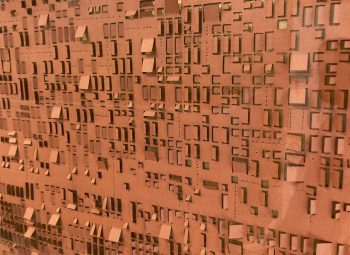
- Susana Silva, Códigos de vacío, 2025. CNC and hand-cut paper, 28 x 43 x 2 in.
Gonzalo Silva’s practice is shaped by extensive research and digital planning prior to fabrication. He gathers visual and conceptual material intuitively, then develops it through a rigorous design process in which research and composition evolve together. By resolving form and structure digitally before production, the physical object is realized with minimal modification, underscoring a method in which conceptual decisions are completed before material execution.
Another striking piece, “Ritual, formulario e institución” draws on Hanacpachap Cussicunin, the first Christian hymnal printed with musical notation in the Quechua language and the first musical score published in the New World. Presented in two parts, the work takes the form of a deconstructed red book binding. At its center is a folded hymnal page cut through with a pattern of holes that interrupts the printed musical notation. Laser-cut Fabriano paper carries fragments of liturgical text, while folded signatures reference the structure of an early colonial book. Architectural drawings of the cathedral where the music was first performed, pages of notation, and a detail from the original frontispiece are incorporated into the composition.
Instrumentos de silencio is compelling in part because it remains attentive to gaps between sound and object, history and artifact, and processes of construction and disassembly. Rather than advancing a single storyline, the exhibition presents a vivid and diverse look at what produces sound and how music is defined across different systems of knowledge.

Susana Silva, “Ritual, formulario e institución,” 2025, CNC and hand-cut paper, 11¾ x 16½ x 1⅝ in.
Instrumentos de silencio, Utah Museum of Contemporary Art, Salt Lake City, through March 13. Artists Panel: Friday, Jan. 30, 2026, 6pm-7:30 pm.

Hannah McBeth studied art history, classics, and Mediterranean archaeology before getting a Master’s at Cambridge University. She enjoys writing, hiking, and traveling to far-off places. Follow her on Twitter @hannahmcbee.
Categories: Exhibition Reviews | Visual Arts