

Lenka Konopasek in her garden studio, with works in progress. The vaulted ceiling and large window — additions that transformed what was once a windowless garage — flood the space with the kind of light that makes the room feel larger than it is.
Surely one of the necessary attributes of any artist’s studio ought to be security, on several levels. Picasso’s million dollar studio, in a couple of French chateaus, included numerous spaces, each behind a locked door, and he enjoyed waving around a giant ring of keys as he unlocked one room at a time for visitors, leaving all the others shrouded in mystery. Yet, privacy for their projects, in whatever stage of completion, is only part of an artist’s freedom from danger. Often choosing to work long and irregular hours, both working and traveling alone, in the sort of risky or threatening neighborhoods that is all many artists can afford only adds a burden of anxiety to the pressures of deadlines and demands on one’s ego. Then there’s the value of the contents, rumored or real, cross-referenced with the deplorable reputation of art thieves for wrecking whatever they come across, whether they choose to steal it or not, and which if recovered—never guaranteed—is often damaged, sometimes beyond restoration.
The studio tale of Utah’s Lenka Konopasek and her partner, Cordell Taylor, is more than a short story. It’s more like a novel featuring the two romantic leads, universally known as Lenka and Cordell. We started in her primary studio, a weathered, ranch-style cottage at the rear of her garden, in a domestic neighborhood in the 9th and 9th neighborhood of Salt Lake City, behind the home the two have shared for more than three decades. Originally the garage, windowless and as inspiring as a shoebox, it responded well to the artists’ efforts to turn it into an asset on several levels: as a charming feature of their garden, a dedicated space reserved for contemplating and making art, but also a secure place sheltered within their own homestead. So for the quarter century she’s had it, it’s never been replaced by the second, larger, more publicly accessible studio she set up in a more commercial part of Salt Lake City.

A corner of Konopasek’s studio holds several bodies of work at once: kinetic-looking metal assemblages on stands, a large laser-cut panel mounted to the wall, and crates holding smaller works in various states.

A worktable in Konopasek’s studio holds panel works at various stages — circular forms with layered, topographic line work in blue and green alongside a large matte-black sculptural mass.
It’s pretty clear that Lenka isn’t at ease anywhere else. It may have something to do with her having grown up in Czechoslovakia, a small, historical, but land-locked and much mistreated nation in what’s known as the cockpit of Europe, which had then only recently emerged from the most destructive war in world history, thus far. In her art, we see endless images of violence, both in nature and among humanity, which she has aestheticized. In her paintings, architectural models, sculptures, and installations, she reveals the sheer, rarely seen beauty of an attribute of existence most of us have trouble even looking at, let alone seeing.

A corner of Konopacek’s garden studio, where paintings in various stages of completion compete for wall space with circular panel works and drawings pinned directly to the wood.
In addition to that, the area where good studio space was available in Salt Lake City was still struggling to recover from freeway construction that had severed community streets and whole neighborhoods, producing threats of crime on the one hand and the certainty of urban renewal on the other. She knew that any space she could acquire for a studio could be torn down, sooner or later, to build apartments in line with the current public practice of calling for more homes, then using the resulting approval to build investment properties instead.
In fact, the remote building that houses her other, newer studio came with a laissez-faire owner and inadequate security, which only grew worse when the building was bought by one with no interest in its future. Break-ins were frequent, leading to the day when Taylor, who had stopped by for an errand, called to inform her the place had been invaded and effectively trashed.
This brings us to Cordell’s studio, a modern business facility set back from its parking lot where, behind a solid-looking brick-and-glass facade, a rabbit warren of office-like spaces lead to something more important: the back rooms have generous floorspace and high ceilings clearly intended to provide their occupants with the flexibility to create whatever options were required or desired. Those who have seen his occasional exhibitions in which he summarizes his progress, or followed them in 15 Bytes, will be aware that while much of his work consists of large, even monumental metal abstracts, he also works in sequences of small, intimate objects that commemorate the process by which he develops new forms and explores their capacity for expression. Most of these end up here in the studio, where it would appear that possibly hundreds of them are displayed on shelves and tables.

The front entrance to Taylor’s studio-gallery on 964 South reads more professional firm than artist’s workshop. The brick-and-glass facade belies what’s inside.

A shelf of Taylor’s welded steel heads, ranked like a formation.

The back room — high ceilings, industrial fittings, works at every scale from tabletop to monumental.
-
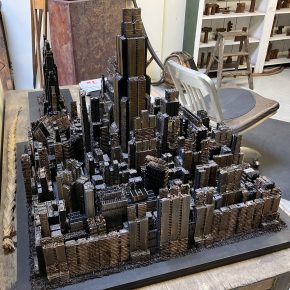
- A close look at one of Taylor’s cityscapes reveals the obsessive accumulation of stacked and welded metal elements that gives his work its density.
-
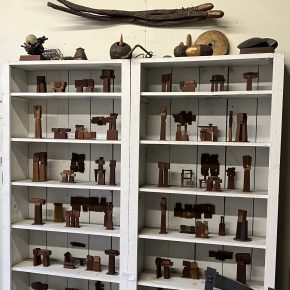
- Two tall shelving units hold sequences of small, intimate studies.
-
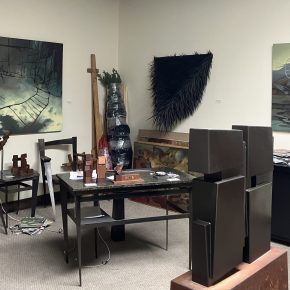
- The front gallery at Taylor’s studio, where Konopasek’s large paintings share wall space with Taylor’s sculptures at every scale.
-
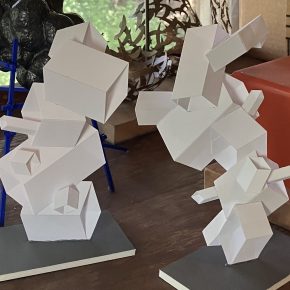
- Paper maquettes — folded, faceted, almost origami-like — sit on a worktable in Konopasek’s studio.
-
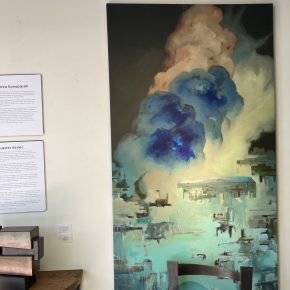
- A large vertical painting from Konopacek’s Disaster Series hangs in Taylor’s studio-gallery alongside one of Taylor’s blocky metal sculptures.
-
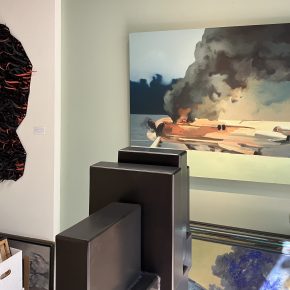
- A painting of a burning aircraft — calm in its handling of something catastrophic — faces a wall-mounted sculptural form in black and red that reads as both organic and threatening.
Meanwhile, in the front rooms, Lenka’s paintings enjoy a kind of hybrid existence, part storage and part display. Each body of work has its own place, where most of it is wrapped and stacked carefully for safekeeping. A few of each of these are hung on the walls, with some of the gallery-style signage that identifies each subject. The casual way she explains that, for them, the goal of having both a studio and a high-grade gallery in the same space has largely been abandoned says plenty about which purpose is more essential to these talented and well-practiced artists.
Seeing the working spaces they built for themselves, several things, some surprising, come into view. Not many artists live successfully in couples: serial monogamy is an occupational hazard, as is the temptation for the artist partner who succeeds to have a spouse with a more remunerative profession. How these two manage it just might be revealed in the extraordinary fecundity on display here. Anyone paying attention should marvel at such evidence of hard and constant labor over many years of willful sacrifice. Two persons, each with such a strong desire to make art, are either in great danger or very fortunate to encounter each other. Lenka says the connection was forged at the University of Utah. Seeing the two together, seemingly casual as they carefully look out for each other, or as happened this time, listening to one while the other is somewhere else, working on a paying gig that will keep them apart for a month or more, each seems to consider the other the way healthy people do their own bodies: never taking them for granted, yet counting on them to be there.
In all this, few things are more important than structure. It’s the old question of the chicken and the egg: does a good studio arrangement bolster an artist, or does a smart artist learn what makes the good studio? Or is it even possible to separate the two?

The exterior of Konopasek’s studio, a converted garage that has shed any trace of its original purpose.
All images courtesy of the author.

Categories: Studio Space | Visual Arts









Thank you Geoff for visiting our studios and a thoughtful article.