
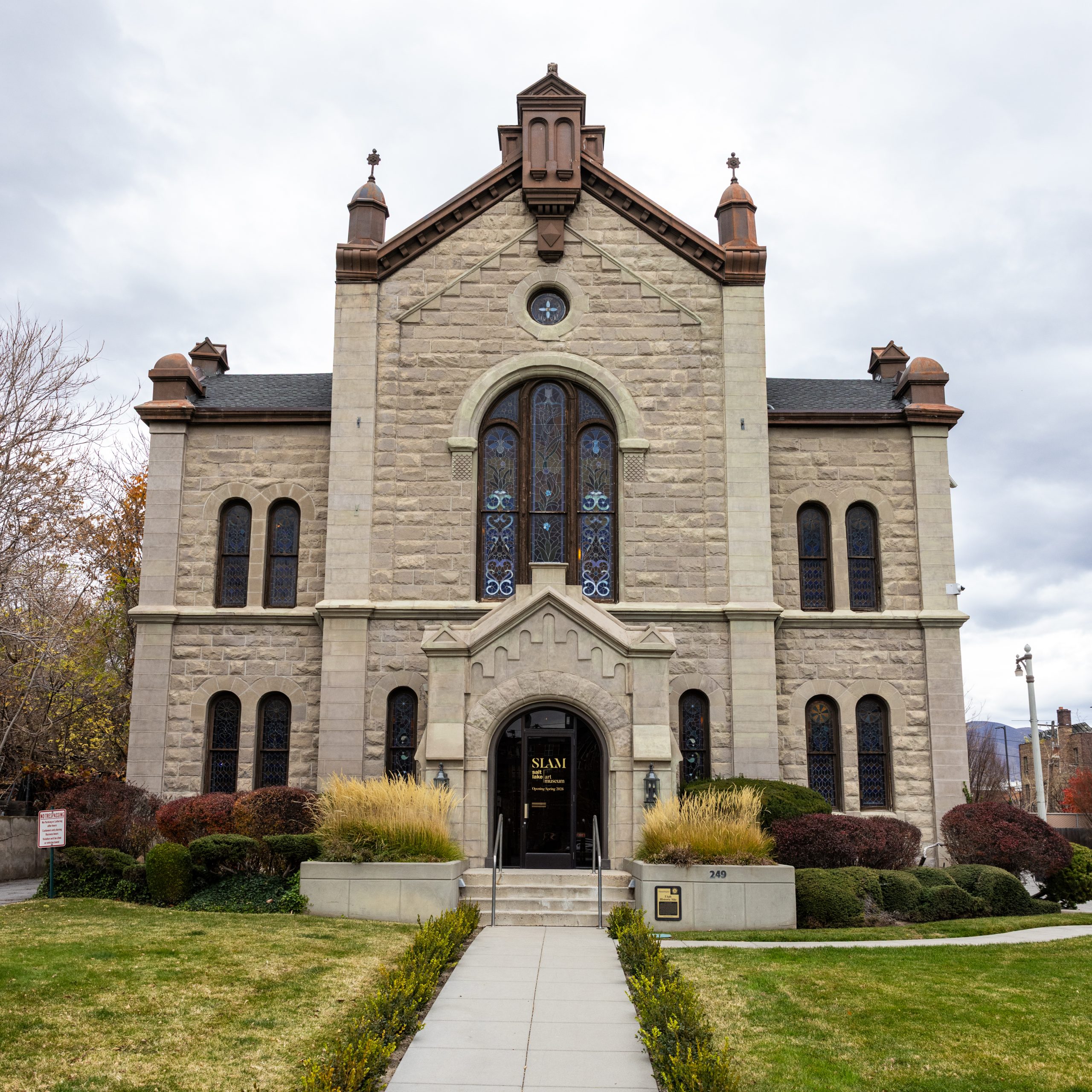
The B’nai Israel Temple, completed in 1890 and now home to the Salt Lake Art Museum, stands as one of Salt Lake City’s most significant surviving historic structures. Image by Steve Coray.
Completed in 1890 for Salt Lake City’s first Jewish congregation, the B’nai Israel Temple carries a depth of cultural memory rare among the city’s remaining historic buildings. Its survival is uncommon in a city where progress has a habit of erasing the physical traces of its own past. Restoring the temple and establishing the Salt Lake Art Museum (SLAM) within it brings into view a narrative that has long remained at the margins of the city’s broader historical accounts.
SLAM’s founder, Micah Christensen—who holds a doctorate in the History of Art from the University College London and a master’s degree from Sotheby’s Institute, London—has longstanding ties to both Utah’s arts community and the Jewish history embedded in this neighborhood. His grandfather worshiped in the B’nai Israel Temple, and his family’s business, Anthony’s Fine Art & Antiques, has shaped the cultural life of the area for decades. In discussing his hopes for the new institution, Christensen explains: “I envision an art sanctuary—one that nurtures both those who create and those who appreciate art.” He adds: “It’s been said that art washes the dust of life from the soul. That is something we need, both individually and communally.” The museum’s presence in the building reconnects threads of family, art, and community that converge at the site.
Utah’s artistic production has been consistently strong, yet the state’s museum infrastructure has expanded slowly. The Wall Street Journal reports that Utah ranks near the bottom nationally in museums per capita, fewer than every state save West Virginia. The adaptation of a historic building for new institutional use responds to this scarcity while also signaling a meaningful commitment to preservation. SLAM’s formal opening is scheduled for Spring 2026, but its early programming already outlines the position it intends to hold within the region’s cultural landscape.

Utah artist Galina Perova (left) and SLAM founder Micah Christensen speak during the Utah Masters Series at the Salt Lake Art Museum, Friday, November 14. Image by Steve Coray.


Among these initiatives is the museum’s Utah Masters Series, the latest of which features an exhibition of work by Galina Perova. Born in Siberia in the former Soviet Union, Perova trained at the Repin Academy in St. Petersburg, where she earned both her M.F.A. and doctorate. In 1989, Perova came to the United States, choosing to remain and pursue her career. Her work is marked by technical precision and a fluency in realist genres, including portraiture, landscape, still life, and figure studies. Her portfolio includes formal portraits of prominent Utah figures such as former Salt Lake City mayors Deedee Corradini and Rocky Anderson, former governor Jon Huntsman, and former University of Utah president Arthur Smith. She has also produced landscapes of southern Utah and maintains a broad practice across multiple subjects. Her inclusion in the series reflects the museum’s aim to situate Utah-based artists—whether lifelong residents or later arrivals—within a context that supports long-term study and recognition.
The question of how Utah artists enter the historical record remains central to SLAM’s mission. Christensen has emphasized that the museum intends to help recognize artists whose contributions have shaped the cultural life of the region but have not always been integrated into institutional histories. This work also extends his scholarly efforts; in 2022, he co-authored The Dictionary of Utah Fine Artists, a comprehensive reference documenting more than 4,500 artists connected to the state. Christensen offered the example of Pilar Pobil, noting that despite her stature in Utah’s artistic community, she has yet to be the subject of a full retrospective at the state’s largest museums. The observation underscores how easily significant artistic legacies can fade without institutions committed to carrying them forward.
The museum’s emergence also intersects with a longstanding question about how Utah understands its own artistic inheritance. For decades, the state has produced painters, sculptors, photographers, and designers at a rate that outpaces the institutional structures available to exhibit them. Many artists have worked within a fragmented system of galleries, university museums, and periodic surveys, but without a dedicated space committed to long-term research and preservation. SLAM’s leadership points to this gap as both a challenge and an opportunity: the possibility of building an institution that can gather disparate histories into a more coherent and accessible form.

The main hall of the B’nai Israel Temple, restored as the central exhibition space of the Salt Lake Art Museum. Image by Steve Coray.


The B’nai Israel Temple’s history begins well before its 1890 walls were raised. Jewish families were worshiping in Salt Lake City as early as the 1860s, first in private homes and later in borrowed locations such as the Masonic Hall and Independence Hall, as a small but growing non-LDS population established itself in the city following the Utah War and the gradual diversification of the territorial capital. Congregation B’nai Israel formally organized in 1873, and by the 1880s the community had built its first synagogue and Hebrew school at First West and Third South.
Completed and dedicated in 1890–91, the B’nai Israel Temple was described in contemporary accounts as an ornament to the city, a recognition of both its architectural presence and the standing of the Jewish community within a predominantly Latter-day Saint landscape. Although originally imagined as a scaled echo of Berlin’s Fasanenstrasse Synagogue, the finished structure became a Romanesque Revival building with eclectic features: a rusticated Kyune sandstone façade, brick side walls, and a prominent dome rising above a cross-shaped roof. Two large stained-glass windows mark the main front elevation, while the dome’s drum and other façade details translate continental synagogue architecture into a distinctly Salt Lake idiom. Overhead, one can observe an eight-pointed window of blue glass—formed by interlocking triangular segments—pulling light into the central hall through the star.
In its newest chapter, SLAM has begun to draw those threads back into the space. During early programming, the museum welcomed local Jewish groups into the restored sanctuary to observe holiday gatherings among the artworks—quietly returning the building to its liturgical origins, if only for a moment, and allowing ritual, memory, and exhibition to coincide under the same dome once again.
-

- SLAM Director of Marketing Samuel Hart
-

- SLAM Collections Manager and Curator Aloe Corry
-

- SLAM Executive Director Chris Jensen
Christensen has assembled a small team whose backgrounds reflect the museum’s emphasis on research, design, and contemporary practice. Samuel Hart, SLAM’s Director of Marketing, brings experience as an art director in Los Angeles, where he developed visual identities and exhibition materials for cultural organizations; he is also a practicing artist whose own work informs his visual approach to the museum’s public presence. Collections Manager and Curator Aloe Corry holds an M.F.A. from the BxNU Institute at Northumbria University and an M.A. in Museum Studies from the University of Westminster, and is likewise a practicing artist whose curatorial and studio training shape her approach to collection stewardship and exhibition planning. Executive Director Chris Jensen holds a master’s degree in Historic Preservation from Goucher College and brings extensive experience in organizational leadership, real estate, and community engagement. His service on the board of the Utah Pride Center—including roles as treasurer, vice chair, and chair—reflects a longstanding commitment to civic and cultural development in Salt Lake City. Together, Jensen, Hart, and Corry help define the museum’s early public identity and its curatorial direction as SLAM moves toward its formal opening in 2026.
For a place with so many artists, Salt Lake City has always had an oddly small number of rooms to put them in. The Salt Lake Art Museum’s arrival at 249 South 400 East suggests that this pattern may finally be shifting. Housed in a building shaped by more than a century of community life, SLAM positions itself as both a steward of inherited histories and a catalyst for the narratives still waiting to be written. Its exhibitions, scholarship, and early programs hint at a future in which the state’s creative life is met with institutions equal to it—a future in which Utah is no longer deprived of the museum spaces its artists, audiences, and histories have long deserved.

The entrance to the Salt Lake Art Museum, located within the restored B’nai Israel Temple, announces its forthcoming public opening in spring 2026. Image by Steve Coray.
The Salt Lake Art Museum, 249 South 400 East, Salt Lake City is currently available by appointment only. Learn more about their Utah Masters Series at saltlakeartmuseum.org.
All images by Steve Coray.
DID YOU ENJOY THIS ARTICLE?
Help make more like it possible.
VENMO us a donation at artistsofutah

Or use PayPal to MAKE A DONATION.
15 Bytes is published by Artists of Utah, a 501 (c) 3 tax-exempt nonprofit.
Related posts:

Hannah McBeth studied art history, classics, and Mediterranean archaeology before getting a Master’s at Cambridge University. She enjoys writing, hiking, and traveling to far-off places. Follow her on Twitter @hannahmcbee.
Categories: Gallery Spotlights | Visual Arts








I wonder if the Museum will acknowledge the historical fact that the second-class status of women was represented in Jewish houses of worship, alongside other religions, by making them sit upstairs, where they were isolated from the holy texts and remote from the activity of worship. When we were in France a few years ago, we were told we could enter an active Synagogue during worship, but after waiting with other passers-by, we found the hospitality limited to admission to the upper floor, where the active worship felt better than a rumor, but still served to give us a sense of how much our outsider status resembled the women’s. Obviously nothing like that takes place in the Museum of Art, but some analysis of the surviving architecture might prove welcome.
As Dr. Christensen showed us around the upstairs galleries, which have been transformed into exhibition spaces, he did mention that in Orthodox synagogues women were confined to the upstairs for worship, but that by the time the B’nai Israel Temple was built the congregation was Reform and everyone worshipped on the main floor.
I am grateful for the addition of SLAM into the Utah arts landscape, too, but it seems like a very odd choice to make half of this article a criticism of the existing arts and museums landscape. Was that necessary, and does it belong in a news outlet dedicated to the places where the modern Utah arts scene thrives? I wish more words had been dedicated to the what is and what will be of SLAM, and fewer dedicated to denigrating the community.