
It began with a hymn.
Methinks the Spirit whispers,
“No man has found ‘pure space,’
Nor seen the outside curtains,
Where nothing has a place.”
Camilla Stark, Rusden Scott, and LAZERos set out to create an elusive “place” in downtown Provo. All they needed was a title. “We wanted something that invoked the spiritual transmission of ideas; it could be revelation, tapping into the zeitgeist, the muse,” says Laz.
The trio had came together through art shows in Provo. Stark and Laz first connected through Instagram over a shared interest in making art about Mormon/Latter-day Saint culture that didn’t fit comfortably into either conventional LDS devotional art or straightforward criticism of the church. In 2017, they founded The ARCH-HIVE collective (aptly named for its nod to Deseret). They were inspired in part by the Art and Belief Movement, the Mormon art movement that began in the 1960s and included artists associated with the effort to develop a more serious contemporary LDS visual culture.
Stark and Scott met at a pop-up, where Stark’s art immediately resonated with Scott. “Her work was like nothing I’ve ever seen,” he says. “…it [was] self-aware, intelligent, bizarre. I couldn’t conceive that it was possible. It spoke to me in some way.” He credits Stark directly with his return to church fellowship and Mormon art. The pair married, Scott joined the collective and the three of them began imagining a new project, a physical space. And a new name.
Last week, near the intersection of Center Street and University Avenue in Provo, The Outer Veil emerged with their inaugural show: Mormanity. Holographic stickers and lemon Jell-O shots included.


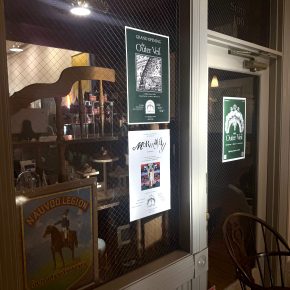
“It carries a little bit of mystery and discovery,” Laz says about the project. Scott adds, “It’s different on purpose.” Stark says of the work they are showcasing, “It is courageous… it detaches from fear and a single message.”
The founders say they’re interested in accessibility and a departure from exclusionary contemporary art spaces. They hope to set themselves apart from other contemporary Mormon art, gravitating toward work that approaches complex topics without surrendering to cynicism. Scott says much of Mormon art is “so easy and abundant. It takes a lot more to be authentic while still having room for challenging concepts.” The selection process for this show was intuitive, something Laz describes as “being on the same wavelength as the artist without knowing them.” Laz, who began anonymously exploring and posting about Mormon art online nearly a decade before the opening, makes it clear that the collective, now through The Outer Veil, is as invested in building community as it is in displaying artwork.
The gallery’s unorthodox plum accent color, pine-green trim, and gilded fig leaf motifs are punctuated by other subtle symbols associated with Mormon culture. Like its interior design, The Outer Veil’s featured work shines. Along the 30-foot-long main gallery wall, an assortment of original artworks hang salon-style, housed in eclectic frames. Rather than beginning as a tabula rasa, it was imperative to the team that the gallery debut with ornateness and character—a visual celebration of the unique flavor of Mormondom.


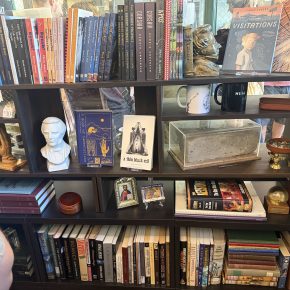

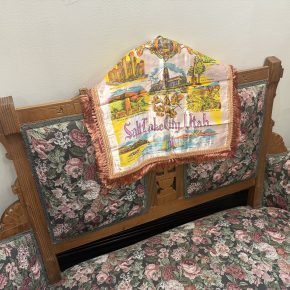
The Outer Veil reserves a wall for selling antique decor, publications, and other materials produced by ARCH-HIVE-promoted creatives. Beyond its function as a gallery and commercial space, The Outer Veil positions itself as “a place of preservation… to celebrate Mormon material culture.” Scott points out that the chairs in the back room—draped with a tasseled antimacassar with watercolor Mormon monuments—were salvaged from the old Provo tabernacle. The maximalist decor is an aesthetic decision, but it also reflects the founders’ effort to maintain the aspects of Mormon culture that have fallen by the wayside: “For many reasons, there has been a pretty major de-emphasis on many unique aspects of Mormonism over the past 50 years,” Scott remarks. “In the end, real things are being lost.”
Each member, an artist in their own right, brings their own expertise to the project. Stark’s background in industrial design, for instance, shaped her approach to networking for a gallery space, as well as its visual identity.
Laz regularly dives deep into research on the LDS church’s aesthetic history, noting the unsung craft of Mormon pioneers. “There are things [they] clearly cherished that are not reflected at all, even among the weirder parts of Mormonism that people know.” As they recount these cryptic artifacts, laughter erupts. Conversation between the three founders easily glides into tales of bloodstone amulets, flaming neon swords, and pioneer hair sculpture. Each anecdote only continues to enrich the vision of the space around them.
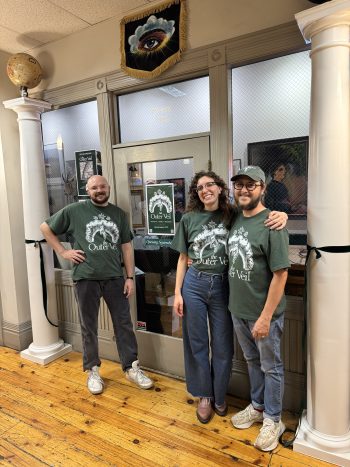
Scott emphasizes the continual need for creative gatherings, noting the outpouring of community engagement from their previous shows. “One of the amazing things about this collective and everything else is how many people have come out of the woodwork who get it.” The collective seeks to grow their unique community, which Stark lovingly calls a “collecting of misfits” that can learn “grand truths” from one another.
The nature of upcoming exhibitions and future events remains intentionally undefined, with no restrictions on medium: performance, installation, and other forms are welcome. The Outer Veil collective hopes to involve not only artists but musicians, filmmakers, non-locals, and even those new to creating art. Film screenings, art critique nights, and more are said to be in the works, all in service of the community’s creative exchanges.
Whatever the future holds, the team makes one point certain. What ties The Outer Veil together is not a specific medium or style, but an expression and an attitude of authenticity. Upcoming looks behind the curtain promise a singularly bizarre and undeniably sincere showcase of artwork.
The Outer Veil is located at 55 N University Ave #100 in Provo, Utah.
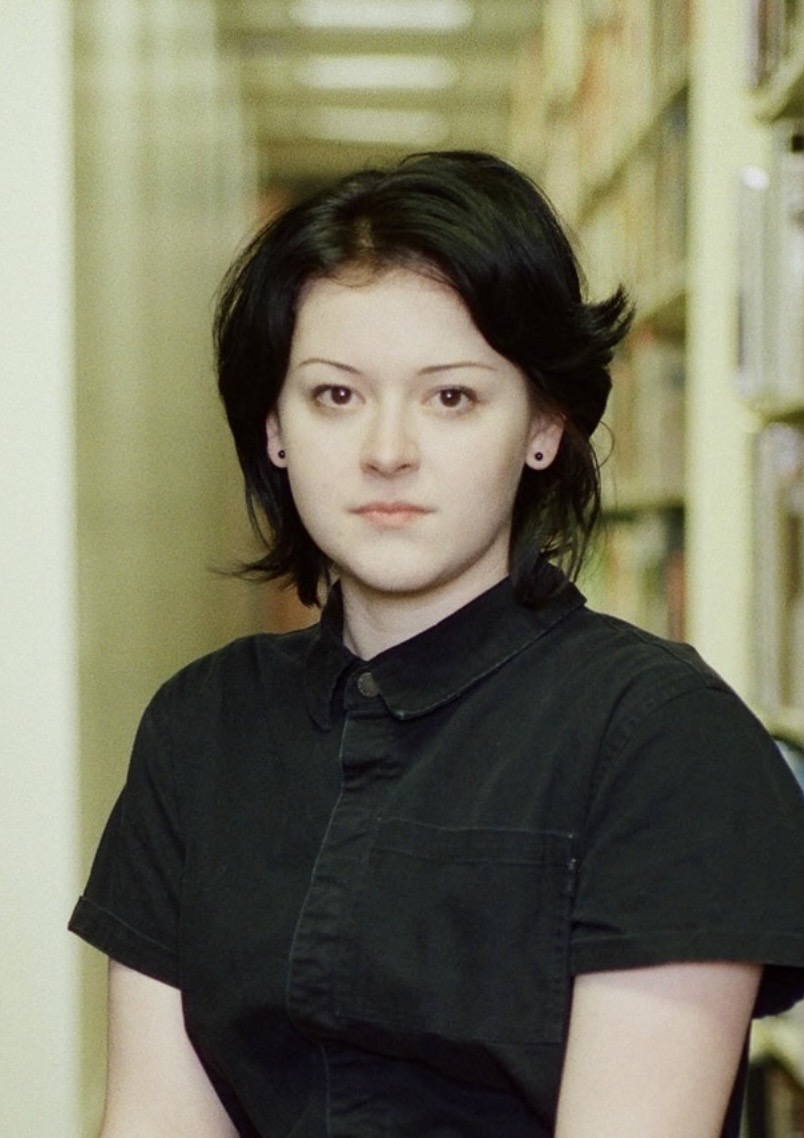
Anna McIllece is a writer and visual artist from central Alaska who lives and works in Salt Lake County, Utah. She holds a BFA in Fine Art from Brigham Young University and approaches art through both studio work and critical inquiry, investigating outsider art, the ancient and cosmic, human ritual, and folk tradition. Forever drawn to the unsettling, she examines how folklore persists and reemerges within contemporary life.
Categories: Gallery Spotlights | Visual Arts