
 Twenty years ago, 15 Bytes paid a visit to what we called one of the most unique sculpture gardens you’ll find “well, anywhere.” The Gilgal Sculpture Garden, tucked behind houses and businesses at 749 East 500 South in Salt Lake City’s Central City neighborhood, hasn’t moved. Many Salt Lakers still don’t know it’s there. This May, a series of Sunday morning events—”May Mornings at Gilgal Garden,” organized by the Central City Neighborhood Council as part of Utah’s Archaeology and Historic Preservation Month—is an invitation to remedy that. A historian will be on hand each Sunday from 10 a.m. to noon to help visitors unlock what the stones are actually saying. It’s worth going. And it’s worth understanding what you’re walking into.
The garden is the life’s work of Thomas Battersby Child Jr. (1888–1963), a masonry contractor and bishop of the LDS Tenth Ward who, by the time he broke ground in his backyard in 1945, had already spent nearly two decades in church leadership and built a successful professional career. He was 57 years old. He would pour his time and money into the project for the rest of his life. “If you want to be brought down to earth in your thinking and studying,” Child wrote, “try to make your thoughts express themselves with your hands.” The result is twelve original sculptural arrangements and more than seventy stones engraved with scriptures, poems, and philosophical texts—each representing, as Child put it, an idea that rang of truth to him in his lifelong spiritual quest.
Child named the garden after a site mentioned repeatedly in the Hebrew Bible: Gilgal, a circle of sacred stones retrieved from the Jordan River to memorialize a miraculous crossing. The twelve tribes of Israel carried twelve stones from the river to the promised land, and Child structured his garden around that number—twelve sculptural groupings, rooted in a landscape of Mormon mysticism and Old Testament imagery. He was not a classically trained artist, and he didn’t pretend otherwise. “You may think I am a nut,” he said, “but I hope I have aroused your thinking and curiosity.” What he was, unambiguously, was a master of his material. Child traveled the state scouring mountainsides and streambeds for the right boulders, some weighing up to 62 tons, hauling them by truck and heavy equipment to his yard, where he had built a complete workshop for handling and cutting stone. All finish work was done on site.


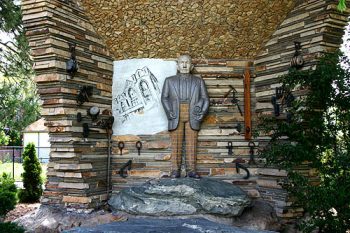


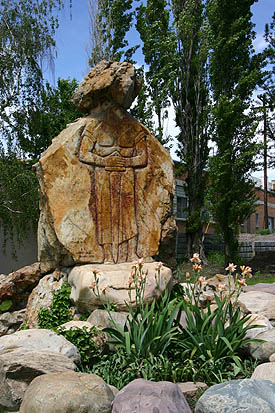
The garden’s most iconic piece—the sphinx with the facial features of Joseph Smith—required outside collaboration. Child’s son-in-law and assistant Bryant Higgs, a skilled welder, pioneered the use of an oxyacetylene torch for cutting and finishing stone: the heat removes waste rock while fusing the remaining surface to a smooth sheen. Higgs then taught the technique to Maurice Edmund Brooks, a formally trained Salt Lake City sculptor with a long career of LDS-commissioned work behind him — he had studied under Millard F. Malin, assisted on the Sugarhouse Pioneer Monument, and carved baptismal fonts for LDS temples in Bern, London, and New Zealand. At Gilgal, Brooks was working in a mode quite unlike anything in his usual practice, executing Child’s vision with an unconventional tool, following Child’s careful instructions to carve features on the sphinx and several other pieces, including the Monument to the Trade, Daniel II, Malachi, and the Last Chapter of the Book of Ecclesiastes. The result is the garden’s most arresting image: an ancient Egyptian form, massive and hieratic, wearing the face of a nineteenth-century American prophet.
The rest of the garden rewards the same sort of deep dive and interest in scriptural allusions. A figure of King Nebuchadnezzar rendered from the Book of Daniel. A monument to peace drawn from Isaiah. Elijah’s Cave. A shrine to Child’s wife Bertha. Stones engraved in that same smooth, fused surface with passages from Ecclesiastes, Masonic texts, and Mormon scripture. The compactness of the garden—it’s a narrow sliver of land—makes the scale of the boulders more striking, not less.
What Child built belongs to a lineage of visionary environments created by self-taught artists driven by something larger than aesthetics—Simon Rodia’s Watts Towers in Los Angeles, Ferdinand Cheval’s Palais Idéal in France. The tradition continues in other places in Utah, like Vaughn Reid’s Museum of Creativity and Carl’s Critter Garden in Hanksville (more to come on those). And of course, Ralphael Plescia’s now razed “Christian School.” The National Trust for Historic Preservation has recognized Gilgal as a “Distinctive Destination,” and it carries the distinction of being Utah’s only designated “visionary art environment,” a category defined by personal or religious conviction expressed through found materials by a formally untrained maker. The label fits, though it may undersell the craft.
After Child’s death in 1963, the garden passed through private hands and fell into neglect. By the late 1990s, a developer was eyeing the property for condominiums. A group of citizens—the Friends of Gilgal Garden, formed in 1997—organized to stop it. They secured $400,000 from Salt Lake County and $100,000 each from the LDS Church and the George S. and Dolores Doré Eccles Foundation, ultimately purchasing the property for $679,000. On October 21, 2000, Mayor Rocky Anderson opened it as a public city park, calling it “an absolute jewel.” The Salt Lake County Master Gardener Association took on the grounds, and restoration work on the sculptures—damaged by decades of weather, plant growth, and vandalism—has continued ever since, a painstaking and expensive process. The Friends of Gilgal have been working with the city on a conservation easement that would ensure the garden’s preservation in perpetuity, keeping the sculptures in their historic place regardless of any future change in ownership.
The garden has been a public park for twenty-five years now, and it remains genuinely unfamiliar to much of the city it belongs to. Child anticipated that. He expected his garden wouldn’t be understood or appreciated by many. He built it anyway, in the conviction that stone can speak, if you give it time.
May Mornings at Gilgal Garden runs every Sunday in May, 10 a.m. to noon, at 749 E. 500 South, Salt Lake City. Free and open to the public.

The founder of Artists of Utah and editor of its online magazine, 15 Bytes, Shawn Rossiter has undergraduate degrees in English, French and Italian Literature and studied Comparative Literature in graduate school before pursuing a career in art.
Categories: In Plain Site | Visual Arts





I was fortunate to tour Gilgal with architect Robert Bliss, who worked on the garden’s restoration. He talked about land artist Nancy Holt staying at his and Anna’s home near the U of U while Sun Tunnels was under construction.