
Exhibition view of the BYU Museum of Art’s Crossing the Divide.
Envisioned as a 5-year long exhibition that updates the permanent American Art collection galleries, BYU Museum of Art’s latest iteration is a significant re-conceptualization not just of the collection, but of the way the institution views historical perspectives and artists’ roles in history. But instead of presenting a straightforward chronological march through American art, Crossing the Divide is built around comparisons—works from different eras, regions, and lived experiences placed into dialogue with one another. The show is scheduled to remain on display through the end of 2029 and includes familiar icons of the collection, newer acquisitions, and some unexpected, rarely or never-before-seen pieces that create an intriguing mix of the familiar and the unexpected.
The curators were faced with a collection that does not fit neatly into a chronological display, namely because of the gaps in the collection—years, movements, and artists that are not represented. So instead of trying to tell America’s history from 1776 to now, co-curators Miri Kim and Isaac King grouped the art into 5 sections (Vision, Manifest, Wayfarers, A New Age, and Perspectives) plus an annually rotating works on paper gallery that for 2026 is focused on Climate. Within each of these sections are many comparison hangings where two different works from two different eras start dialogues about what has endured and what has changed about this country over its history. Sometimes those dialogues are about very painful and brutal aspects of our history. Sometimes they are about different perspectives and vastly different life experiences. Sometimes they are complementary and show links from one century to another.
An unexpected comparison involves “Southern Utah Range Part I,” a 1975 ceramic piece by Japanese American ceramic artist Ban Kajitani on a pedestal that allows the viewer to look through its plexiglass cover at other views of the Utah landscapes in the background from each side. The ceramic landscape is abstracted, but still matches up beautifully with the imagery and colors of the paintings beyond it.
Another powerful comparison includes one of the collection’s icons, “Fallen Monarchs,” by William Bliss Baker, and Conrad Heyd’s “Leurenkill,” ca. 1862-63, commissioned by the owners of an upstate New York tannery factory. Heyd painted what the owners thought of as the unlimited resource of hemlock trees surrounding their plant, where the bark (and the bark only) from the trees was processed into tannic acid to tan leather. But these forests were not unlimited and the industry mostly shut down by the 1880s-1890s. This painting has been enhanced by another partnership—this time between the curators and the campus’ former arborist, Max Darrington, who was consulted on the research of this powerful piece of forest history. He helped identify the trees themselves as well as the historic and detrimental procedures of those who logged the area. Both “Fallen Monarchs” and “Leurenkill” speak to our current understanding of conservation and preservation of the land.
-
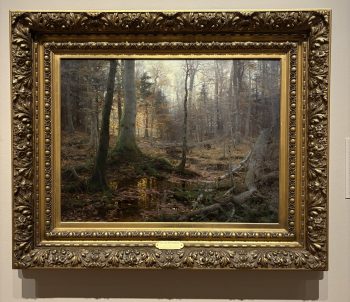
- William Bliss Baker “Fallen Monarchs,” 1886
-
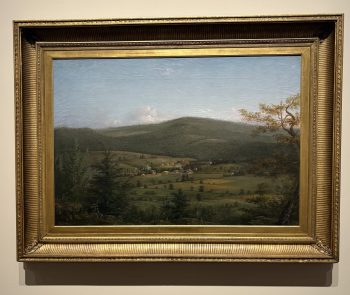
- Conrad Heyd “Leurenkill,” ca. 1862-1863
That attentiveness to history—environmental as much as cultural—gives the exhibition particular resonance in this year’s 250th anniversary of the Declaration of Independence. With adept knowledge of both history and art history, the curators provide opportunities for visitors to explore new questions and old ideas. Both Kim and King started at the BYU Museum of Art in 2023, and redesigning the American galleries was the first task on their plates. “We both come from the academic field,” stated Kim, “and this is the first curatorial role we’ve each had. We’re also both new to BYU and Utah.” King added, “We immediately got to know the collection. We always had expectations for many of the expected works to have in the show.” The two shared research and planning to find ways not only to incorporate the expected works, but also to find others that would open the show to new perspectives — something they agreed was critical to looking at our history and art history as the country approaches its 250th birthday.
It seems that most aspects of the curatorial process were agreeable to both. Working in partnership with another curator is a particular approach that doesn’t always happen. Both Kim and King bring a wealth of experience on the research end—King taught art history for many years and earned a PhD from the University of Pittsburgh, while Kim is finishing her PhD in art history from Princeton. Crossing the Divide allowed them to experience the complete research-to-installation process that an exhibition provides.

Visitor examines a salon-style wall in the Visions section of Crossing the Divide at BYU Museum of Art.
Some of this included meeting in the middle. For example, there are two salon walls in the space where multiple pieces are hung asymmetrically across large expanses of wall. King’s approach was to continue the comparative layout of the rest of the exhibition, while Kim wanted to step away from the curatorial voice by allowing visitors a multitude of paintings to look at and interpret on their own. By working those two ideas together, the curators created opportunities for viewers to make their own comparisons while also creating two great spots for selfies.
In the first section, Vision, the curators explore the many landscapes that make up the country—including many from Utah. The first comparison is between George Inness’ “November Montclair,” from 1893 and Richard Mayhew’s “Indigenous Spiritual Space Series #2,” from 1994. A somewhat more traditional comparison, the two moody, misty landscapes painted a century apart seem to ask: what makes these different?

Li Lihong, “China-McDonald (Flowers and Birds),” 2008
In the Manifest section of the gallery, Kim and King explore the many meanings of the word manifest, including the manifest of a ship—the inventory it carries, including enslaved people—and the fraught concept of Manifest Destiny. They do this through comparisons such as J.F. Francis’ “Still Life with Drink” and Rose Hartwell’s “Still Life.” Francis’ refined and refreshing glass of lemonade also references the brutal history of sugar plantations and slavery, while Hartwell’s bananas and oranges reference the history of U.S. imperialism in Latin America where bananas were grown.
The New Age section offers more 20th- and 21st-century comparisons as well as some particularly distinctive looks at urbanization and global capitalism. Most notably, Li Lihong’s “China-McDonald (Flowers and Birds),” 2008, draws immediate attention. Lihong’s hometown of Jingdezhen, China, is the porcelain capital of the world, and the artist plays on that fact by producing an immediately recognizable “M” for the McDonald’s Corporation in porcelain decorated with birds, blossoms, and mountains typically found on Chinese decorative arts. The work speaks “to historical and contemporary circuits of global trade and exchange,” as the curators note.
Nearly as large as the landscape section, the final Perspectives section focuses on people and perspectives on the American experience. Two of the strongest comparisons are included here. First, Claude Buck’s “War Protest,” ca. 1945 is positioned near William Morris Hunt’s “Captain William Madigan,” ca. 1866. Buck’s skeletal figure saunters through the grisly remains of a battle surrounded by darkness and a fiery sky while Hunt’s Civil War captain stands regally in his uniform, proudly traditional and plainly removed from the brutality of war.

From left: Claude Buck, “War Protest,” ca. 1945, oil on panel and William Morris Hunt, “Captain William Madigan,” ca. 1866 oil on canvas.
-
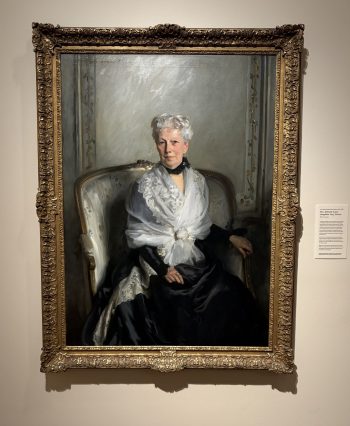
- John Singer Sargent “Mrs. Edward Goetz (Angelina Levy Goetz),” 1901
-
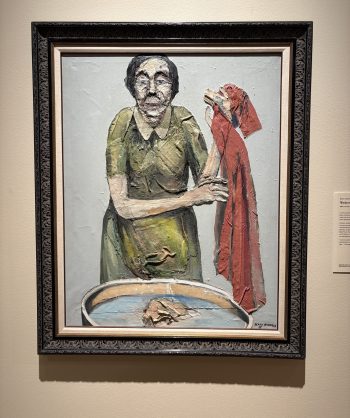
- Benny Andrews “Washerwoman,” 1963
Just past these works is another kind of portrait comparison. John Singer Sargent’s “Mrs. Edward Goetz (Angelina Levy Goetz),” 1901 reflects the famous portrait painter’s idealization of the wealthy society figures of his time. Mrs. Goetz was a music historian and London socialite. Paired with Benny Andrews’ “Washerwoman,” 1963, Kim states, “Andrews broke down what a portrait actually is and what it portrays.” She and King continue in the wall text: “Andrews’ subjects and materials shaped and reflected his social and political commitments during the Black Arts Movement, which championed Black aesthetics, liberation, and pride alongside the revolutionary politics of Black power.”
The comparison between the two women first presents obvious differences in clothing and setting — elegant attire and regal pose reflecting a privileged life in one, rough working clothes and deep impasto surfaces in the other. Andrews spoke of his fondness for collage “because I found oil paint so sophisticated and I didn’t want to lose my sense of rawness…we wear rough fabrics…These are my textures.” This comparison, like so many in the show, poses questions and invites viewers to find questions of their own.
“Crossing the Divide” is particularly well positioned to speak not only to the 250th anniversary of the country, but also to the evolving perspectives and approaches surrounding that history and our roles within it. From the curators, we see broadly informed perspectives distinctly open to other voices and conversations. We also see a revitalization of the museum’s collection. Kim and King merged their interests and strengths to create a long-term exhibition that will continue to surprise and engage visitors throughout the remainder of its run.

Crossing the Divide: American Art from the Permanent Collection, BYU Museum of Art, Provo, through 2029.
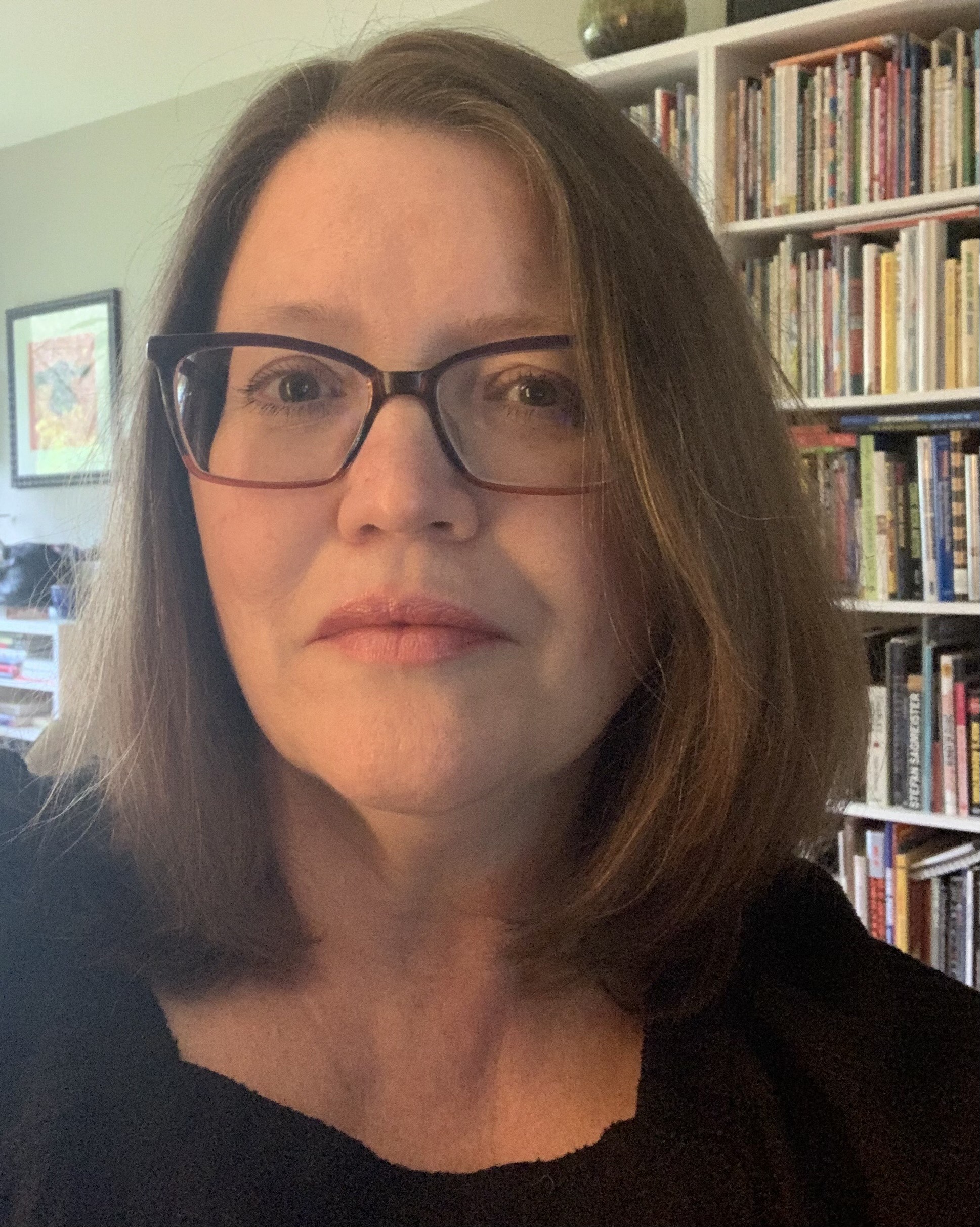
Gina Cavallo has been a curator, registrar, and executive director in museums for over 35 years. She spent many years as an art critic for publications in Phoenix. She began her career at the Phoenix Art Museum and the Heard Museum, was a founding curator at the Scottsdale Museum of Contemporary Art, spent two terms managing exhibitions at the Virginia Museum of Fine Arts, and was the Executive Director at the Mission Inn Foundation & Museum in Riverside, California. Her current role is Director of Development for Taproot Theatre Company in Seattle where she also serves as the curator of the Kendall Center Exhibition Series. She moved to Orem in 2024 with her husband, a theatre faculty member at UVU.
Categories: Exhibition Reviews | Visual Arts