
Ryan Harrington inside Harrington Art Studio in Midvale, where he’s hanging work for his upcoming commUNITY Art Show and Fundraiser. Image by Steve Coray
Ryan Harrington has lived in Utah long enough to watch its creative landscape reshape itself—slowly, unevenly, and often through the efforts of people working quietly in the background. Over the past two decades, he has become one of those people. His art blends the clarity of design with the energy of urban visual culture: his marker and acrylic works are built from clean lines, calibrated color interactions, balloon-lettering structures, and a long-running block-head character that shifts mood with the smallest change in outline. The work is approachable, polished, and distinctly his. But Harrington’s influence extends far beyond the pieces he makes. Through framing, curating, collecting, teaching, and simply showing up for other artists, he has become a connective thread in Utah’s creative fabric.
That ethos shapes the December 13 exhibition and fundraiser he is hosting at Harrington Art Studio, where proceeds will benefit the Utah Food Bank. The structure is simple and thoughtful: invite the public into a welcoming space, show work that feels alive and varied, and give people a chance to support both artists and a community cause. “I want artists to feel supported when they walk in,” he says of the gallery space he has been curating since December of 2022. Shows were intermittent at first, but Harrington put out a call at the beginning of 2025 and has been exhibiting on a regularly monthly schedule since, culminating in December’s group show. There is no spectacle here—only strong technique and an atmosphere that makes people want to stay. Visitors are encouraged to wander, talk, discover something new, and participate in a gathering that is as much about connection as it is about what hangs on the walls. “[For visitors], if the space feels good, and especially if their visit supports a fundraiser, they’re even more inspired to buy.”
Harrington’s path began at Salt Lake Community College, where he completed a two-year art program that provided the foundation he needed while keeping his life practical and sustainable. That decision continues to shape the way he works and the way he thinks about art-making in Utah. “I learned a lot in those two years,” he says. “Enough to keep building skills, raise a family, and figure out how to grow creatively.” Many Utah artists know the complex balance of ambition and livelihood; Harrington speaks from that experience without romanticizing it. His trajectory has never hinged on myth or sudden discovery; instead, it reflects steady discipline, technical curiosity, and a willingness to adapt as life requires.

Work-in-progress illustrations and paint materials spread across Ryan Harrington’s studio table, showing the clean lines and playful color interactions that define his signature style.
His style has sharpened over time but retains its sense of play. Influenced by typography, cartoon illustration, graffiti logic, and the visual cues of skate culture, Harrington’s block-head character recurs across prints and canvases, carrying humor and expression through subtle variations in line. His abstract pieces explore softer palettes—teal, light yellow, light blue—where color and form interact with deliberate clarity. There is precision here, but also friendliness; the work feels designed, but not distant. Harrington understands how people visually navigate a piece—and how to direct that movement without making the experience feel forced. It is the kind of design sense that comes only from years of practice and a deep respect for the eye.
Harrington’s range extends beyond wall pieces and framed works. In recent months he has been experimenting with playful hybrids and format shifts, including an illustration of a small skate ramp rendered in the palette of Mondrian—a Neoplasticism transition study that turns the language of modernism into something quick, graphic, and immediately readable, much like the skate stickers he designs and trades within the community. Even his more modest offerings carry the same attention to form: the Limited Edition Mini Blocks—a set of six hand-painted 1½-inch blocks—circulate widely among supporters who want a piece of his work without the barrier of high pricing. The accessibility of these smaller pieces mirrors the openness of his studio; both suggest an artist who sees value in meeting people where they are, whether they’re seasoned collectors, first-time buyers, or simply curious visitors drawn in by color and character.
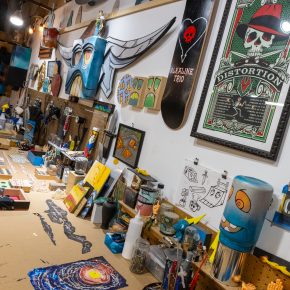
His studio, located on the upper level of Harrington Art Studio in Midvale, embodies that spirit. Tools are arranged in thoughtful order, light drifts across works-in-progress, and a deep emerald-green couch gives the room the easy comfort of a clubhouse where skaters, illustrators, and friends drift in and out. A skateboard leaning against the wall looks right at home. Harrington jokes about finally having a place where he no longer worries about ruining the carpet at home, but the studio has become more than a workspace; it is a gathering point for a growing creative community. People stop by not only to see what he’s making, but to sit, talk, get feedback on their own projects, or simply exist for a moment in a creative environment that doesn’t feel intimidating.

Harrington’s Midvale studio is a welcoming creative hub filled with tools, paintings, works-in-progress, and the informal warmth that draws artists and visitors alike.
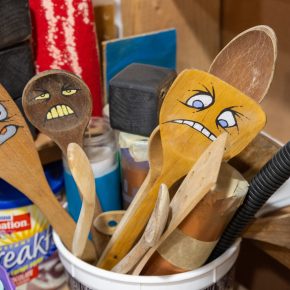
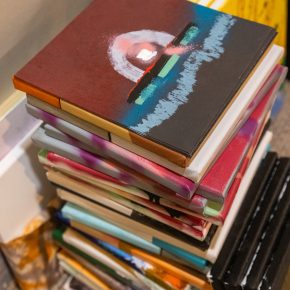

Another aspect of Harrington’s practice that often goes unspoken is how framing has shaped his eye and, in many ways, his role in the community. After years of framing for someone else, Harrington decided to go on his own and opened Harrington Art Studio in 2020. Artists trust him not only to handle their work carefully, but to understand the intentions behind it. Spending time with so many different pieces—abstract, figurative, photographic, experimental—has sharpened his sense of what visual stories people in Utah are trying to tell. Over the years, he has learned to recognize patterns: the return of certain color palettes, the growing popularity of risograph prints, the way younger artists fold digital aesthetics into traditional media. Framing becomes its own kind of education, one that feeds back into his studio practice and his understanding of the region’s artistic pulse.
It also gives him a vantage point few artists have. Through the steady flow of work that passes across his table, Harrington sees the diversity of Utah’s creative energy—not in theory, but in the literal stack of pieces waiting to be hung, delivered, or displayed. Some come from emerging artists hoping to have their first show; others from seasoned makers refining a long-term vision. Being the person who prepares their work for the world places him at a crossroads of sorts: part technician, part confidant, part community historian.

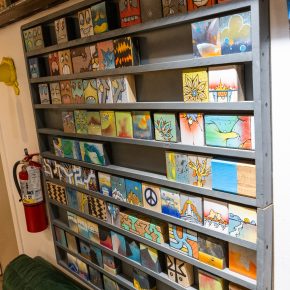
A hallway of framed artworks leads into the bustling framing area at Harrington Art Studio, where artists and visitors gather amid rows of vibrant frame samples.
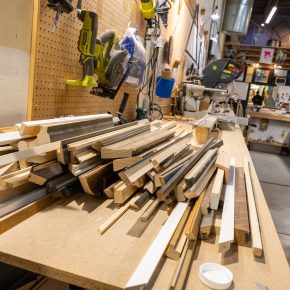
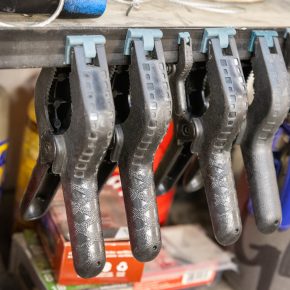
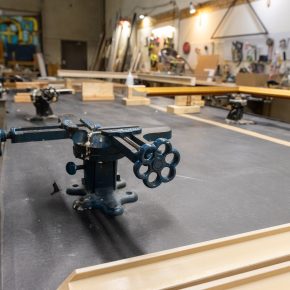

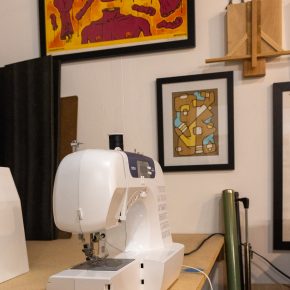
A view of the framing area of Harrington Art Studio as seen from Harrington’s second-floore studio.
That openness resonates with the broader landscape of Utah’s art scene. Over the past decade, Salt Lake City and its surrounding communities have been reshaping their creative geography in varied ways—industrial pockets turning into studio corridors, new galleries emerging outside traditional districts, and clusters of artists building momentum in places once overlooked. Midvale sits firmly within this shift: accessible, adaptable, and shaped by those who choose to invest in the local scene rather than wait for institutions to set the terms. Harrington’s presence there isn’t incidental; it reflects his belief that communities grow from accumulated small actions rather than singular grand gestures.
The December 13 exhibition is intentionally wide-ranging: each of the many artists involved brings strong technique or inventive concepts, and part of the show’s appeal lies in how ensemble it feels—lively, varied, and engaging for visitors who enjoy encountering different approaches within one thoughtfully curated space. It features the increasing visibility of skateboard-inspired art in Utah, including work from Rumble, whose practice draws directly from skate and urban design language and feels especially at home in Harrington’s orbit; and A-Roth, presenting an acrylic-on-panel piece titled Kickflip. It also includes a contribution from Peter Wiarda, whose architectural photography has become a subtle but recognizable thread in the region’s visual culture. The exhibition Harrington’s goal is not to present a definitive statement about Utah art, but to create a room where many voices can coexist without strain.
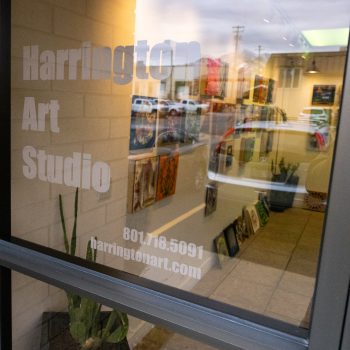
What makes Harrington’s story compelling, ultimately, is the steadiness behind it. His practice is built not on spectacle or mythology but on years of focused, reliable work: learning the mechanics of framing; opening a gallery; buying work from emerging artists; developing illustrations after long days; and creating a place where people feel welcomed and valued. Each step reflects a belief that creativity grows through commitment, generosity, and the day-to-day work that rarely draws attention but quietly builds community.
As Utah’s creative landscape continues to evolve—expanding quickly while navigating rising costs and shifting pressures—Harrington represents something increasingly vital—an artist whose work is inseparable from the people around him. His technique carries both craft and care, and his influence expands through relationships as much as through finished pieces. He strengthens others simply by being present, offering structure, and showing what becomes possible when art and everyday life are allowed to reinforce one another.

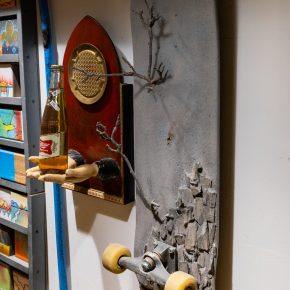
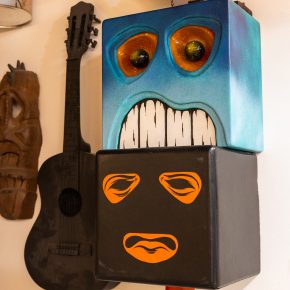
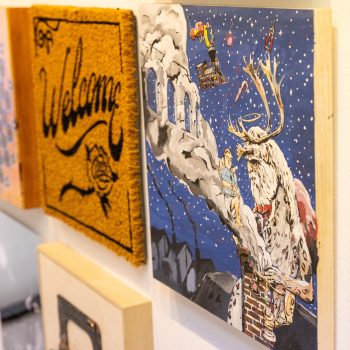
A wall of favorites inside Harrington Art Studio includes many works by Utah artists.
commUNITY Art Show and Fundraiser, Harrington Art Studio, Midavale, Saturday, Dec. 13, 5-9 pm.
All images by Steve Coray.

Hannah McBeth studied art history, classics, and Mediterranean archaeology before getting a Master’s at Cambridge University. She enjoys writing, hiking, and traveling to far-off places. Follow her on Twitter @hannahmcbee.
Categories: Artist Profiles | Visual Arts