
Installation view of Relative Truths at the Utah Museum of Fine Arts, with a painting by Pamela Beach in between two paintings by Zhang Xi. Image courtesy of Utah Museum of Fine Arts.
With university faculty art exhibitions, there is rarely a throughline—a main theme or narrative that ties all the disparate works by different artists together—and the UMFA’s Relative Truths, seems, at first, to be no exception. There are several stated themes—isolation, division, contested histories, cultural anxiety, dismantling of human rights, persistent creativity of the human mind—and each can be found in more than one work. But a word that came to mind throughout the gallery, and might pull it all together, was “questions.”
Each piece poses—explicitly or implicitly—a question to the viewer that can open a new thought pattern, give a new perspective, or challenge our conventions and beliefs of what is real or true. Some of the labels include extended information and end with questions to contemplate. Some of the questions are particularly timely, like Sydney Porter Williams’ “The Fall,” 2023, an installation with a tattered sweater hanging above empty pill bottles and flameless candles. The piece immediately brought to mind a social media post I’d just read about the poster’s sister who was unhoused and had not shown up for a family birthday. How can a person with a family that cares about birthdays have a member who lives on the streets? Porter Williams’ piece may not ask this specific question, but its implications of the pain and suffering of a person’s fall from the “norms” of society are powerfully communicated with a handful of found objects.
Another timely question regards the use of AI in art. Martin Novak’s “Same As It Never Was – Memory #1,” 2024, is, as the label reads, an AI-assisted digital composition, enhanced and manipulated with Adobe Photoshop and upscaling software. The color tones, the roses, and the sailor uniform ooze the vintage portrait we want this to be. The figure’s face, though, is too perfect, too cold, and too jarringly contemporary to be a sailor from WWII. But the question here is not whether this is real or true. It is whether we need it to be a true memory of a real person. Novak has shown his hand in the title and media listing, but what if he hadn’t? Would we think this was Novak’s grandfather? Which one would be real art–a photo of the real grandfather or this perfect young sailor built inside a machine? And does it matter if what we’re seeing here is a finely detailed, pleasing-to-the-eye image, whoever or however it came to be?

Edward Bateman, “Anges et Filles (Angels and Girls), Paris, 1860,” 2025. Image courtesy of the Utah Museum of Fine Arts.
Intriguing in another way, is the work of Edward Bateman. Bateman’s “Anges et Filles (Angels and Girls), Paris, 1860,” 2025, presents as a Victorian-age set of images of young girls with what are presumably angel sculptures. But the “sculptures” are too human to be sculptures. Again, the sepia tone and darker borders indicate vintage photographs, making us question what we see. The figures seem to speak to now, not 1860. Reviewing Bateman’s university faculty page, it is noted that “through a use of constructed and often anachronistic imagery, he creates allegedly historical artifacts that examine our belief in the photograph as a reliable witness.” That point is made beautifully albeit with what must be hours of painstaking, detailed digital work. The complexity of his process yields a richness of empathy and admiration for all his figures and places they appear in, real or imagined.
In a traditional scientific journal format, Carol Sogard’s “Organic and Man-Made Remains of a Former World,” and its accompanying inner pages, “Quimper Peninsula,” and “The Ashen Earth,” mimic a similarly Victorian passion–botanical study. This time, though, the botany is our own detritus from a technology-crazed contemporary society. The presentation of these bits and pieces of our metal and plastic world in the design of a finely crafted, rare book of specimens is both engaging and depressing. What are we leaving for future populations to dig up in archaeological explorations? Can documenting these items help us process the loss we feel watching our natural world choke on these same items?
There’s beauty in all of the questions posed in Relative Truths. Vanessa Romo’s “Meditations on/in feminism and/in art” questions our preconceived ideas about the need to “view the world as polar…beauty/grotesque, femininity/masculinity, empathy/apathy, opinion/fact, and human/thing.” She uses muslin dyed with saffron to create a net of woven rings, knots and fringe, which is covered in a thin coat of porcelain as an exposition on gender roles. It also juxtaposes an industrial form with a delicately fragile beauty on its surface. The label with the piece asks the questions: “How often do you consider the things around you? How can they be paired with another unlikely object? How does the meaning change for you?”
Several works stand out with subtle questions and exceptional presentations. Emily Tipps’ “WorthyTrashWorthyTrashWorthy,” presents paperback pages and letterpress prints as rolls of toilet paper on a stand. Paul Stout’s “Future Extinct Bird Skull,” looks like an accessory for someone’s nightclub outfit presented in a specimen bell jar with a lovely dark wood base. Maureen O’Hara Ure’s “The Middle Ages” and “Trouble in Mind” are mixed media paintings with expressive ink linear designs that make them feel like Japanese woodblock prints. Michael Hirshon’s two giclée prints are actually digital drawings made as limited edition NFTs, but they have the look of travel posters (although the flaming dirigible in “Too Big to Sail” doesn’t look like a fun trip).

Installation view of Relative Truths at the UMFA, with works by Simon Blundell, left, and Edward Bateman. Image courtesy of the Utah Museum of Fine Arts.
Simon Blundell’s “She Opened Up a Book of Poems,” and “From the Sky Down,” both 2025, are digital montage photographs printed with dye sublimation and mounted on aluminum. The printing process itself creates the rich, bold colors and sharp definition of the images and, perhaps, the aluminum surface adds to that sheen as well. The two works blend the latest technology with imagery that depicts the beauty of nature, challenging our idea of how to present a landscape from a new perspective.
There are some truly captivating paintings in the show. Zhang Xi’s “Sophie’s World,” and “The Jump Rope,” are rich with bold colors and active compositions. Pamela Beach’s “Now Pretend I am on a Leash” has great patterns and texture along with more bold colors, though with a slightly sinister youth-at-play content. John Erickson’s “Western Space” takes a horse in typical Western-art gallop and adds pop art elements like black-centered white rings and an abstracted expressive background. V. Kim Martinez’s “Tantalus-Blood Falls” uses the vinyl paint Flashe to great effect, bringing the paint’s notoriously bold colors and matte finish to an almost sci-fi, cartoon-like image.
The work in the exhibition that takes up the most wall space is also one that comes most in line with our current cultural environment, albeit telling a story of the earlier 2000s. Henry Becker and Kevin Thomas’ “20/20 A Retrospective of Two Decades at War,” from 2022, comprises 20 prints on newspaper hung in a grid on wires with binder clips. The prints follow a chronology from September 11, 2001 to August 30, 2021, when the last U.S. servicemen left Afghanistan. The artists share that the images reveal “how actions at the highest levels of government and in our own backyards have changed the way we live, how we interact with one another as people and cultures, and what it means to be an American.” A fitting question for our time, for all time.

Henry Becker and Kevin Thomas, “20/20 A Retrospective of Two Decades at War,” 2022, in Relative Truths at the UMFA, through Jan. 4, 2026. Image courtesy of the Utah Museum of Fine Arts.
Relative Truths, Utah Museum of Fine Art, Salt Lake City, through Jan. 4, 2026.
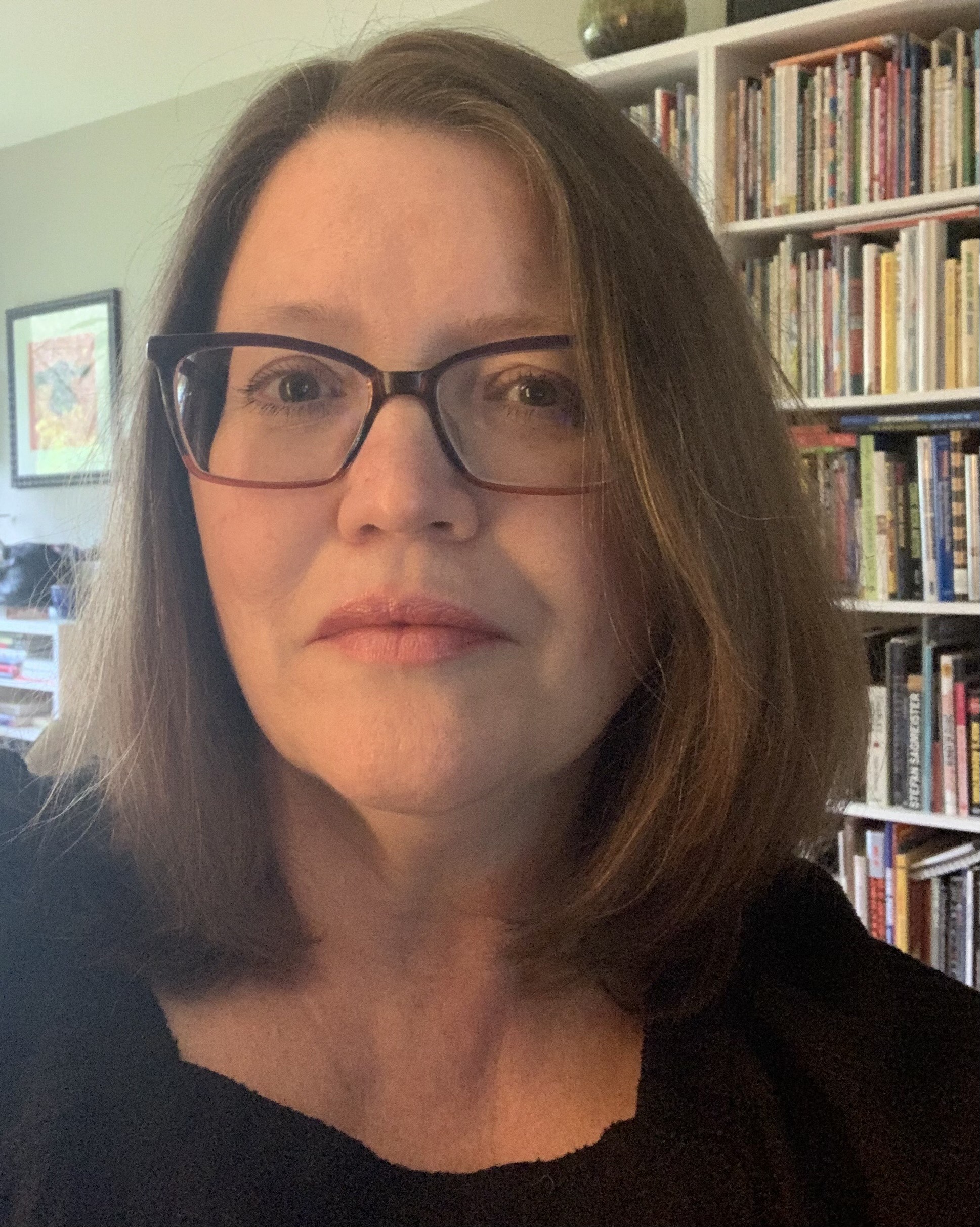
Gina Cavallo has been a curator, registrar, and executive director in museums for over 35 years. She spent many years as an art critic for publications in Phoenix. She began her career at the Phoenix Art Museum and the Heard Museum, was a founding curator at the Scottsdale Museum of Contemporary Art, spent two terms managing exhibitions at the Virginia Museum of Fine Arts, and was the Executive Director at the Mission Inn Foundation & Museum in Riverside, California. Her current role is Director of Development for Taproot Theatre Company in Seattle where she also serves as the curator of the Kendall Center Exhibition Series. She moved to Orem in 2024 with her husband, a theatre faculty member at UVU.
Categories: Exhibition Reviews | Visual Arts







Definitely should see this show. Master artists at work with interesting things to say. The University of Utah art faculty exhibit is always strong and worth spending time walking through the gallery at UMFA.