
Image by Steve Coray.
There’s a particular energy that begins in art, drama, or band rooms. These are the places where people first learn that making things can be a way of life rather than something to outgrow. Those early spaces make room for ideas, experiments, and people who never fit the usual mold; and for many, that creative spark never fades. Cities are at their best when they recognize this and embrace the eccentric, electric, and creative instead of expecting that impulse to fade. That recognition is cultural and economic, visible in the Granary District’s 6th and 6th Studios opens at 569 West 600 South.
Inside the studios, rooms are alive with color, sound, and new collaborations. A newly completed desert-themed mural created by Christian Michael, owner of 6th and 6th Studios, with artists Will Best, Eric Teniu, and Kuma greets guests at the entrance—a cactus and hummingbird rising together as bright markers of the space’s energy.
“Salt Lake’s art scene isn’t short on talent,” Michael says. “It’s suffering from capitalism. People are scared to buy art, and the city treats creative life like it’s temporary instead of something that brings real value. If we want growth, artists need the space to stay and work.”
Creative neighborhoods work because they draw people in, keep them nearby, and give a city its identity. The Granary District shows this clearly. When studios, venues, and small businesses sit close together, visitors stay longer and wander into things they hadn’t planned on, which builds community and keeps money circulating among living artists. Salt Lake’s Gallery Stroll has always had good intentions, but its spread-out format sends people driving between neighborhoods instead of exploring. The Granary offers a different model: a walkable cluster with enough art and independent businesses to create natural movement and sustained interest. With early support and stability, districts like this can grow into reliable cultural and economic anchors for the city.

Painting by Hayden White. Image by Steve Coray.

“Our vision is to have creative and financial control of our art,” Michael says. “We don’t have to pay gallery people 50%. We’re taking control of our curation and making sure people don’t make us look corny or misrepresented.”

This kind of ownership—both creative and economic—is what allows 6th and 6th to function as a real community hub. And it isn’t happening in isolation. The people running the space are building practical relationships with the city around them. “We’ve had great support from the Salt Lake City police,” says Gio Brooks, part of the Studios and Plumhouse Social Club staff, located at 6th and 6th. “They check in with our security and make sure things stay safe, make sure the vibe stays positive.”
The studios stretch across newly painted hallways lined with large-scale paintings, sculptural experiments, and half-built projects migrating between rooms. It’s a mix of emerging and established voices, sharing the same creative corridor. There’s Elmer Preslee, the sculptor whose world of big-eyed characters, thrift-store assemblage, and clay-driven imagination has made him a cult figure both locally and abroad. And Hayden White, whose re-imagined Rockwells looked so good at FICE last month. Together with Michael, who moved to Salt Lake 15 years ago and whose background in fine art, fabrication, and mural work sets the building’s tone, they form a core that attracts a broader community of exhibiting artists.
Next door, Plumhouse Social Club extends the building’s energy into the night, hosting late-night DJs, performances, and collaborative experiments that feed back into the studios. That rhythm between day and night works because Salt Lake’s creative scenes have learned how essential it is to look out for one another.

At Plumhouse Social Club, light, sound, and atmosphere extend the building’s creative energy into the night.
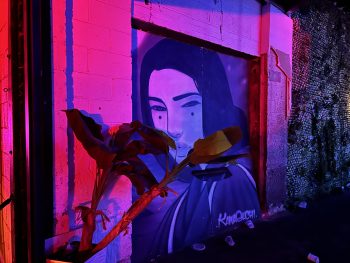
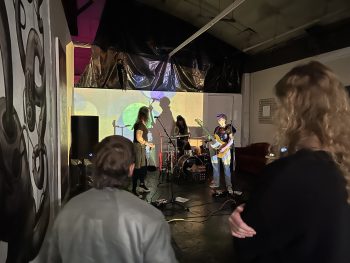
Spaces like 6th and 6th and Plumhouse rely on the community that gathers here, a kind of stewardship that isn’t institutional or heavy-handed but simply part of the culture. It’s a place that wants its people to thrive, especially those who already feel in the margins, and that kind of care makes creative spaces more welcoming and sustainable.
This combination of workspaces and nightlife cultivates an environment where creative practices don’t have to separate themselves into daytime “productivity” and nighttime “release.” Instead, art, fabrication, and performance fold into one another, blurring categories and opening possibilities that individual studios rarely generate alone.
These creative ecosystems are fringe; they’re ordinary, necessary, and culturally productive. When cities nurture them, neighborhoods grow around them. When they ignore them, they lose the momentum and connection that make urban life feel alive.

A new mural wraps the exterior of 6th and 6th Studios. Image by Shawn Rossiter.
Friday, February 6th, Music at 6th and 6th: Kidkay3, with Sentience, GOUT and ROOM. Doors at 7, music at 7:30.
Follow @6thand6thstudiosslc for upcoming events.
Related posts:

Hannah McBeth studied art history, classics, and Mediterranean archaeology before getting a Master’s at Cambridge University. She enjoys writing, hiking, and traveling to far-off places. Follow her on Twitter @hannahmcbee.
Categories: Alternative Venues | Studio Space | Visual Arts