For all its cranes, new apartments, and redevelopment buzz, the Granary District has always been a place of odds and ends: empty lots the size of moonscapes, century-old warehouses slouching against cinderblock additions, and industrial streets that still bear the ghosts of rail lines. It’s a neighborhood defined as much by its gaps as by its structures—a mismatched terrain shaped by cycles of labor, abandonment, reinvention, and return.
Before planners renamed it the Granary District and developers discovered its potential, this jumble of warehouses south of downtown was already home to a quiet but persistent creative population. Artists, musicians, fabricators, and fringe entrepreneurs claimed these drafty, low-rent spaces long before the craft breweries, climbing gyms, and neon-bright murals arrived: Poor Yorick, TRASA, Captain Captain. Their presence—often invisible, sometimes informal, always resourceful—laid the cultural groundwork that the current revitalization now leans on.


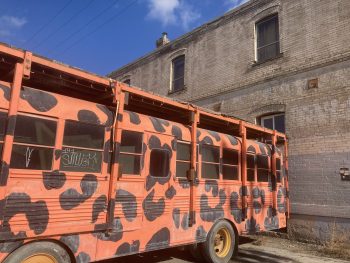

What makes the Granary compelling today is not a single aesthetic but its heterogeneity: the way a sleek new five-story apartment can sit beside a roofless shell of a building; how a polished public sculpture faces a graffitied loading dock; how a mural wraps around a structure no one has occupied in years. The neighborhood remains a collage of uses and eras, each piece pressing against the next without blending into a uniform whole.
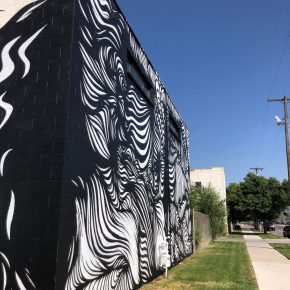
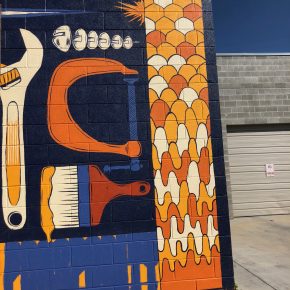
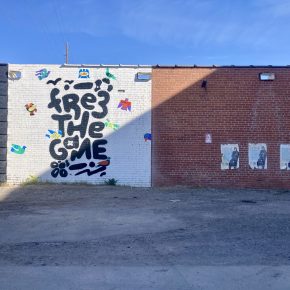
In this photo essay, the street art and public art of the Granary District trace that patchwork identity. Some works are polished and commissioned, others improvised and ephemeral. Some cloak the remnants of industry; others announce new beginnings. Taken together, they reveal a neighborhood caught between histories—one shaped by makers long before official renderings and redevelopment plans tried to define what it could become. They show a place still in motion, still unresolved. And perhaps that’s the Granary District’s greatest asset: its ability to hold contradictions, to invite improvisation, and to make space—however temporarily—for the people who transform overlooked corners into expressions of imagination.
-
- 2012
-
- 2012
-

- 2026
-

- 2026
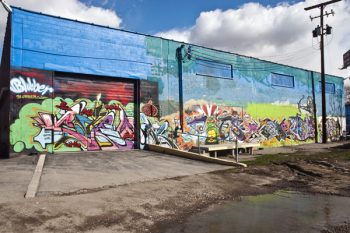
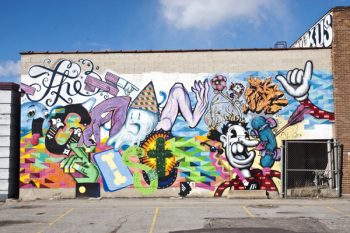
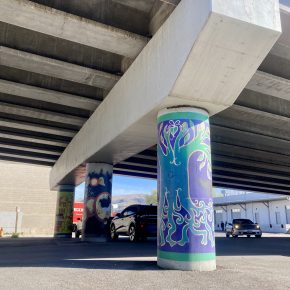
As a neighborhood, the Granary is shaped in part by infrastructure—the sweeping concrete arc where the 900 South exit branches off I-15, carving out a zone that long remained industrial and overlooked. That isolation helped preserve it, but it also made it a natural canvas. In the early 2010s, before formal programs took hold, murals began appearing in an ad hoc way, often tied to artist-run spaces like the Pickle Company building, which served at various times as a hub for creative activity. These early works were less coordinated than what would follow, but they helped establish the district as a place where artists could experiment at scale.
Installed in 2017 along 800 South, the Bears Ears mural brought a sweeping depiction of the southern Utah landscape into the industrial edges of the Granary District, its imagery tied to the then-recent designation—and national debate surrounding—Bears Ears National Monument. Painted by Josh Scheuerman, the work stood as both a celebration of place and a quiet political gesture, embedding questions of land, stewardship, and identity into the neighborhood’s emerging visual culture. Though it quickly became a recognizable landmark, the mural was ultimately short-lived, demolished as part of the Fleet Street redevelopment—its disappearance echoing the broader cycles of change that have come to define the district.

In 2018, Salt Lake City’s Redevelopment Agency and Arts Council formalized their investment in the area through a mural grant program that commissioned 15 artists to create 11 large-scale works across the Granary District and into what would soon be known as the Central 9th neighborhood. Funded by more than $147,000 in RDA support, the program required artists to work directly with local property owners, embedding the murals into the walls of active industrial businesses rather than isolating them as standalone artworks. As Jann Haworth noted while completing her own piece facing the Pictureline parking lot—an effort that involved “a half-mile of masking tape, gallons of exterior paint, [and] dozens of rollers and brushes”—the works were as much collaborative, site-responsive endeavors as they were individual artistic statements. Installed across a still-fragmented landscape, the murals helped seed a visual identity for neighborhoods in transition, signaling a shift already underway.

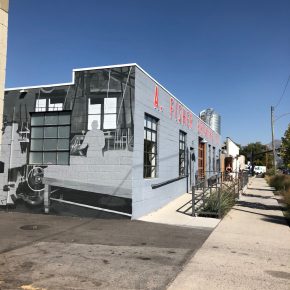



That spirit of experimentation had earlier taken physical form in 2013 with Granary Row, a seasonal pop-up of repurposed shipping containers dropped into the wide median of 700 South. Conceived as a temporary market and gathering space, the containers housed small businesses, creative ventures, and even an art space, activating an underused corridor with music, food, and foot traffic while testing what the neighborhood might become. What began as an experiment in human-centered reuse helped catalyze new investment and attention, and over the past decade the district has steadily transformed—its once-speculative energy giving way to more permanent development, including Granary Live, a large-scale outdoor venue that now draws national acts and major events into the neighborhood.


Trent Call image on the side of a shipping container at X is a reminder of the days of Granary Row.
A few years later, Utah artist Jimmi Toro added another layer to the district with a mural along 600 South, created in 2021 as part of Visit Salt Lake’s “West of Conventional” campaign. Fronting the railroad tracks near the 600 South off-ramp, it is one of the first things visible from I-15 and helps mark the district’s western edge—a kind of visual threshold between the Granary and the industrial corridor beyond. Its abstract floral imagery trades literal depiction for a more stylized sense of place, reflecting a city increasingly interested in presenting this once-overlooked area as creative, contemporary, and in transition.


The Fleet Block, just east of the Granary along 900 South, briefly became one of the city’s most charged sites of expression in 2020, when its low-slung industrial buildings were covered in murals responding to the Black Lives Matter protests. Artists transformed the block into an open-air forum—portraits, slogans, and abstractions layered across its walls in a collective act of urgency and witness. Like much in the Granary, the moment was temporary. The buildings were soon demolished as part of a major redevelopment project, clearing the site even as the images lingered in memory. Now positioned at the center of one of the area’s most ambitious transformations, the Fleet Block encapsulates the district’s ongoing cycle: art emerging in the gaps, only to be overtaken by the very momentum it helps create.

Discover more with our Utah Art Map!



With our In Plain Site byline we feature publicly viewable art, both official and street art, throughout the state of Utah.
Categories: In Plain Site | Visual Arts