‘A’ Gallery’s current exhibition features work by several gallery artists
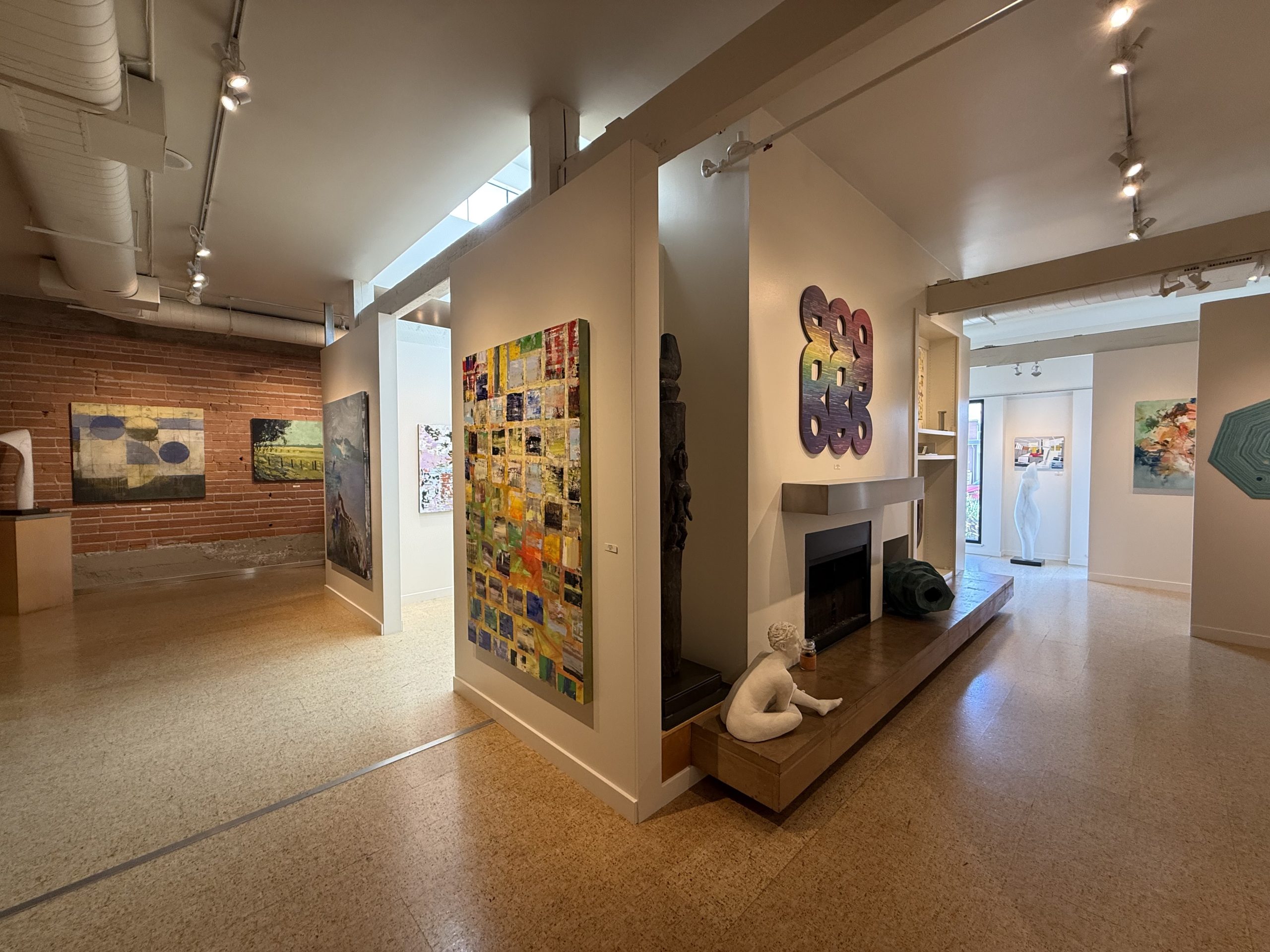
In a 2006 interview, Robert Enright described the works of contemporary painter Peter Doig as being “fixed in a sort of drift,” embodying a seemingly contradictory in-between zone that holds tightly to both stasis and movement. Carried into the current exhibition at ‘A’ Gallery is this same tension, where images, marks, and materials seem suspended between states of resolution. Recurring throughout the selected works are dense flurries of mark-making: straight strokes, quick gestures, and dashes no longer than a grain of rice. From a distance, the works resolve into figurative, geometric, or organic silhouettes; up close, however, the image begins to give way to its constituent gestures.
Some paintings are unruly, creating a texture reminiscent of the growth of a fungal organism. Jennifer Rasmussen’s “Flame,” a four-foot mixed-media work, is a dance between wet and dry brushwork. Earthy ribbons of orange suffuse outwards over misty blue-grays. More of her featured works communicate this same pattern of organic bursts, some venturing closer into the world of representational florals.
Painter Nathan Mulford’s works, however, approach brushwork through delicate mathematical frameworks with precise pencil tracings atop acrylic. Mulford’s bisected hemispheres and gridlines, though diagrammatic, are no less evocative of the spirit of abstraction. They reference a sense of order that is constantly shifting or realigning. Between Rasmussen and Mulford, abstraction becomes a negotiation between organicism and construction, rather than an ultimatum between the two. Harmony is ultimately created by the inclusion of works with different approaches to organization.
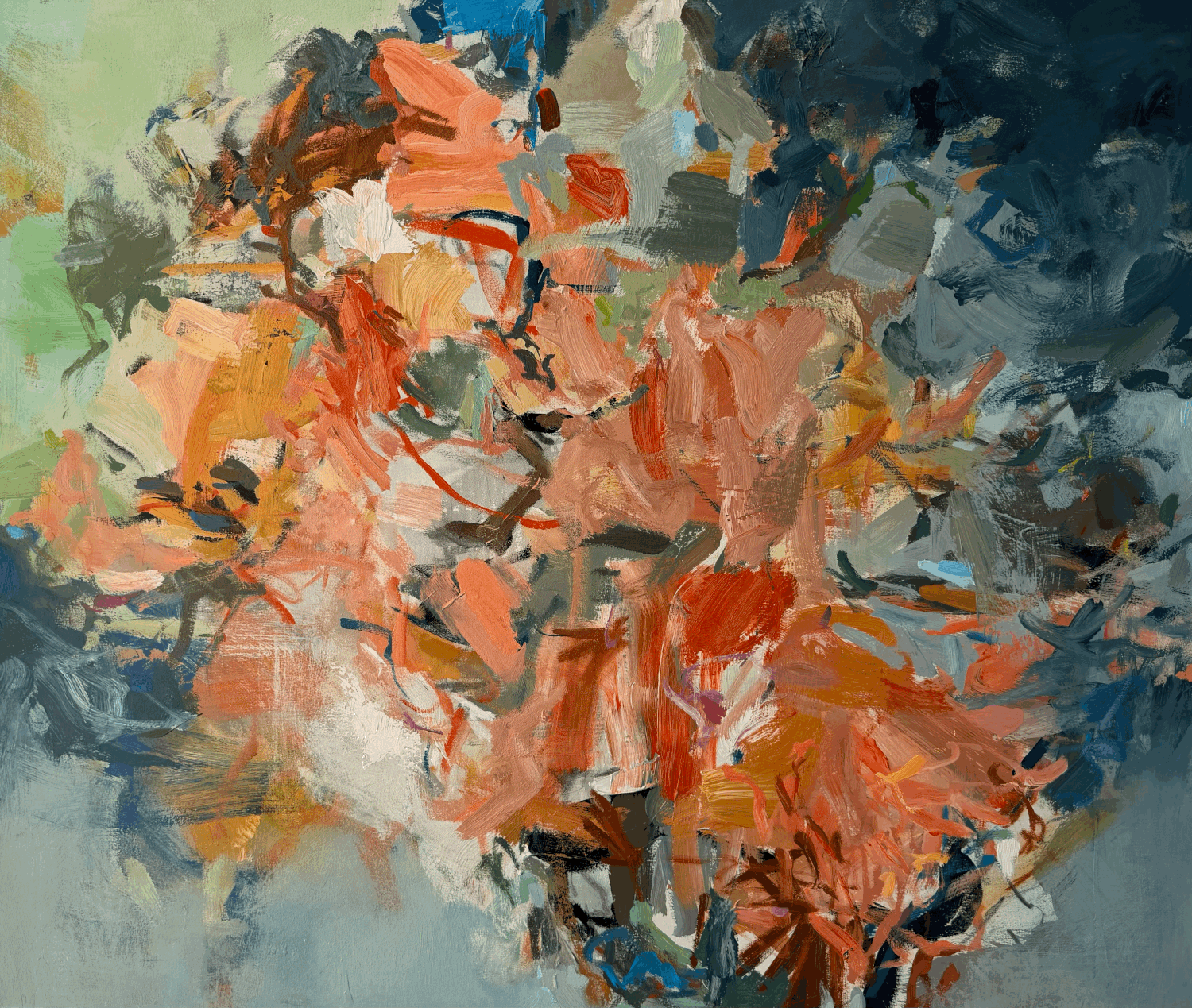
Jennifer Rasmusson, “Flame,” acrylic and oil on canvas, 48×42 in.

Nathan Mulford, “Somerset,” acrylic & graphite on canvas, 48×48 in.
Another harmonious curation decision is inserting sculptures (soft, almost whipped, white marble forms) by Ryoichi Suzuki between gallery walls and in corners with more traffic. They create a welcome counterbalance against the non-objective explosions and color fields.
Matthew Choberka’s “Glimmer in the Grass” catches the eye in more ways than one: the vivid primaries dazzle alongside subtle flashes of glitter in the paint surface. The reflective bits seem to function as a physical, material trace of transformation.
Traditional canvas shapes alternate with Roland Thompson’s painted aluminum surfaces. “Record Tape Disk (Post-Punk Mix)” is particularly striking: nine teardrop shapes, each punctuated with a central aperture, are arranged in a grid and painted with horizontal stripes that produce a holographic effect. That illusion, combined with the painting’s surface and shape, reinforces the exhibition’s larger idea of perpetual movement and dissolution.
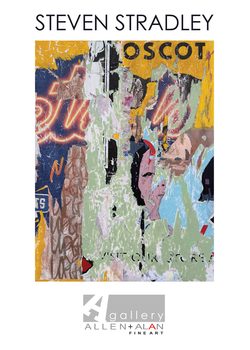
The central gallery divider houses several multimedia collage works that almost appear as screenprinted or pixelated images. Steven Stradley, a former Utah artist now based in Michigan, ruminates on consumer images and their degradation in these works ruminates on consumer images and their degradation in these works. Hidden in “Upgrade” are traces of neon signage and a face with a fatigued expression peering from behind a haze of green paint strokes. Drawing upon printed images, Stradley masters an urban texture filled with short-lived paper advertisements, layer upon layer of wheatpasted scraps hiding the messages below. Above the scraped layer of collage scraps, he paints loose figures that, in his words, “build and unbuild themselves.” In this sense, his works do not oppose the exhibition’s “fixed drift” but instead complicate it. The forms are caught in the unraveling of their own image.
-

- Matthew Choberka, “Glimmer in the Grass,” acrylic on canvas, 46×60 in.
-

- Steven Stradley, “Upgrade,” acrylic and collage on canvas, 30×40 in.
Because so many of the works engage with motion, dissolution and fragmentation, the distinctions between individual pieces can occasionally become less immediate. Yet this visual cohesion can also allow for comparison, sharpening the distinction between each artist’s manipulation of material and space.
A success of this collection of images is the conversation between these illusory effects and materiality. Images appear and re-appear without requiring those constituent marks to disappear in the greater effect, but this magnifying effect extends laterally, too. A work doesn’t just accumulate in short memory; it alters the perception of the piece(s) beside it. An errant mark in one location may carry the same energy as the glaze on top of a ceramic piece directly below, allowing gestures to migrate across the gallery space.
Each of the works retains the integrity of its image without subordinating the nature of the material from which it was made. Here, paint strokes, the curve of ceramic, the texture of a resin or oil are not incidental surfaces but crucial elements of the work itself. Even as these gestures fade with physical distancing, the material sings. It buzzes before the eyes. The whole may coalesce, but the marks remain, drifting back to their fixed state.
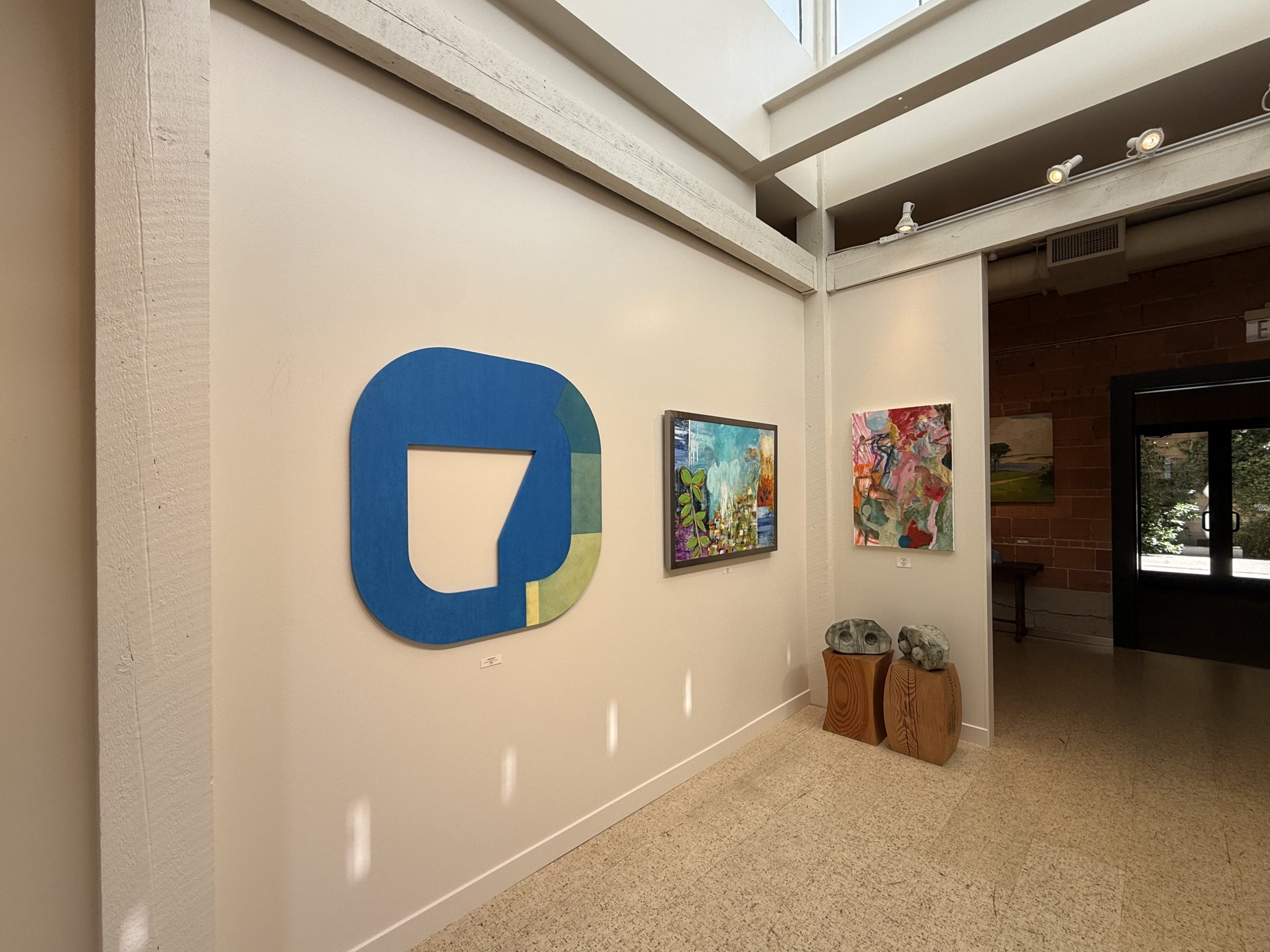
A Gallery/Allen+Alan Fine Art is located at 1321 S 2100 E, Salt Lake City.
Anna McIllece is a writer and visual artist from central Alaska who lives and works in Salt Lake County, Utah. She holds a BFA in Fine Art from Brigham Young University and approaches art through both studio work and critical inquiry, investigating outsider art, the ancient and cosmic, human ritual, and folk tradition. Forever drawn to the unsettling, she examines how folklore persists and reemerges within contemporary life.
Categories: Exhibition Reviews | Visual Arts