
Trent Alvey has been around for a bit.
When she first appeared in the pages of 15 Bytes in 2003, she was already an established artist. (But if you’ve known Alvey long enough, you can imagine her interjecting: an artist should never be established, she would say. She should always be emerging.) She had just spent two months in Namibia, ostensibly to paint, though the trip was also a way of breaking loose from a life and a creative practice. “I felt I had completed a creative era in my life and needed to move forward,” she wrote in an essay for the magazine. “I wanted to paint. I craved simplicity.”
Plein-air painting in Namibia proved anything but simple. Alvey found herself searching for snakes, learning to carry extra fuel, water and two spare tires, and improvising art supplies when the materials she normally used proved impossible to find. The south of France was the place to paint en plein air, she decided. “Deciding to go to Namibia … was absolute insanity,” she wrote.
Africa would not prove a one-time encounter. Alvey has returned many times, often in connection with the work of her husband, Dennis Sizemore, and the continent has become one of the recurring geographies of her art.
Alvey has appeared many times in 15 Bytes since that 2003 essay, as her work has roamed across media, subjects and continents. In 2013, fellow artists selected her for Utah’s 15, our print publication recognizing artists who had made a significant impact on the state’s visual arts community.
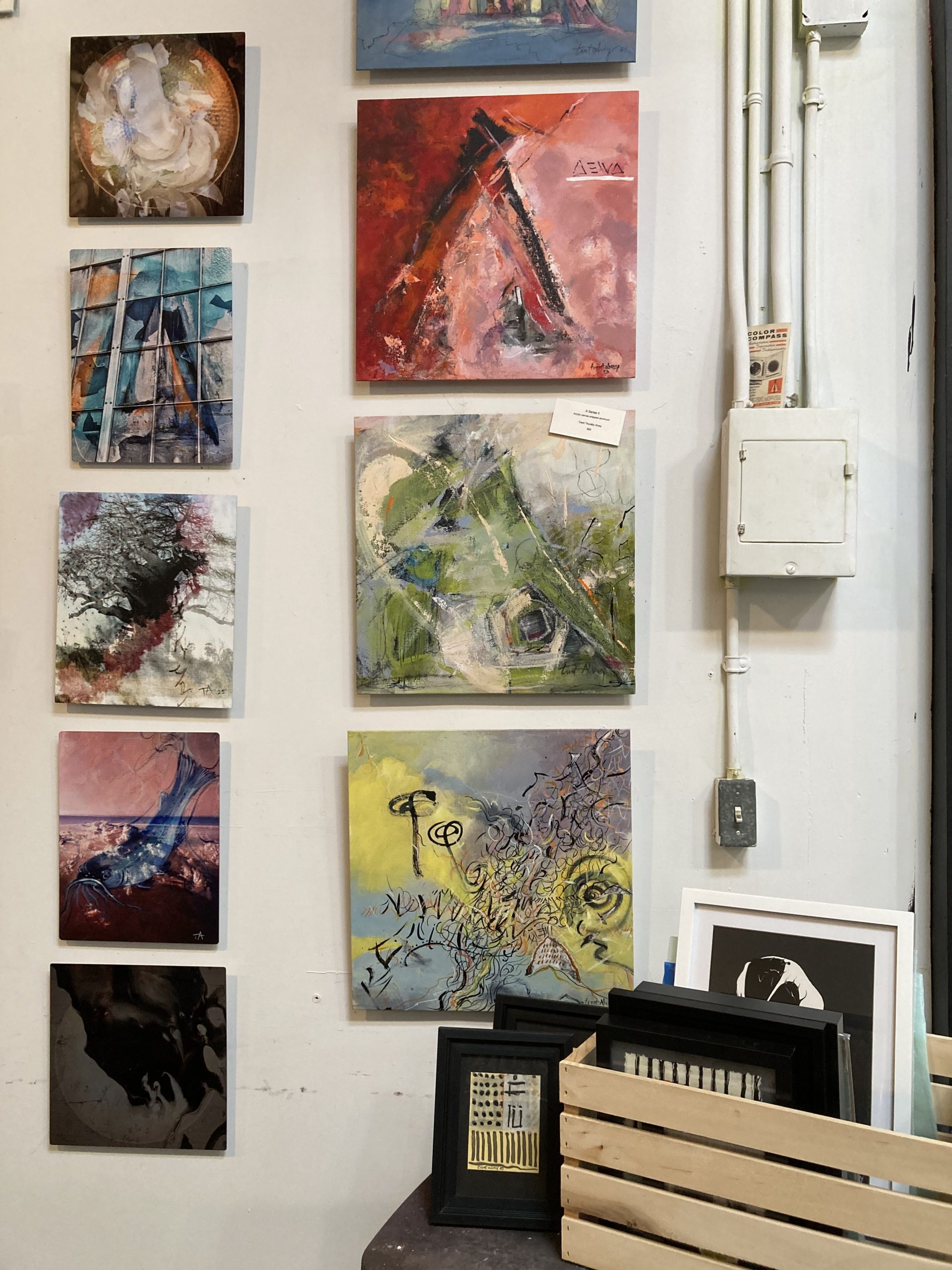 More than two decades after that first article, Alvey has gone back into some of the paintings that grew out of those earlier travels. For Saturday’s Poor Yorick Open Studio, where Artists of Utah is sponsoring her exhibition, she has pulled from storage several enormous works, some six or seven feet across, that she hasn’t lived with for years.
“I think I just got lonely for them” she says. “I wanted to get them out. Look at them.”
Ask Alvey to reduce a sprawling career in painting, photography, video, sculpture and installation to its recurring impulses, and two quickly emerge: travel and science. “The bigger projects,” she says, have often been prompted by travel, by her encounters with other cultures and places.
The paintings coming out of storage bear that out. One, from roughly 2003–05, grew out of her time in Africa. A gray-and-white snake coils around most of the canvas, swallowing its own tail. Inside the ring stand four skeletal figures in soldiers’ caps, while rifle silhouettes—the kind of weapons the U.S. and other countries have long sold into Africa—hover above and below.
Others take her elsewhere. In one, sandhill cranes wade through shallow water at Bosque del Apache in New Mexico, where the birds filled the evening sky in what she remembers as “a really prehistoric event.” In another, a forest of bare gray trunks stands above a flat stripe of mustard yellow: Yellowstone’s Lamar Valley, painted in the aftermath of the park’s massive fires.
Pulling the paintings out again is a little like opening an old family album. “I think it is kind of nostalgic,” Alvey says. “You start remembering all the … stuff you were into.”
Lately, much of what Alvey has been “into” has been closer to home.
Her recent work has repeatedly circled the Great Salt Lake and its ecological crisis, while another longstanding concern has been Utah’s nuclear legacy and the experience of downwinders. She is currently thinking about new work on the latter, an issue that is also personal: she recalls relatives who suffered from cancers and other illnesses she associates with radiation exposure.
The older paintings at Poor Yorick offer something of a reprieve from that intensely local focus—a chance to sort through other places and ideas that have occupied her over the years. But for Alvey, old interests have a habit of connecting themselves to new ones.
This summer brought another trip to southern Africa, where Alvey made a video involving San people of the Kalahari, shown at Phillips Gallery this summer. She became fascinated by traditional knowledge of water beneath the desert, including stories of San people observing where elephants dug for water and using those locations to find underground sources themselves. The experience brought together the two impulses that have long animated her work: culture and science.
It also brought her thoughts back to Utah. Alvey has become interested in comparing the ancient Lake Makgadikgadi system of the Kalahari with Lake Bonneville and its remnant, the Great Salt Lake—distant landscapes connected in her mind by geology, water and the ways humans and animals learn to inhabit difficult environments.
For now, though, there are these paintings: large objects that have spent years stacked away from view. And several smaller works, each with a story she’s happy to tell.
Artists accumulate work. They often have to get storage units. Alvey jokes about wanting to clear some of it out, but she also sees another purpose in keeping it around. Art, she says, becomes a record of a life. “It helps you to remember,” she says. “It helps you record your life and look at stuff, and you can remember what you were doing at certain times and what was going on then and how you got through that.”
Occasionally she encounters an old work she barely remembers making. More often, she says, it “just jumps out like an old friend.”

Poor Yorick Open Studios, 126 W. Crystal Ave., Saturday, Sept. 26, 4-10 pm.
Trent Alvey will be exhibiting in the B wing in Brad Slaugh and Tracy Strauss’s studio.

The founder of Artists of Utah and editor of its online magazine, 15 Bytes, Shawn Rossiter has undergraduate degrees in English, French and Italian Literature and studied Comparative Literature in graduate school before pursuing a career in art.
Categories: Exhibition Reviews | Visual Arts