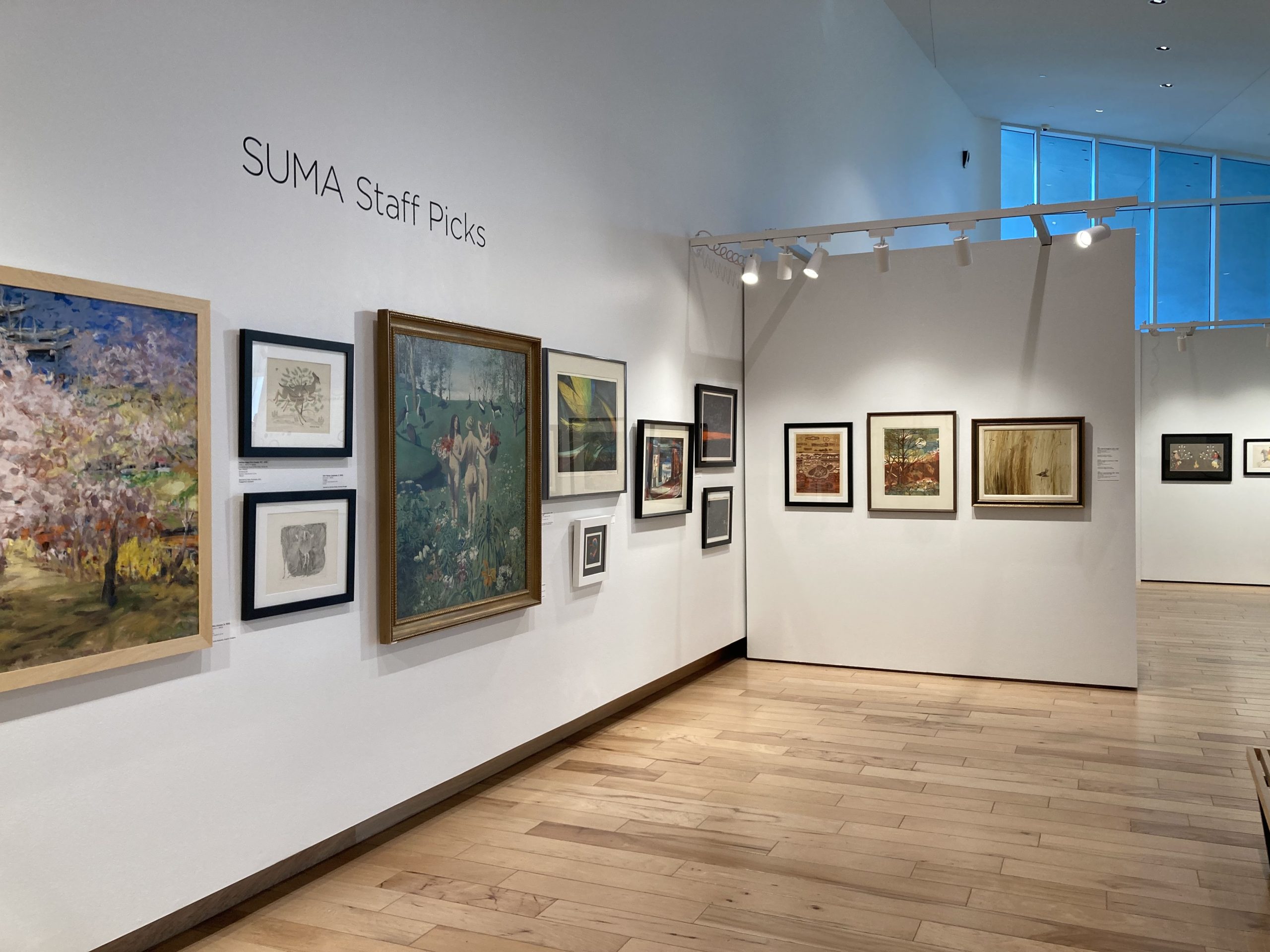
Installation view of SUMA Staff Picks, part of the Southern Utah Museum of Art’s tenth-anniversary exhibitions.
In a recent article, Art in America cited a somewhat vague statistic: 95 percent of museum collections are hidden from view. The magazine hedged on the accuracy of the figure, but it could be off by ten, twenty or even thirty percent and still drive home the point: until a work finds its way into the logic of an exhibition, the public may never see it.
Which is one reason the exhibitions currently filling the Southern Utah Museum of Art are such a welcome surprise. At their center is Art from Abstract to Zion: Celebrating 10 Years of SUMA, an anniversary exhibition whose A-to-Z title gives some indication of its organizing principle: show the breadth of the collection rather than attempt to make everything cohere. The result is, admittedly, a bit of a hodgepodge. But that is precisely its charm. Without the demands of a tightly focused theme, works that might otherwise struggle to find their way into an exhibition have made it out into the light of day.
Four paintings by Donald Beauregard offer a compact introduction to a turn-of-the-century Utah artist whose promising career was cut short by his death at 29. There is a portrait and a brooding landscape of conventional scale, but it is the two tiny oils hanging beside them that command attention. In “Breton Head,” c. 1906–08, a cottage, slender trees and a distant shoreline are compressed into a few inches of vigorously worked color. The even smaller untitled seascape below it nearly dissolves altogether: rocks and surf emerge from thick strokes of blue, violet, turquoise and white. These are little paintings that reward getting very close.
Turn around, and you’ll see a wall of works by Anna Campbell Bliss, who could hardly be more different. Where Beauregard compresses landscape into tiny, vigorously brushed oils, Bliss expands elementary geometric forms into exercises in optical perception. Nested squares and intersecting triangles pulse with contrasting colors, advancing and receding as the eye moves across them. Bliss, who studied color and light with György Kepes and Josef Albers, turns a handful of elementary shapes into exercises in how—and how unreliably—the eye perceives color and space. The distance between the two artists—historically, stylistically and conceptually—pretty well sums up the Abstract to Zion ambitions of the exhibition.
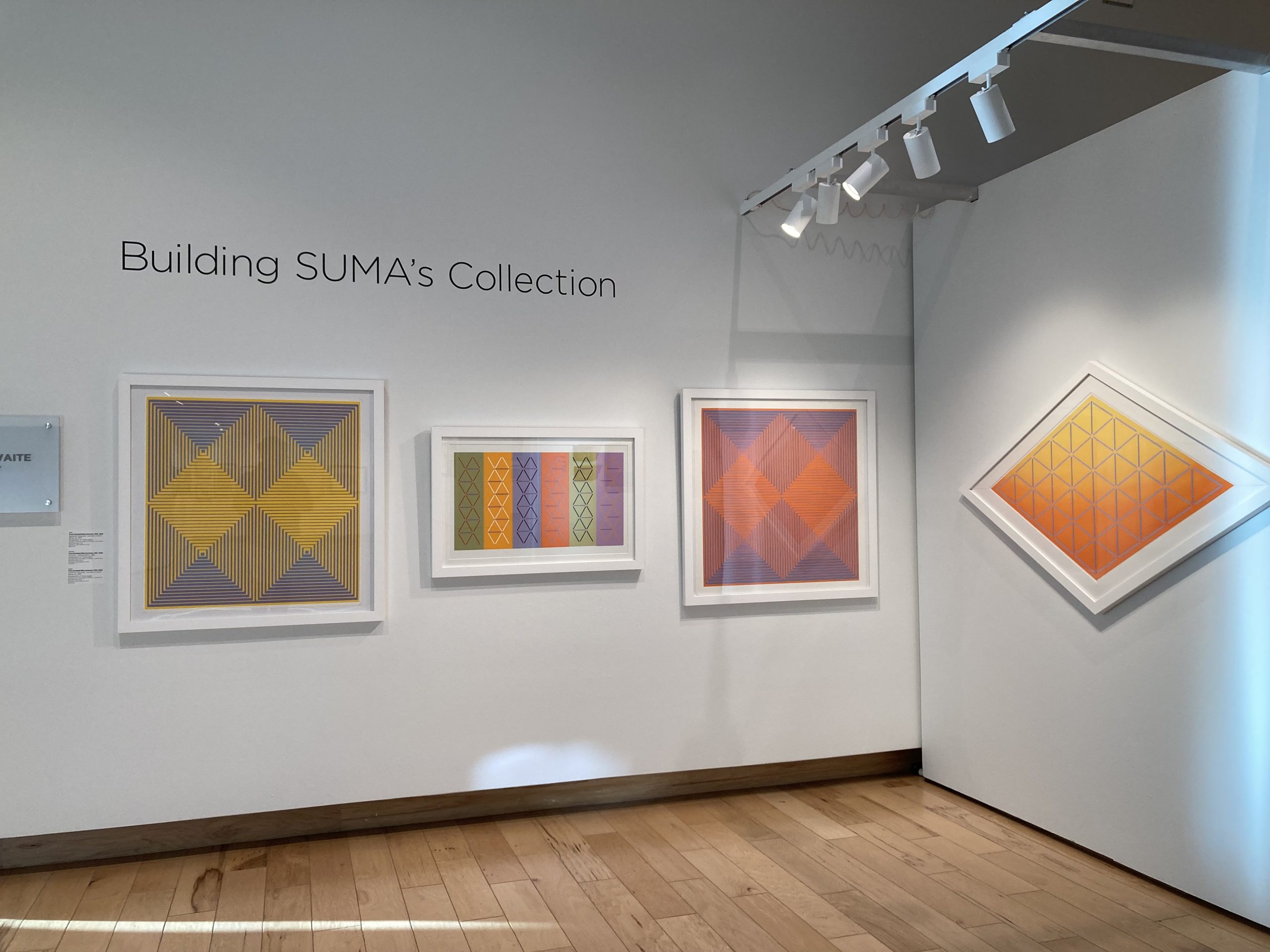
Works by Anna Campbell Bliss in Building SUMA’s Collection. Bliss used repeated geometric forms and contrasting colors to explore optical perception.
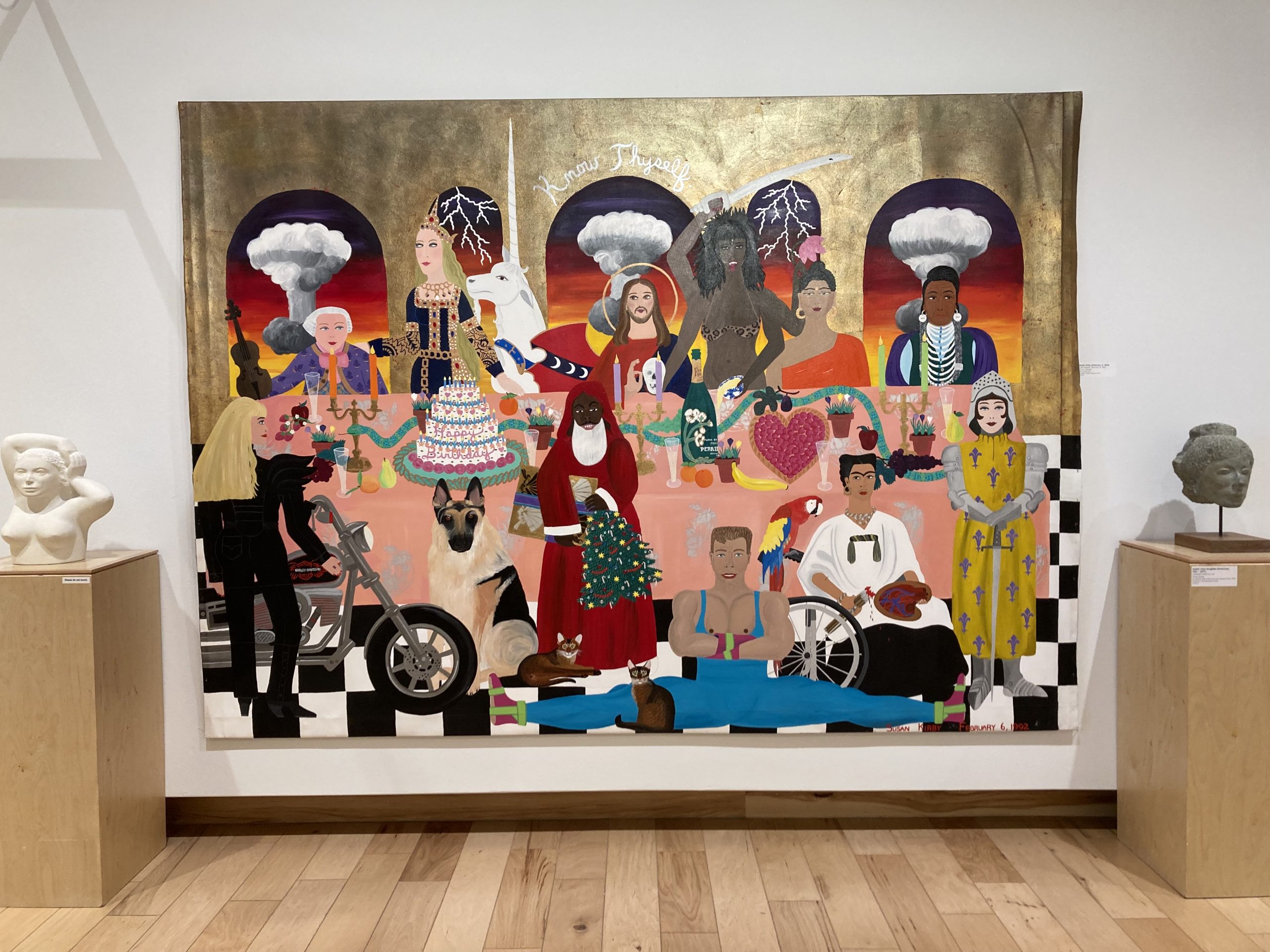
Susan Kirby’s sprawling banquet scene in the back of the gallery presents another reason a museum treasure might spend considerable time in storage: where do you put the thing? The enormous painting assembles an improbable guest list around a long table, crowding historical, religious and cultural figures together with animals, motorcycles, food and other unexpected intrusions, while mushroom clouds rise ominously beyond the arches. Its flat, brightly colored figures initially give the painting the genial exuberance of folk art, but that uneasy juxtaposition of celebration and catastrophe makes the gathering considerably stranger—and darker—the longer one looks. Kirby had a solo exhibition at Salt Lake City’s Finch Lane Gallery earlier this year, where this unruly gathering would have felt right at home.
If Art from Abstract to Zion loosens the curatorial reins, Behind the Scenes at SUMA lets go of them almost entirely. Across from A to Z on the south wall, museum staff were invited to select favorites from the collection, with no obligation that their choices play nicely together. The result offers an even better opportunity for the collection’s outliers to find their way onto the walls.

Julius Moessel, “The Three Graces,” 1922, oil, 35 x 40 in.
Julius Moessel’s “The Three Graces,” c. 1920s, is just the sort of painting one imagines might have trouble finding its way into a tightly-themed exhibition. The German-born, European-trained artist, best known as a Surrealist, transports the ancient subject into an improbably abundant Arcadia, where three nude women bearing flowers share the landscape with cranes, antelope and a profusion of meticulously observed plants. There’s a slight resonance with Kirby across the hall, but Moessel’s timeless, dreamlike pastoral world really recalls the Symbolist idylls of Pierre Puvis de Chavannes. Utah does not generally lean into exhibitions centered around the nude and the figures in “The Three Graces” might be what most viewers would focus on, but the real heart of the painting is Moessel’s obsessive interest in flora and fauna. It is a strange and wonderful painting—and the museum has more (here’s hoping we can see them together someday). In the meantime, the staff-picks exhibition allows someone to simply pull out and say, “Look at this.”
From Moessel’s imaginary Arcadia, it is a considerable leap to Gerald Campbell’s “The City”(1949), where buildings tilt, streets converge and a telephone pole struggles to remain upright beneath a blood-red sun. In the postwar period, Campbell came to study in Salt Lake City (at the Art Barn) before ending up in California (and on the cover of Time magazine). He was one of a gaggle of Utah artists at mid-century who were experimenting with new forms of depiction. This work appeared in the annual Cedar City Exhibit, which much like the Spring Salon, attracted entries from across the country. “The City” retains enough recognizable architecture to keep us grounded in an actual place, but bends perspective and intensifies color until the city seems to be shifting beneath our feet.

Gerald Campbell, “The City,” 1949, gouache and pastel, 21 x 28 in.
Between the two, Joseph Mugnaini’s “The Murder of Moby Dick” turns a praying mantis into something simultaneously insect, machine and fantastic beast. Mugnaini, best known for his long association with Ray Bradbury, was particularly at home in this territory where the recognizable slips easily into the fantastic. The scene is based on the screenplay of “Moby Dick” Bradbury worked on in 1953. The enormous yellow and green wings cut through a starry darkness while the curving forms below suggests the great white whale and attendant porpoises.
None of these works needs the others to make its case. Some of them speak to each other but there is no singled conversation, just one loud, sometimes clashing din. That’s the fun of it. The collection is allowed simply to be a collection: uneven, surprising, historically scattered, full of objects that may have very little to say to one another but plenty to say on their own.
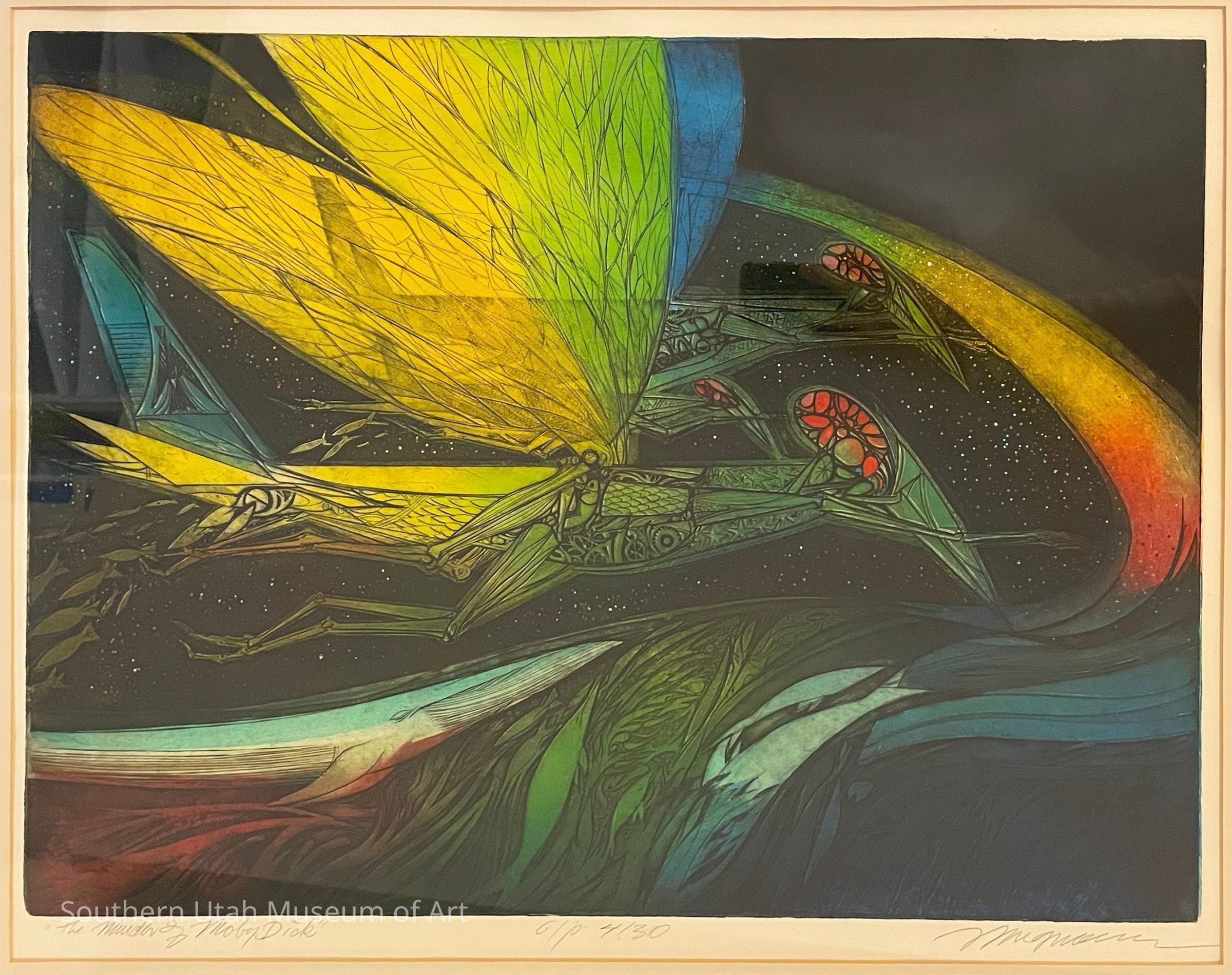
Joseph Mugnaini, “The Murder of Moby Dick,” 1982, 19 x 24 in.
Art from Abstract to Zion: Celebrating 10 Years of SUMA, Southern Utah Museum of Art, Cedar City, through Sept. 26
The founder of Artists of Utah and editor of its online magazine, 15 Bytes, Shawn Rossiter has undergraduate degrees in English, French and Italian Literature and studied Comparative Literature in graduate school before pursuing a career in art.
Categories: Exhibition Reviews | Visual Arts