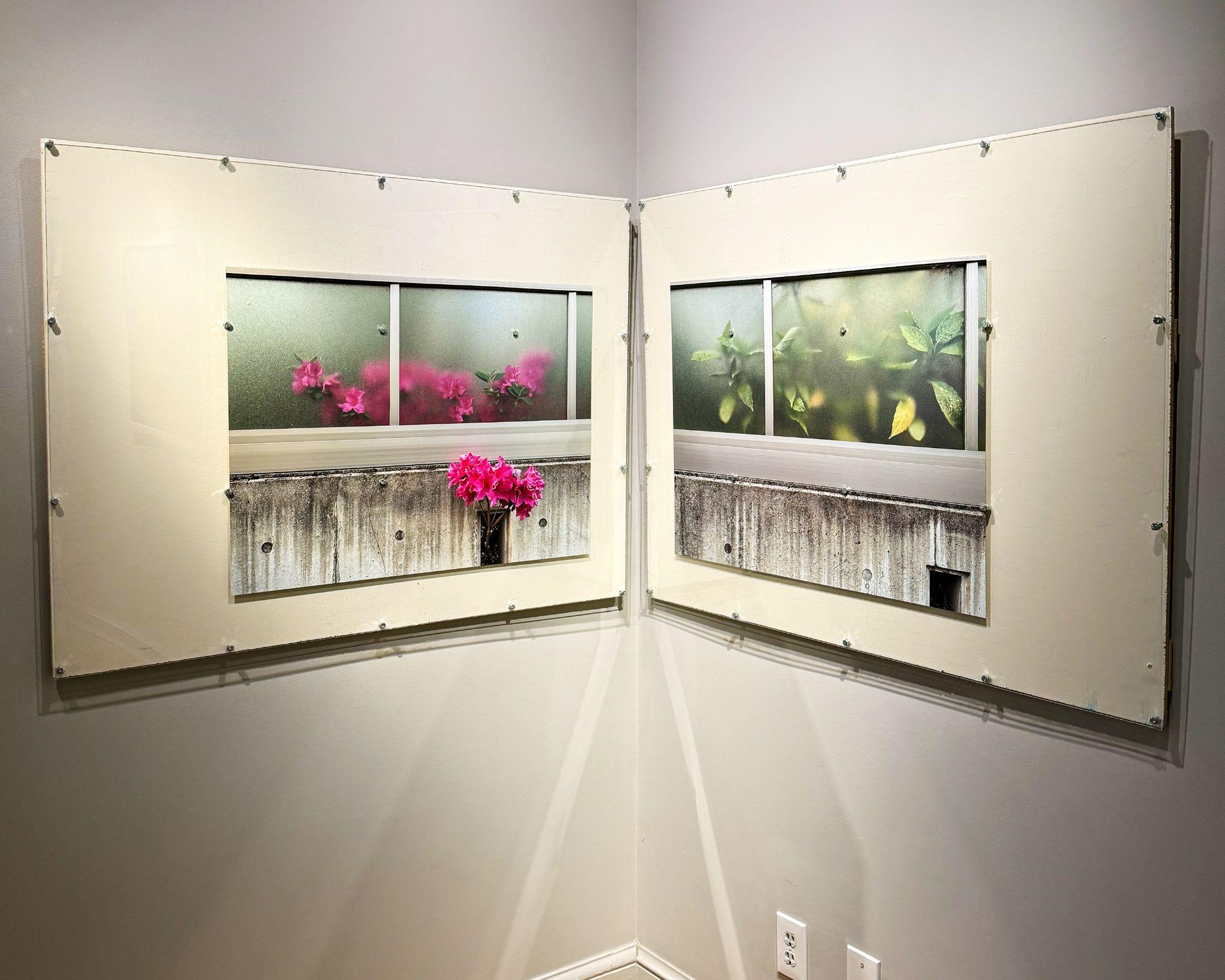
Brenna Cooper, “flowers” and “leaves” at Finch Lane Gallery.
Photography officially turned 200 years old this year (or next year, we don’t know for sure. Perhaps Joseph Niépce neglected to organize his EXIF files properly). Initially just a clever employment of physics and chemistry, photography became a powerful player in politics, culture, and commercialism, and one of the major catalysts to the vast movement we now know as modern art. Today, photography is utterly ubiquitous. Billions of people walk around carrying better, smaller cameras than Niepce could have ever dreamed of, at least half of which have just received their final warning that their cloud storage is at capacity due to myriad digitized photos. While some find this an intimidating backdrop for photographic art, others recognize fertile ground for work that is both immediately and timelessly relevant.
Lizzie Windsor, Brenna Cooper, and Jeremiah Parkin are more than up to the challenge, as demonstrated by their exhibition IRL, on view at Finch Gallery until September 4th. The artists describe IRL as a response to the digital stress of our image-saturated lives and an invitation to reconsider how we interact with photographs. In the exhibition, each artist not only expertly navigates photography’s limitations but utilizes clever Brechtian techniques to unveil its illusions on their own terms. It’s a show not just about looking through a camera, but looking at a photograph.
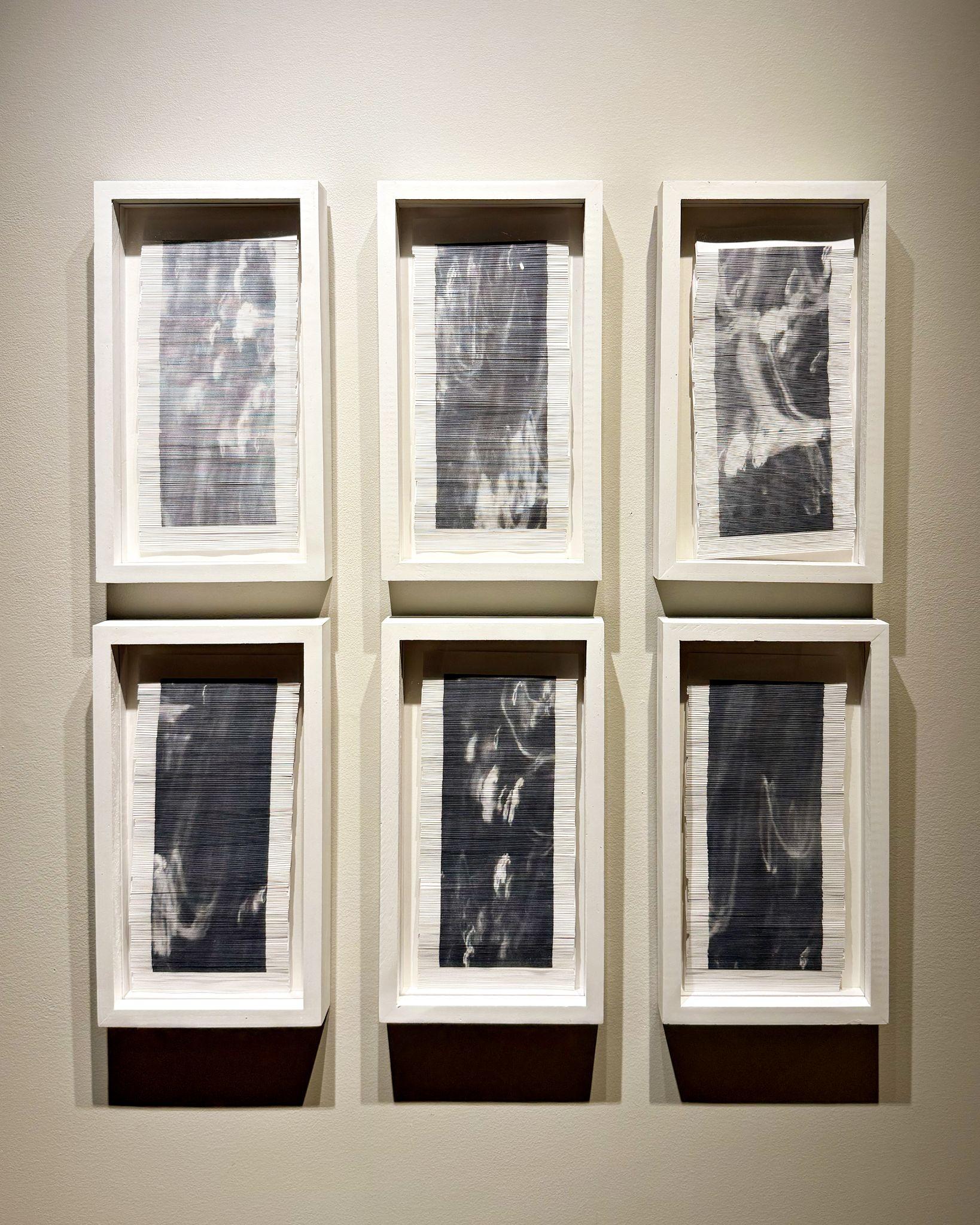
Brenna Cooper, “spring//autumn//spring”
Brenna Cooper’s work uses poetic complication to make beautiful simplicities visible. Motivated by her connection to the camera as a tool for seeing, she reveals the wonder in what we might otherwise overlook. When asked which of her pieces in the exhibit stood out to her, Cooper picked “spring//autumn//spring” without much hesitation. Installed on the east wall, it is a family of six photographic works on paper in a two-by-three grid, inspired by a walk that has become an important reflective part of her day: “I take the same walk every day, and it is slowly changing as time elapses. The people I pass are different, the weather and lighting change, the organic material on the sidewalk slowly differs, and only after capturing it can you compare the stark contrast between its different states. I love the reward of paying attention to small details and observing small changes.”
Her “flowers” and “leaves” form a diptych photographic couple where colors are both vivid and controlled. The magenta geraniums and verdant foliage press intently up against frosty windows installed in an unidentifiable concrete structure. There is a simultaneous sense of outsideness and insideness that playfully defies one’s conventions of physical space. The photos themselves are compelling, but Cooper takes the duo further. Both “flowers” and “leaves” are fixed asymmetrically to white boards with industrial screws. The screws pierce the print with precision, glinting in the gallery lights and casting shadows that play thoughtfully against the strange image they sustain. While some photos transport you to another place in space and time, these works want you to be present in this gallery, sharing physical space and real time with these artifacts of art and science.
The camera has always had a keen ability to render itself invisible, but Lizzie Windsor’s work throughout IRL goes to pains to remind you of its presence. “We’re bringing photo into a place where it feels like an object, and it feels like its own thing rather than just a photograph where we can see into another world,” Windsor says of the exhibit. Two of Windsor’s responses to this idea are on the east wall of the gallery. “Untitled (taking a pic),” and its companion, “Untitled #2 (taking a pic),” carry immediate aesthetic power through bright yellow and orange knitwork juxtaposed with the smooth photographic blues and greens of a mountain landscape.
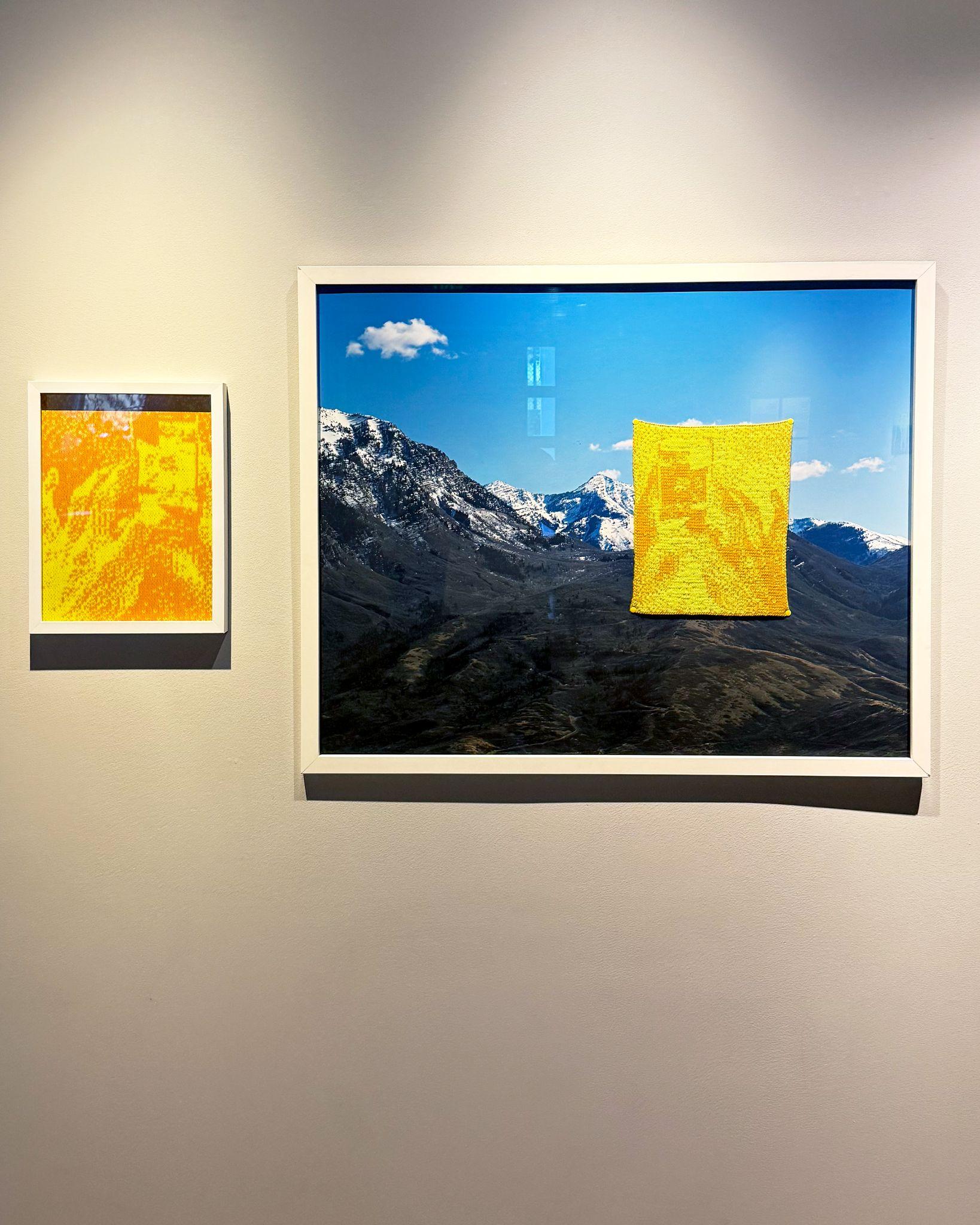
Lizzie Windsor, “Untitled (taking a pic)” and “Untitled #2 (taking a pic)”
In “Untitled (taking a pic),” we first meet our main character—a framed photo of a rectangular duotone knitting. The knitting in turn represents a photo of someone taking a photo on a smartphone—an astute spiral of notions that almost instantly offers both humor and philosophy. “Untitled #2 (taking a pic)” features our protagonist in the flesh, as what appears to be the same knitting is pinned squarely onto a large framed photo of a scenic mountain landscape with bright yellow pins. The duotone knitting appears to be reversed, revealing yellow where our photo knew orange and vice versa. It’s been cheekily interposed to create the illusion of an unknown smartphone photographer reaching up wistfully to take a photo of the mountain scene and preserve a memory.
Utah visitors can meet the same familiar view just outside the gallery, and the knitting’s personal point of view fits effortlessly into our shared experience of “taking a pic.” It’s a well-crafted illusion, but one that refuses to hide itself. Its desire to take us to another place is always disrupted by the physicality of the knitting, the time implied by its construction, and the absurdity in its attachment to a framed photo. It pulls equally and oppositely on the viewer in multiple directions, leaving the audience with a choice in the final destination.
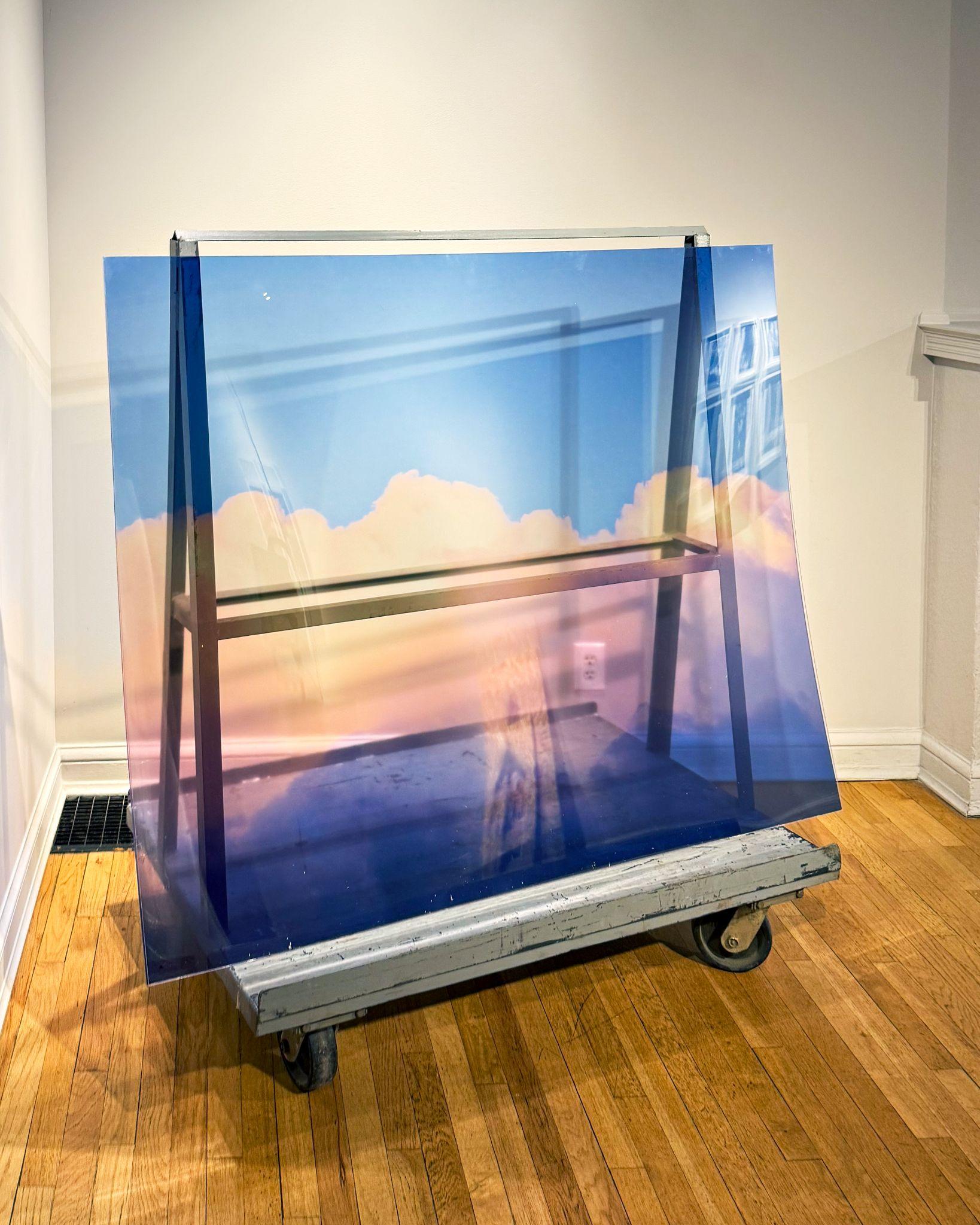
Jeremiah Parkin, “Untitled (clouds)”
In contrast to the quickness of digital photography, Jeremiah Parkin’s work slows the encounter down, drawing attention to light, glass, color and the photograph as a physical object. His 5-by-5 foot photo “Untitled (clouds),” translucently printed on a sheet of plexiglass, delicately reclines on a nondescript industrial cart. The photo itself depicts, as promised, puffy white clouds with violet shadows inflating lazily toward a deep blue sky. Nevertheless, a moment spent with this piece reveals hidden actors literally and figuratively shedding new light on it. Lights and shadows from the room interrupt the photo at every opportunity, meeting no resistance across the diaphanous surface. Even its support asserts the photo’s utter changeability, revealing its utilitarian structure garishly through the unopposing glass. Despite everything, the viewer can’t help but fight to take in the full, unadulterated photo visually and mentally. Perhaps we feel like we are failing the artist in our futile attempts, but eventually the epiphany arrives: it’s not an image but an ever-changing object that can only be purchased by presence and attention.
This emphasis on physical presence extends to Parkin’s process. In “Premium Dinocare,” located on the gallery’s east wall, he opted for older, manual printing techniques for the output of his photograph. He initially planned to use CMYK bitmapping techniques to screenprint the image, but “the tests for that went horribly wrong, so I decided to pivot and landed on a more basic splitting and layering of an image as opposed to CMYK separations. Each layer interacts with the light in the room, the other layers around it, and the wall behind it differently. I like how it pushes just past a standard 2D photo and brings the photo into the actual world.” The ink cascades across the smooth glass of “Premium Dinocare” with satisfying grittiness. Its physicality grounds the provocative poetry of breaking a photo down into the fundamental colors of pigment.
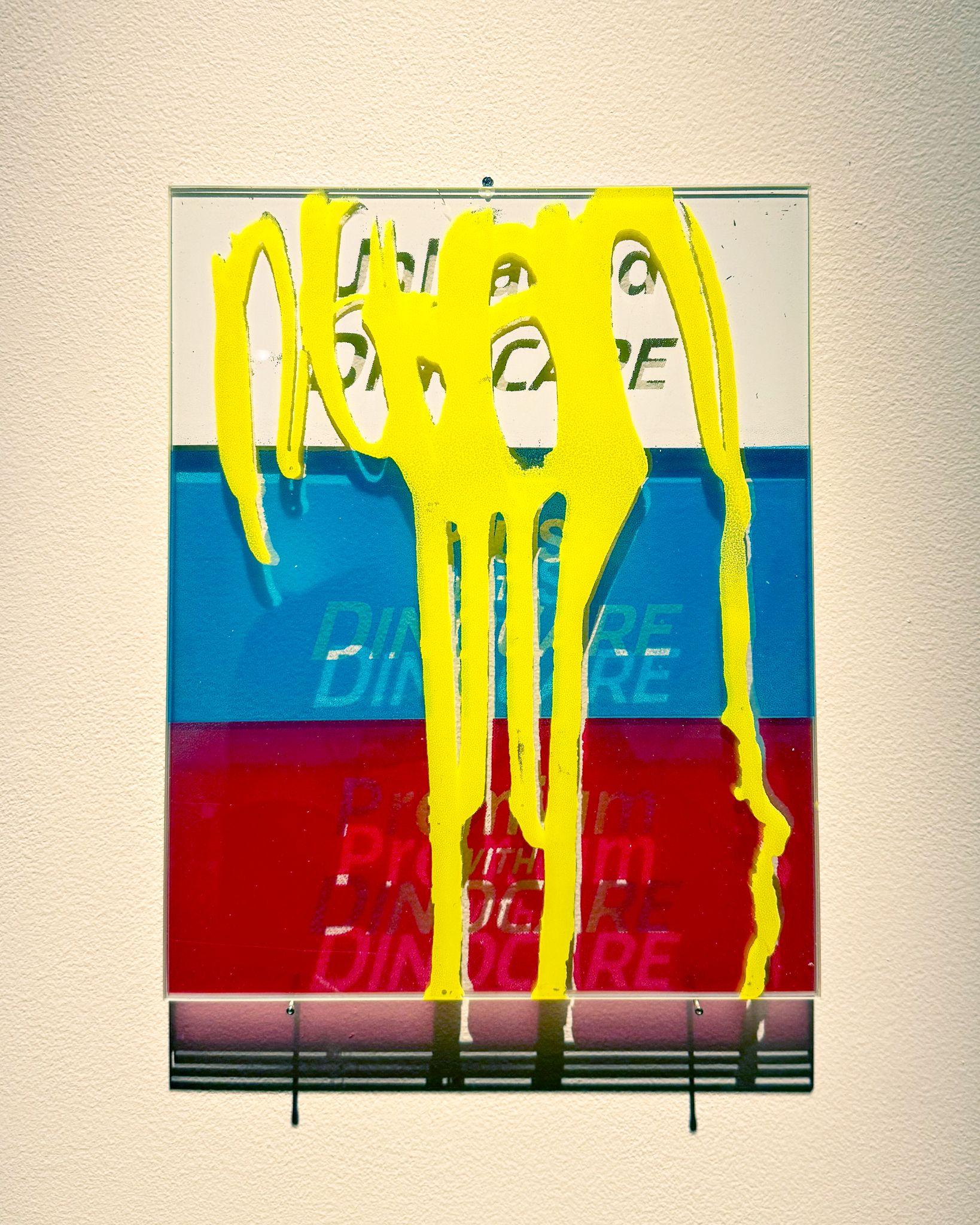
Jeremiah Parkin, “Premium Dinocare”
Two hundred years into photography’s history, making and seeing a photograph has never been easier. IRL makes it difficult again—in productive ways. IRL weaves distinct artistic voices into a compelling photographic tapestry, creating a visual discussion that counts gallery visitors as fellow conversationalists. The photographs insist on their materials, their surroundings, and the time required to encounter them. In an image-saturated world, perhaps that resistance is precisely what allows us to see them again.
Brenna Cooper & Jeremiah Parkin & Lizzie Windsor: IRL, Finch Lane Gallery, Salt Lake City, through Sept. 4.
Emily White Tousley is an interdisciplinary artist, educator, and writer from Utah County. She obtained her BFA in Fine Art and teaching license from BYU and is currently attending an MFA program in Art at the Glasgow School of Art in Glasgow, Scotland. Her artwork explores existential themes through sculpture, sound, photography, and painting, and she has taught interdisciplinary art classes in various capacities for three years.
Categories: Exhibition Reviews | Visual Arts




We loved IRL. Each artist’s work is unique, thought-provoking and beautiful. The pieces described in this excellent review are, indeed, wonderful and well worth a visit. The other nine not described here are equally exciting and must be experienced in person. These three new artists are ones to watch—and even collect—before their work gets too expensive for us ordinary folk!
All of these artists have worked so hard on this and it’s great to see each of their talents in this. Great work!!