
Rebecca Klundt “Selected Poems” 22×32 in.
Sometimes a gallery shows two artists simply because that’s who they have. There’s nothing wrong with that. Or they may have discovered an unknown pair: two deep excavators, say, who are mining the same subject matter. Some artists prefer to show with their friends. Again, nothing wrong there. However, at David Ericson Fine Art, we can rest assured that if there are two seemingly contrasting approaches on exhibit, it’s because one of the sharp, sophisticated gallery directors on the scene has spotted some quality that connects them, and there’s sure to be a valuable lesson to be found in seeing them together.
Rebecca Klundt certainly qualifies as a standout original. First, there’s her radical pictorial technique, which possesses unique artistic qualities and pictorial charm that may not be immediately apparent to everyone who comes upon it. Then there are her themes, which are by turns deeply spiritual and engaged in the minutiae of scripture and stories they retell to others. Consider “Angels Around Us,” a small image in which we see a very tall, extremely narrow edifice with an orange door, one orange window, another opening with a checkerboard cover in black-and-white, and an orange, spire-like roof that reaches a total height four times the structure’s width. This ambiguous building manages to feel like a house, but mixes its identity with that of a church spire or a silo. The angels that form a protecting arch over this possible tabernacle, family abode, or farm have familiar, tubular bodies and spherical heads. Their lack of detail may mean to leave some antique debates—like do they have wings or not—open to viewer discretion. Or it could be simply because they are made of wood scraps that have been painted with opaque acrylics and then glued closely together onto an unseen backing board, all the while using a minimum of detail so as not to clutter the narrative.
One thing that is useful to understand is that in this technique is being employed by a trained artist who, however, started out without woodworking skills. Yet among these discrete, found scraps that receive minimal manipulation, each piece contributes both a shape and a color, in essence working very much like the brushstrokes that organize paint into a more familiar expressive order. It may sound like, and even look like, some simpler achievement than it is, even like a child’s toy. But children’s toys are their first, most influential tools, and as adults we still respond to how children communicate. So, more than a mere literal or figurative image, this architecture, while nearly flat, may be added to the pencil, brush, chisel, computer, or any other tool capable, in the hands of an artist, of creating a complete, aesthetic composition.

Rebecca Klundt “Delicate” 21×32 in.
Certainly one comparison is to the art of mosaic. Oil paint dates from around 1400. Some stained glass can be dated to 686, and in the Middle Ages that glass became the “Queen of the Arts,” which demanded Gothic churches be invented and built, in which the walls were almost completely replaced by glass art. Yet even before all that, there was mosaic, which appeared in the third century B.C. Mosaic still remains a major, international art form, and its glories have, and still primarily come from its ability to capture and convey supernatural ideas and feelings. Klundt’s mosaic-like form blends modern materials and expressive paint applications to create a version more suited to today’s sensibilities.
Consider Klundt’s “Delicate Arch,” a landscape foregrounding what may be the only geologic rock feature in Utah more famous than Spiral Jetty, and this one found, not made. But where the Jetty once presented for contemplation the anomaly of a stone pathway over the body of a surface of water, the impact of an arch is more often the way stone can seem to fly weightlessly overhead. Its essence is vertical. Klundt emphasizes this here by consistent use of horizontal elements, which are everywhere akin to the horizontal layers of sediment that, laid down by gravity and cut by flowing water, became the stone that, penetrated by wind-borne sand over millions of years, became the towering arch. Everything around it is held in place by Earth’s gravity, even the sky. The arches, along with a handful of astronauts, resist it, but even for them escape is only temporary.
Neither “Angels Around Us” nor “Delicate Arch” is unambiguously religious, but other works from the beginning were. And none of them has excluded cultural content that fits her spiritual narrative. “Grass Roots” seems clearly influenced by “American Gothic,” Grant Wood’s 1930 image of two figures standing before their small farmhouse, and like it, and the only thing missing from the earlier work is what may have been Wood’s humorous use of a former house of ill-repute as model for their home. “Inspired,” with its three spires suggesting the Salt Lake Temple, is a subtle reference, but the title of “Jordan River” refers not to the body of water, which is missing, but to the temple that borrowed its name.
-
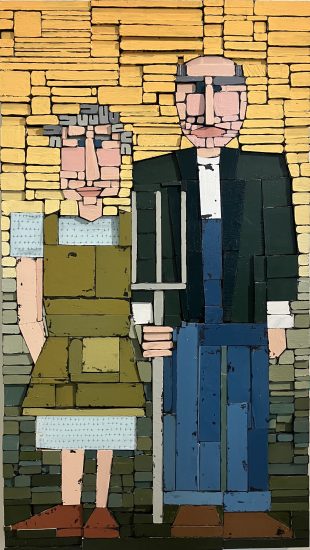
- Rebecca Klundt, “Grass Roots”
-
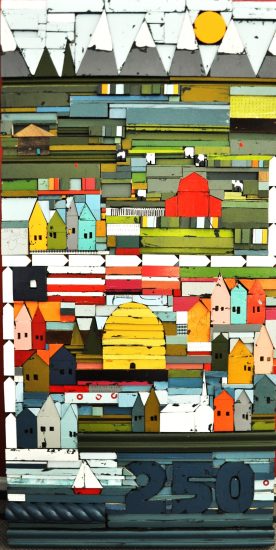
- Rebecca Klundt “America 250 – Sea to Shining Sea 24×48”
One recurrent and engaging trope that now shows up fairly frequently is the inclusion of details that may have been present on the chosen blocks, or may have been added during the work. “The Three Widows” are surrounded by ghostly images that invoke lace and other marks that fall between atmosphere, character identity, and the possible invocation of the women’s preferred activities. Some images of children not in the show, but which have been seen at Ericson’s, include childlike pencil scribbles that suggest the energy, initiative, and misbehavior of their subjects. In “Selected Poems,” this sort of thing moves to center stage, producing a dense, graffiti-like collection of odd tessera that invoke, but don’t quite represent, library shelves stuffed with books.
The climactic works here and now are two bravura images celebrating the 250th anniversary of the United States and our democracy. In “America, Sea to Shining Sea,” an entire rural township surrounds a barn-like beehive, with a river and sailboat in the foreground and a sawtooth mountain range on the horizon. A bit of carved railing in the water might invoke a bit of turbulence, or the central role played in the subject by handicrafts. In “God Bless America,” the familiar, and more realistic shape of a Temple replaces the beehive, which has only moved aside, while a white picket fence calls to mind the line in Robert Frost’s “Mending Wall”—“Good fences make good neighbors.”
It seems fair to say that here, Rebecca Klundt’s serious art training has come to the fore. Seeing the photos of these works in thumbnails erases any doubt about their compositions, and the sheer density of elements takes them from the realm of novelty and into that of serious treatment. Few artists take on such a challenge, which might be described as a complex puzzle, or the rural version of a great cityscape. Or both, of course, and the conclusion this presentation supports is that far from a caprice, this body of work is a serious project that fairly represents Utah as art in the modern world.

Rebecca Klundt, “These Three Widows,” 35×35 in.
Rebecca Klundt and Michelle Nixon, David Ericson Fine Art, Salt Lake City, through June 15.

Geoff Wichert objects to the term critic. He would rather be thought of as a advocate on behalf of those he writes about.
Categories: Exhibition Reviews | Visual Arts