Usually, when a creative event is described as “not to be missed,” the claim is rooted in its contemporary relevance. Numerous indispensable art exhibitions have conveyed alarm about the environment and what threatens it, and to be sure no political or social circumstance feels more pressing, nor so inexplicably ignored. For the last decade, the Kimball Art Center in Park City has alternated sounding that alarm with a proffered alternative, one that looks beyond the human folly of the moment to explore the source of our fatal predicament in the timeless nature of the human condition. Currently, in Returning to Wonder: Moments of Awe in the World Around Us and All Sketches Wish to be Real, Kimball director Aldy Milliken and curator Nancy Stoaks—who are surely among the most comprehensively attuned stewards of our shared art—have pulled together a mix of local and national artists to celebrate something fundamental, which might best be described as the role of actual sensory experience, as seen in the gallery, in the creations and sharing of conscious experience and memory.
Early in his career, American glassblower Josiah McElheny, clearly unwilling to follow in the footsteps of his contemporaries, let alone copy the empty ornaments of his Italian and Bohemian forebears, chose to pursue what he called “beautiful, non-decorative objects” that included advertising his faux Roman glass as grave goods from the (fictitious) “only known tomb of a Roman glassblower.” Then, in a parody of another academic staple, he displayed three categories of glass side by side: authentic pieces, copies of rare works made for broader exhibition, and forgeries intended to deceive collectors—all three made by him in the glass shop. His further work involved making actual physical copies of glass objects that survived, whether they were ever real or not, only in prints, paintings, novels, and other images of two, or fewer, dimensions.
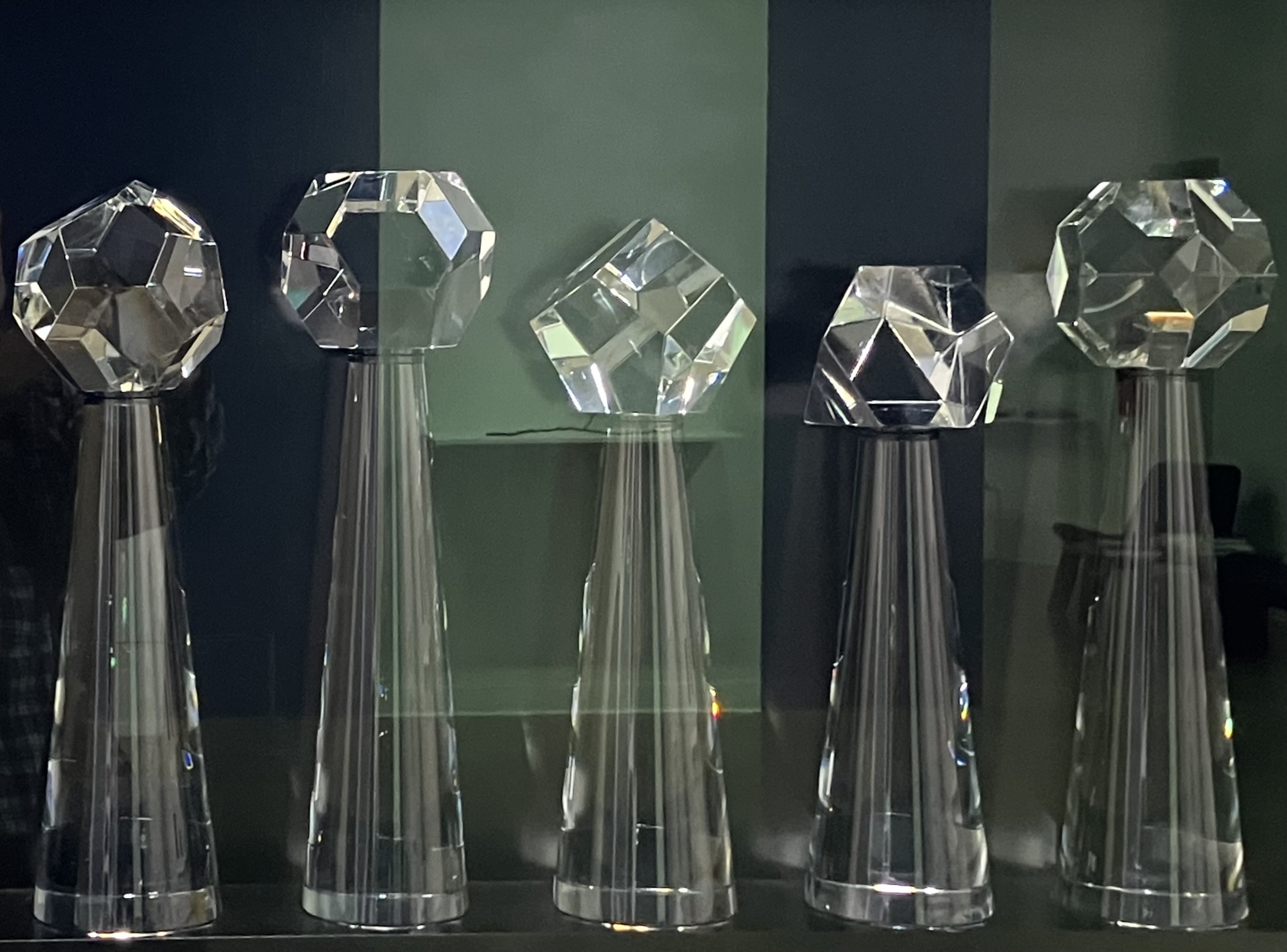
McElheny today, while moving ever closer to the existential core of the individual, hand-crafted object, has found a way to refresh the image, or mental construction, of geometric forms. Making them of colorless, extremely clear glass brings them as close as possible to the pure diagrams of math textbooks or computer graphics, yet adds the physical, three-dimensional experience back into the stripped-down data. Rotate them and they come to life. Calling them “From the Library of Future Geometries” suggests they are still in the action of becoming, which is to say part of the reciprocal realization and idealization of ideas and actualities.

Mended spiderwebs by Nina Katchadourian


Meanwhile, Nina Katchadourian must have pondered the daily lives of spiders, which consist almost entirely of building and rebuilding elaborate and fragile webs, which are of course nets in which these eight-legged fisherfolk capture creatures that swim in the air. Katchadourian undertakes nothing less than repairing these gossamer strands—damaged in use and surely too fine for such efforts—with the result that what we encounter, whether as pristine structures or tattered remains known as “cobwebs,” becomes a sensory lesson in spinning, anticipation, and deterioration. Through her deliberately hopeless, misguided efforts at repair, which she hastens to say were soundly rejected by the webs’ builders, she comments incisively on layers of possibilities, including the sometimes well-intended, sometimes indifferent intrusions of humanity into pre-human nature and the universality of life experiences between all its species. We all face the second law of thermodynamics, and we could probably learn some modest yet valuable lessons from watching the ways spiders deal with entropy.
In manner of speaking, all artworks are fictions. McElheny and Katchadourian have only reined in their imaginations a bit by drawing on other disciplines. Lia Halloran, in her illustrations for the book The Warped Side of Our Universe: An Odyssey Through Black Holes, Wormholes, Time Travel, and Gravitational Waves, depicts phenomena that were long thought to exist but remained unproven until recently, along with others that are dubious or at least still in question.
Sometimes an actual place can be turned into a fictional location by a combination of circumstances and knowledge. Photographer Reuben Wu uses long exposures and drone-mounted lights to turn Bolivia’s isolated and extremely undeveloped Uyuni Salt Flat into something that looks like a science fiction movie location or a sacred space—either way an extraordinary place.
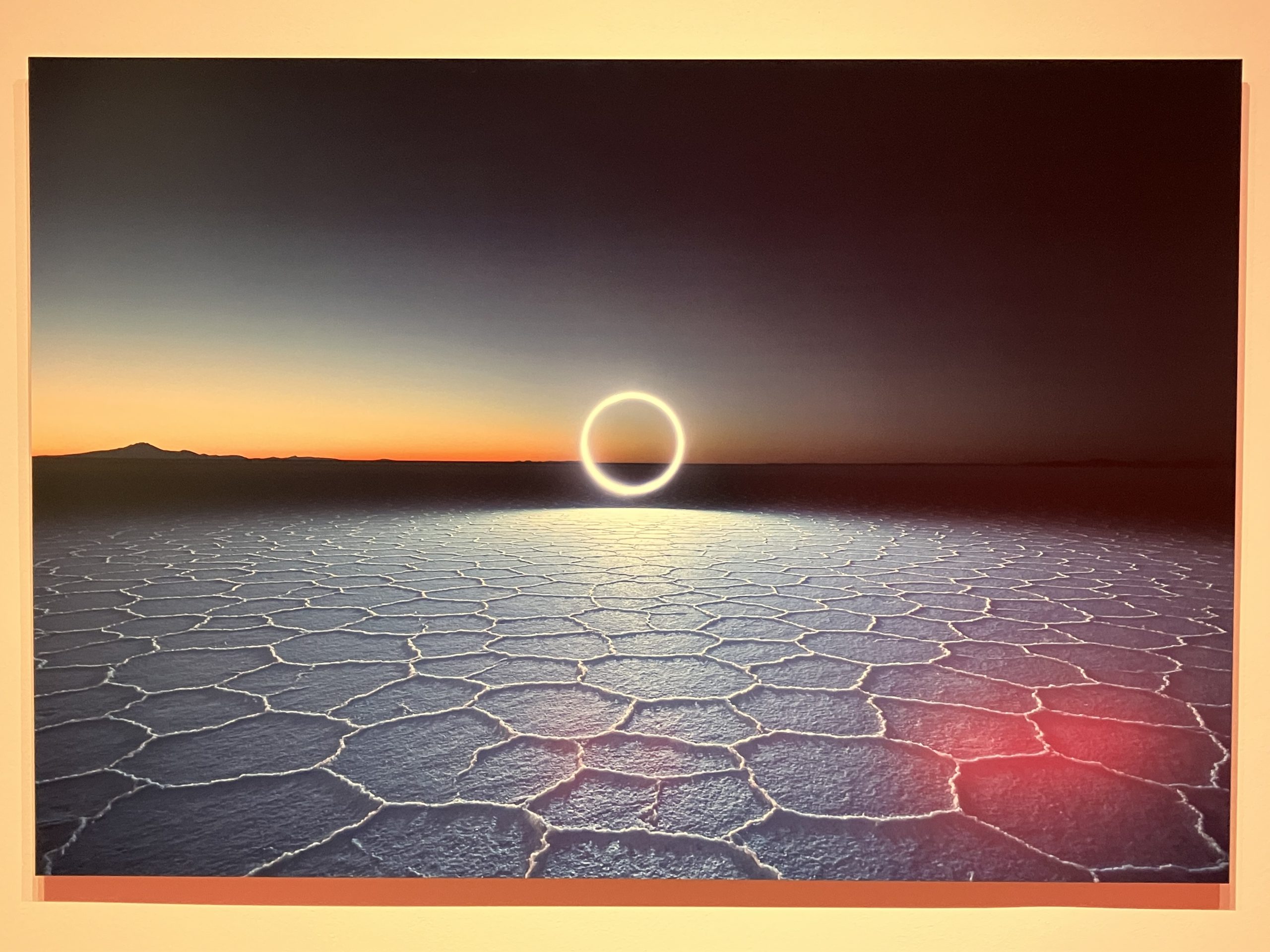
Reuben Wu, “XT1876, from the Field of Infinity Series”
One of the most contentious issues in art today concerns just how much text should accompany a work or exhibition. There are those who think the object should speak for itself, which may be a challenging case to make regarding the historical work of art, and then there are those who would have the scholarship and explanatory text that inevitably accumulates around a success, or even a compelling failure, be present with its subject, in the gallery, when it is shown. Artists like those here who intend their work to say something specific may have no choice but to go with text, but another approach is taken by Pipilotti Rist in “Peeping Freedom for Franziska Shutzbach.” Here a realistic 6-light window, complete with louvered shutters, contains an irresistible view of swirling, pulsing colors that flow like ink on water, massaging the eye and gently energizing the body. It seems certain that viewers will tell themselves a story about this, depending on their familiarity with the name or some other, personal perspective. Perhaps that it’s a window into another dimension or an escape into an altogether different, more appealing moment in time.
These are only a few of the consciousness-altering visions in these two shows, which include a number of local artists, some of whom within the last year were parts of the ceramic extravaganza, showing student work in the artist-in-residence gallery at UMOCA, or building a body of work that has added new dimensions since then. It’s a failure-proof opportunity to see how the works of artists like photographer Alexandra Fuller and Kellie Bornhof have progressed since they made their first appearances.
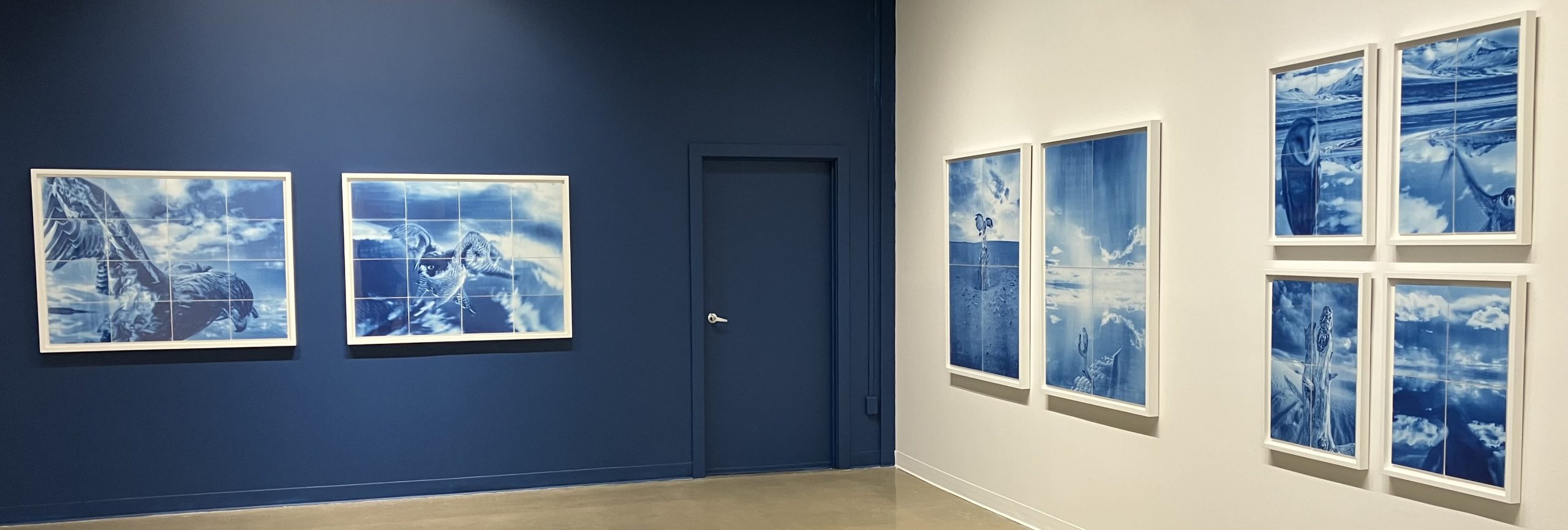
Installation view of photographs by Alexandra Fuller.
Returning to Wonder and All Sketches Wish to Be Real , Kimball Art Center, Park City through May 3.
DID YOU ENJOY THIS ARTICLE?
Help make more like it possible.
VENMO us a donation at artistsofutah

Or use PayPal to MAKE A DONATION.
15 Bytes is published by Artists of Utah, a 501 (c) 3 tax-exempt nonprofit.

Geoff Wichert objects to the term critic. He would rather be thought of as a advocate on behalf of those he writes about.
Categories: Exhibition Reviews | Visual Arts