Two months after the terrorist attacks of September 11, 2001, Frank McEntire and his wife traveled to New York City. The wreckage of the World Trade Center was still being cleared, but throughout the city another response to the attacks had appeared. McEntire remembers “altar-like memorials” on fences, sidewalks and buildings, particularly at fire stations. Makeshift constructions of photographs, flowers, notes and personal objects, “They were sincere expressions of our shared humanity,” McEntire recalls.
Three years later, McEntire was invited to exhibit alongside painter Hyunmee Lee at Utah Valley State College, now Utah Valley University. The exhibition was scheduled for September 2004, around the third anniversary of the attacks, and McEntire decided to create works commemorating 9/11.
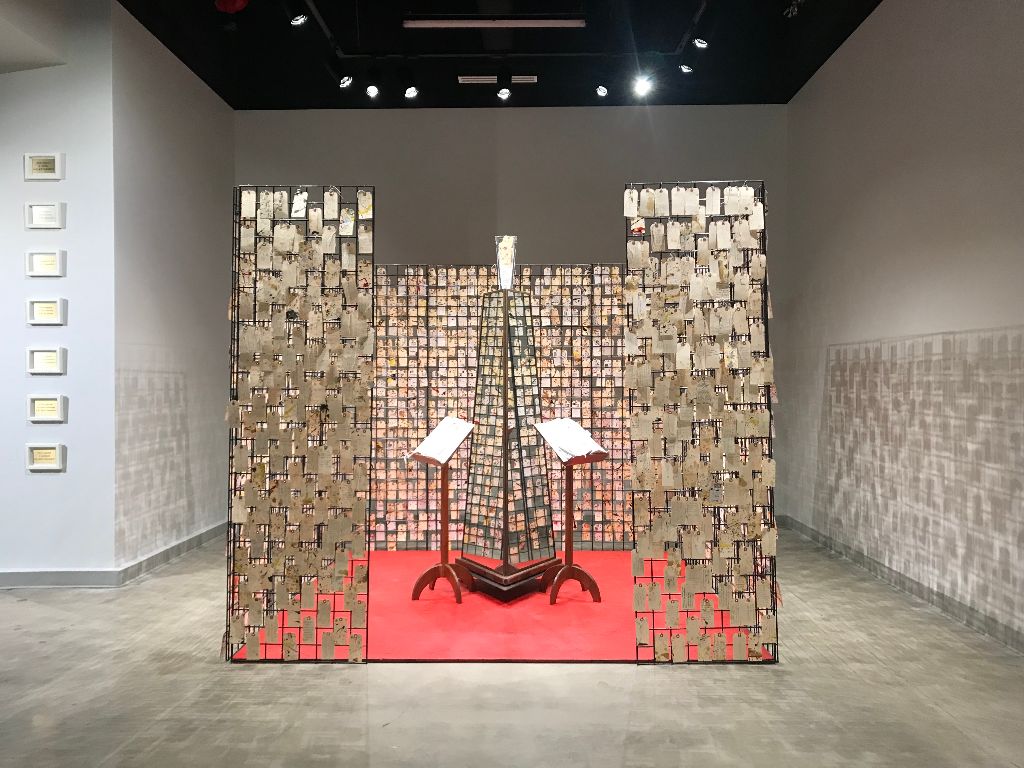
At the center of what became Spontaneous Memorial was “Fences.” After returning from New York, McEntire had set himself the task of creating 3,000 remembrances of those killed in the attacks. Reading Portraits 9/11/01: The Collected “Portraits of Grief,” compiled from The New York Times’ biographical sketches of the victims, he began using their photographs and stories to make collaged memorial tags. McEntire arranged the tags on a grid structure surrounding a partly enclosed, shrine-like space. The price tags McEntire used for his collages carried their own associations: the price of an object, the cost of a life, the tag identifying a body in a morgue. The fence recalled the temporary structures McEntire had encountered in New York, where photographs and information about the missing posted in the days after the attacks became, as the likelihood of finding survivors diminished, memorials. Messages of hope became messages of mourning.

At that UVU show, McEntire could have no idea what he was starting. Spontaneous Memorial would become an installation McEntire continued to assemble, alter and exhibit for more than two decades. After its 2004 debut, Spontaneous Memorial appeared at the Anne Frank Human Rights Memorial in Boise in 2005 and the Salt Lake City Main Library the following year. Subsequent versions were exhibited in Provo, Kearns and Springville and, in 2012, at Houston Baptist University in Texas. It returned for significant anniversaries of the attacks, including exhibitions at Snow College in 2016 and Bountiful Davis Art Center in 2018. Twenty years after 9/11, it returned to Utah Valley University, where the project had begun.
When 15 Bytes first wrote about Spontaneous Memorial in 2006, during its installation at Salt Lake City’s Main Library, Kasey Boone zeroed in on the apparent contradiction of its title. How could something installed deliberately each year be spontaneous? Boone found the answer in the audience: “The spontaneity happens in the moment when the patrons (different in every location, changed by every year) join the act of memorializing.”
By the tenth anniversary in 2011, Spontaneous Memorial had become a substantial assemblage of objects McEntire had accumulated and transformed over eight years. Enlarged, paint-spattered photographs from his Portraits collages covered a wall. In “Fly with the Angels” a priest’s stole draped over an old wardrobe stood in remembrance of Flight 93—its title came from a message a visitor wrote on the back of one of McEntire’s memorial tags. Objects salvaged from an LDS chapel acquired new purposes. An old oak roll-top desk, complete with ledgers, invited visitors to leave their own reflections. A wall-mounted tithing table became “Message Table,” its compartments stocked with blank tags and pens. Visitors could write messages and attach them to “Fences.”
 The questions raised by Spontaneous Memorial had begun to extend well beyond September 11. The attacks had led the United States into wars in Afghanistan and Iraq and as those conflicts continued, McEntire increasingly incorporated their consequences into the installation. In one installaiton, McEntire took a chapel’s hymn board and filled its number slots with cards from the U.S. military’s “Most-wanted Iraqi” playing-card deck. Nearby, a wooden music stand held an old Mormon hymnal opened to hymn 331: “Oh, Say What Is Truth?”
Looking back on the first eight years of the project in a 2011 15 Bytes article, McEntire described the repeated act of working with the material as its own form of remembrance. “I reflected on the individuals whose lives were taken each time I touched one of the memorial tags or found ways to work with the 9/11 theme—a humbling experience.” At the time, McEntire believed the tenth-anniversary installation at the Springville Museum of Art would be the last. His interest, he said then, had become exploring “memorial” not only as a means of remembering an historical event and honoring the dead, but as a form of artistic expression in itself.
Geoff Wichert wrote about McEntire’s related installation First Response for 15 Bytes in 2018. “The meaning of 9/11 has changed as America has changed,” Wichert wrote. First Response grew out of many of the same concerns as Spontaneous Memorial, while broadening its attention to other forms of disaster and human suffering. Later that year, Wichert encountered Spontaneous Memorial itself at Bountiful Davis Art Center, calling it the “latest, most complete, and most satisfying version” of McEntire’s continuing response to 9/11.
People have sometimes asked McEntire why he has continued putting so much time and expense into a project that began more than two decades ago. “I suppose there will always be ‘wars and rumors of wars,’ as my wife’s great-grandmother used to say,” he says. “It’s important to remember that within those conflicts are individuals, each with stories and loved ones, and that both manufactured and natural environments suffer great loss and destruction.”
In 2004, every adult who entered Spontaneous Memorial brought memories of September 11 with them—where they were when they heard the news, how they watched the towers fall, the fear and uncertainty that followed. Twenty-five years after the attacks, an increasing portion of the installation’s audience will have no such memory. “For those of us who experienced 9/11, Spontaneous Memorial helps us remember how we felt at the time,” McEntire says. “To the younger generation, it provides an important history lesson.”
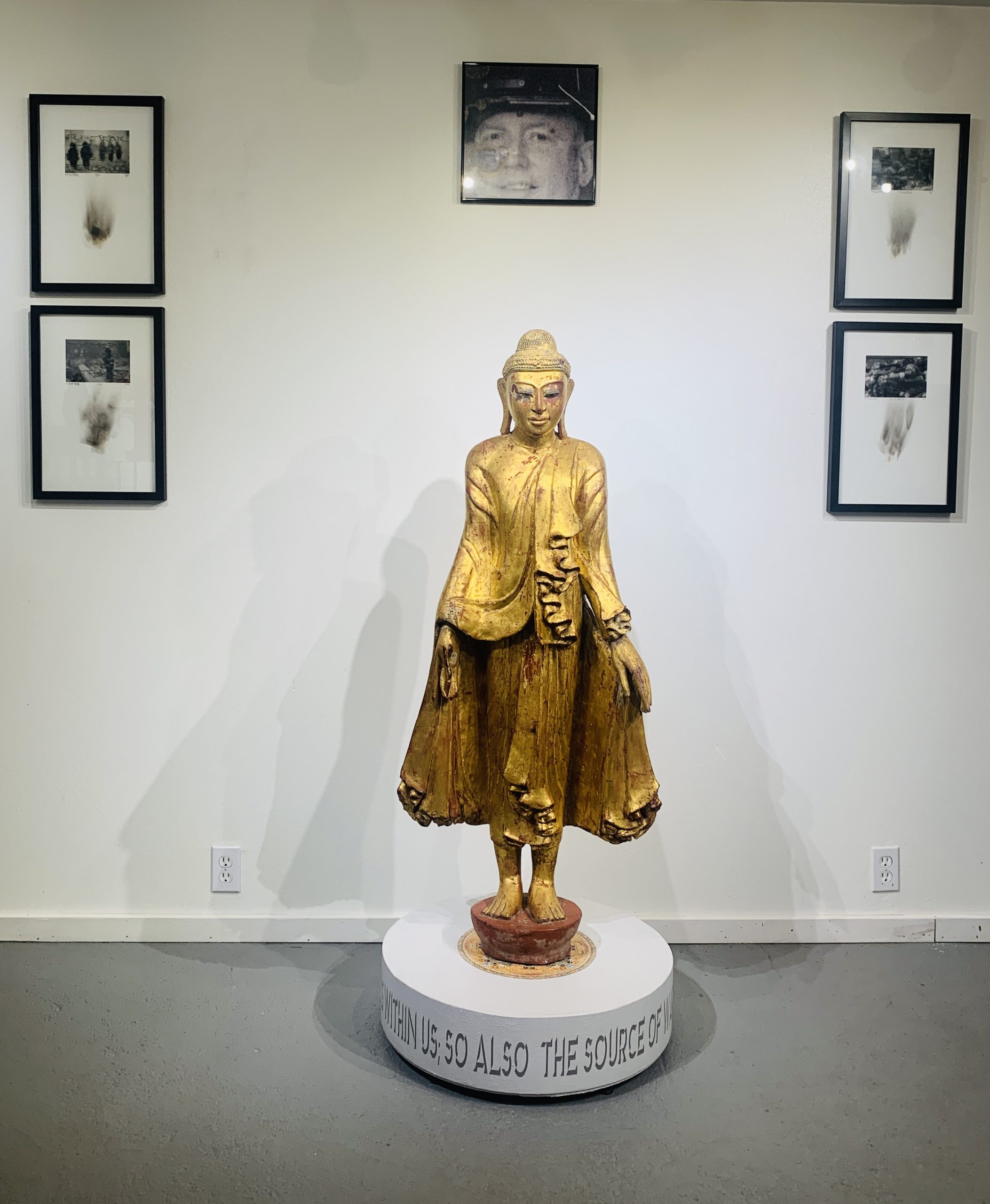
McEntire’s latest addition to Spontaneous Memorial is a standing figure of Gautama Buddha. Around its circular base he has placed a quotation attributed to the Buddha: “The source of peace is within us; so also, the source of war.” McEntire says those words have become “the summation of Spontaneous Memorial.”

The founder of Artists of Utah and editor of its online magazine, 15 Bytes, Shawn Rossiter has undergraduate degrees in English, French and Italian Literature and studied Comparative Literature in graduate school before pursuing a career in art.
Categories: Visual Arts