Twenty-five years ago this month, Sunnie Bybee was a young artist fresh out of BYU when her work appeared in In and Out of Habit, the six-person exhibition reviewed in the very first issue of 15 Bytes.
A quarter century later, Bybee is still making art—and still interested in the stories people use to make sense of the world. “I am interested in the stories that we tell ourselves as a human race,” she says, particularly those concerning “good and evil, work and wealth, strength and vulnerability.”
Earlier in her practice, Bybee drew heavily on European fairy tales. “The strange beauty of evil approaching innocence drew me in. I was attracted to the tropes that seemed to travel through time and remain relevant. I used these familiar tropes as a way of approaching contemporary political strife and inequality, allowing the language of the fairy tale to become something darker and more ambiguous.”
More recently, she has turned toward another kind of mythology: American history, particularly the labor movements and conflicts surrounding the Industrial Revolution. “I am interested in the mythology of American progress and the human cost that is often obscured within it. The landscape of my work has consequently become populated by figures and symbols drawn from American political and cultural life that seem to embody authority and power.”

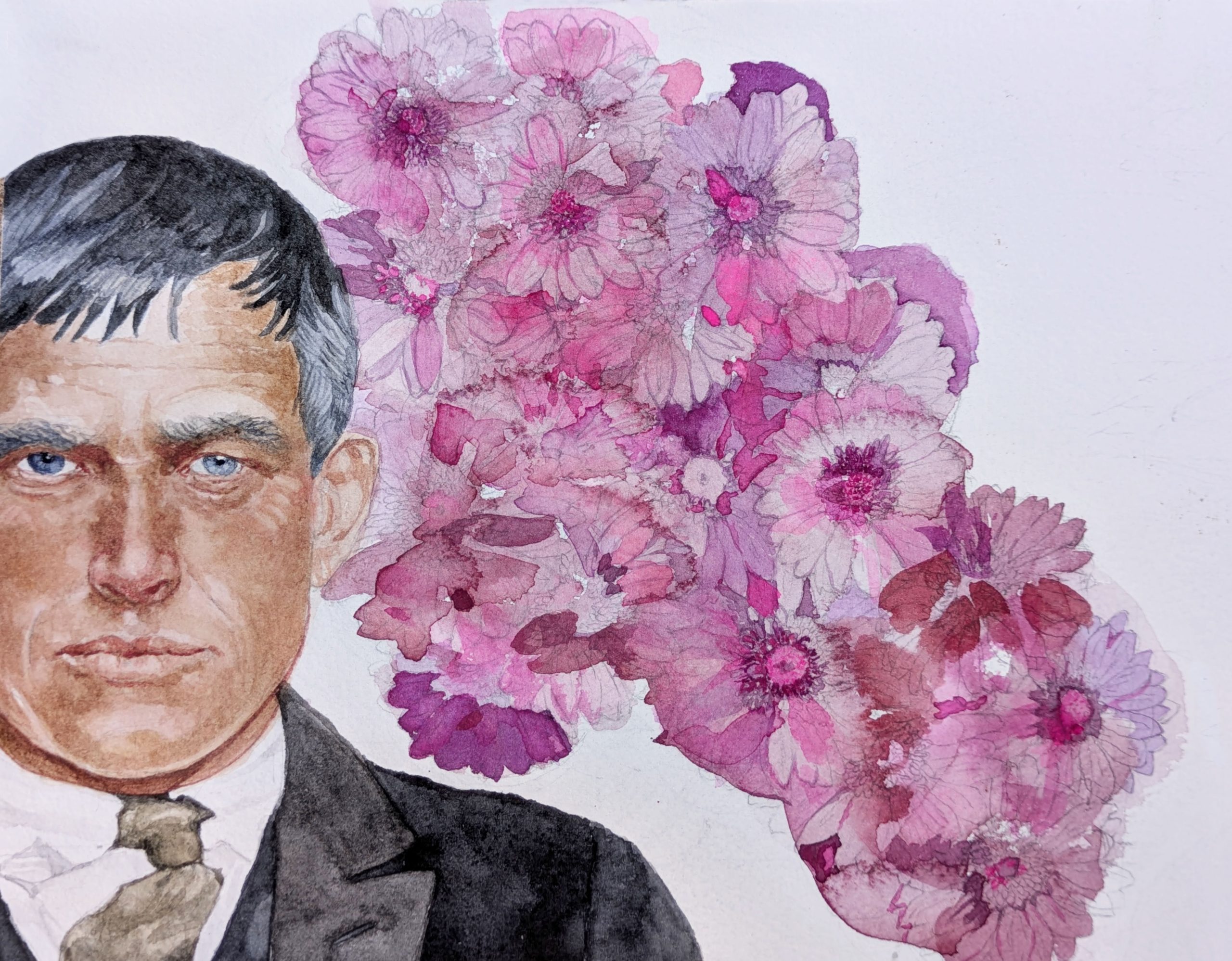
In one recent work, “Learn War No More,” a Boy Scout, paper crown on his head, sounds a bugle in an expansive field of red poppies. In another, “Empathy,” a stern male figure shares the composition with a luxuriant mass of vivid pink flowers. Flowers recur frequently in Bybee’s work precisely because their meanings are unstable. “They can suggest beauty, innocence, mourning, violence, or decay,” she says. The Boy Scout and his poppies allow her to explore the tension between militarism and tenderness—and what she sees as a contemporary rejection of empathy as weakness.
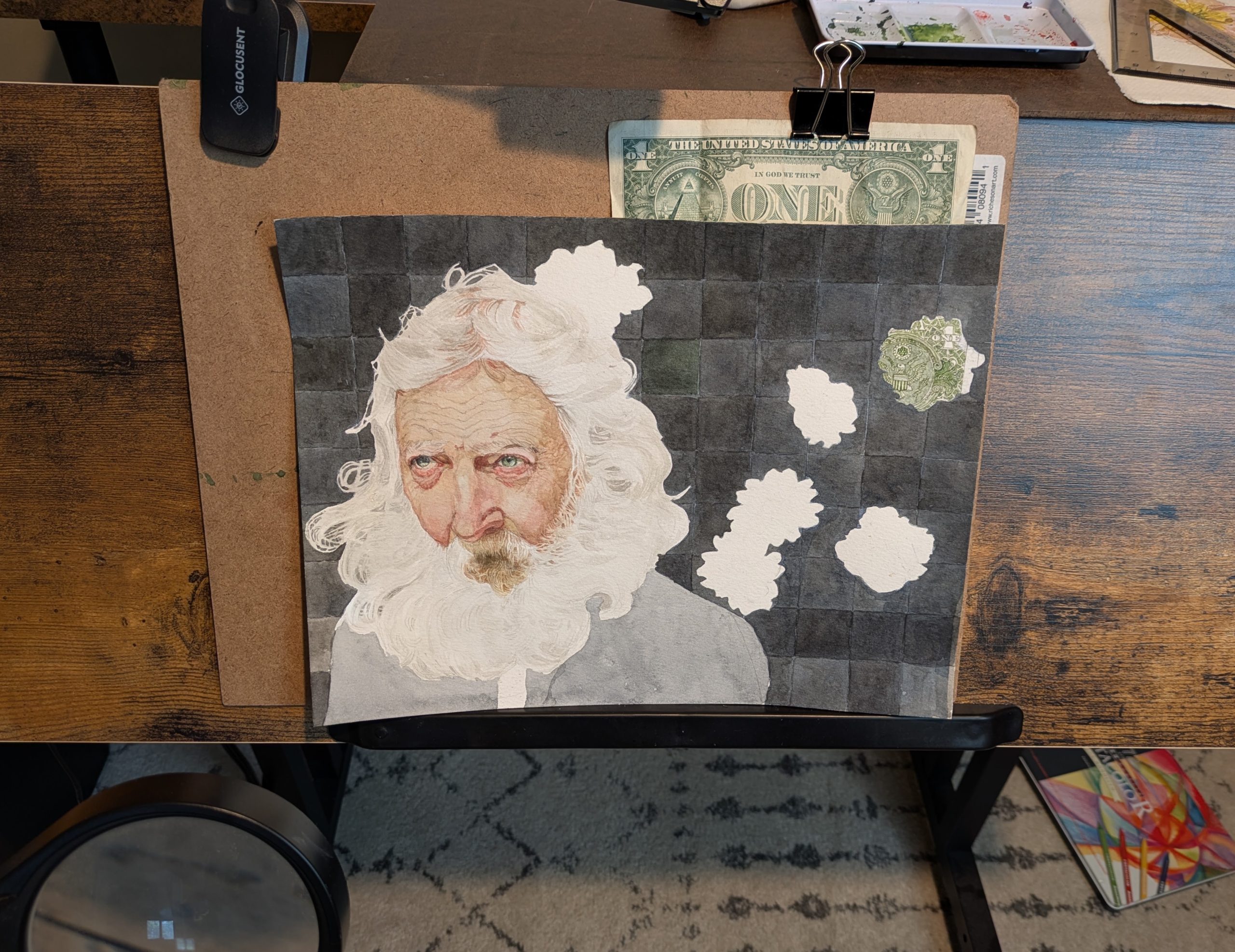
On her easel now is a watercolor portrait of an older, white-haired man. His face and upper body emerge against a dark, gridded field interrupted by irregular openings. Through one of them, fragments of a dollar bill have begun to appear. An actual dollar, clipped to the board just above the painting, serves as reference. The money will eventually become a larger presence in the work. Bybee is less interested in depicting wealth than in allowing the familiar imagery to break apart and encroach upon the figure. “I am interested in capitalism not simply as an economic structure,” she says, “but as an ideology capable of becoming relentless and even vicious in its demand for productivity, accumulation, and competition.”

Bybee grew up in Provo, where high school art teacher James Rees encouraged her determination to become an artist. She went on to study art at BYU. Bruce Smith was an important influence on her development as a figure painter, while Joe Ostraff became a mentor. Bybee has taught art in Utah’s public schools since 2005 and currently teaches high school. She now lives in Ogden with her husband and two children, fitting her studio practice into the spaces left by teaching and family life, particularly during the summers.
“Teaching has become another great love of mine,” she says, “and I find a lot of meaning in helping young people discover their own creativity and voices.” With what time remains, she says, she tries “to make art that is meaningful to me and, hopefully, to at least a few other people as well.”
Find more of the artist’s work at https://www.instagram.com/sunniebeeart.
All images courtesy of the artist.

This 15 Bytes feature talks with artists about what is on their “easel” right now.
Categories: Visual Arts | WIP