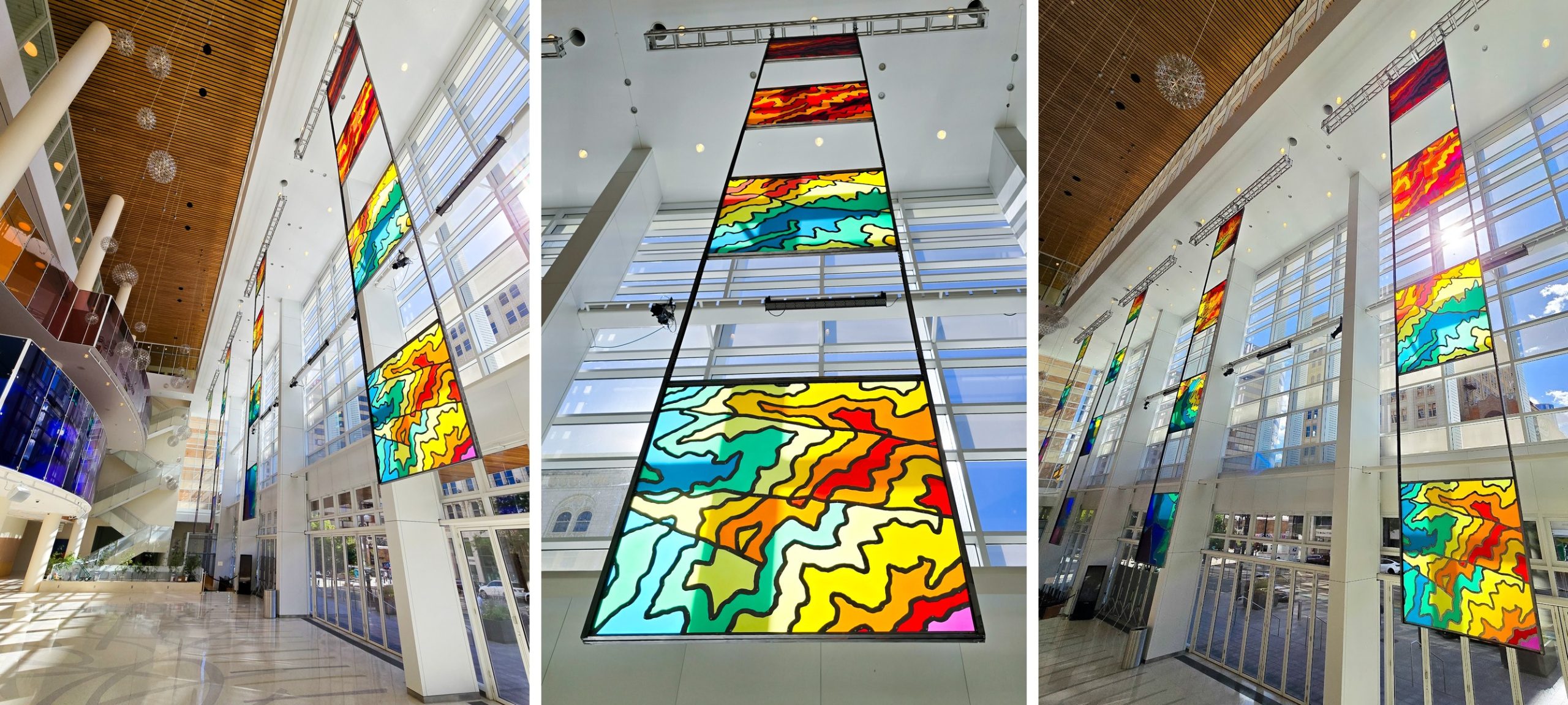
Chad Farnes’ “Elevation of Light” at the Eccles Theatre in downtown Salt Lake City. Image courtesy of Salt Lake County Public Art.
Among the countless artists I met in the 1970s and ’80s who employed glass as a primary medium, “stained plastic” was about as derogatory a term as was likely to be heard. Stained glass is conventionally handmade from materials of the highest quality, incorporating both accidental and intentional flaws and variations. To this day, its window makers cherish the unusual and one-of-a-kind qualities of such glass. Known generally as a cheap, even shoddy material, plastic is a mass-produced material, with virtues that extend to anonymous uniformity and ease of replacement, with all the faults that suggests. Nor does plastic offer the durability of glass. Indeed, medieval stained glass has been seen to last for centuries, its lifespan in some instanced limited only on the front end—the year of its crafting—while it never needs to wear out. In fact, its colors and textures are permanent and durable, unlike plastic, a 19th-century invention that deteriorates after a relatively short lifespan.
But how much do these differences matter? After all, much medieval art and especially architecture was only meant to last through the first millennium, after which the Savior was expected to return and bring about the end of the world. That some art from that period has lasted was an unexpected boon, not part of a plan. Further, today the traditional notion that art should last—“ars longa, vita brevis,” or art is long, life is short—is routinely dismissed by artists whose works are meant to last only as long as they have value to an audience. Marcel Duchamp granted any work of art a limited lifespan, about 50 years, arguing that after that it was properly considered an antique, of sentimental value perhaps, but no longer effective as art.
“Elevations of Light,” an installation of sixteen plastic panels created by Chad Farnes to celebrate the tenth anniversary of the Eccles Theater complex in the heart of downtown Salt Lake, is intended to last for a year. There is no reason to assume that it won’t do so, or to propose an afterlife of what is, after all, an Installation: a form of art intended for a specific time and place with no requirement that it last longer or fit in anywhere else. Even if that were not true, it would be fair to ask how its being made of plastic affects its impact as art. In fact, the answer is that, if anything, it works far better than an equivalent work in traditional stained glass might.
To begin with, the lobby of the Eccles building is illuminated by an enormous wall of glass, which admits both the entire sky and the light reflected from the structures on Main Street that face it. Aside from the prohibitive cost of filling that vast expanse with any art work in any material, to do so would inevitably rob the space of its primary, arguably glorious virtue: its extensive, luminous, and above all, open space. What Farnes chose to do instead was to articulate the space with a set of four vertical arrays, each hanging in its own space and containing four large panels that persuasively bring to life the potential perspectives of the space they occupy. In each set of four, regardless of whether the audience views it from the ground floor or the mezzanine level, the top panel is high overhead, then each succeeding portion comes closer to the viewers’ level. From the apparent visual trapezoid on top to the relative square on the bottom, they engage the eye in a dance that takes the measure of just how far the windows extend from near the roof almost to the floor.

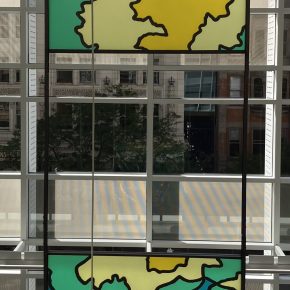
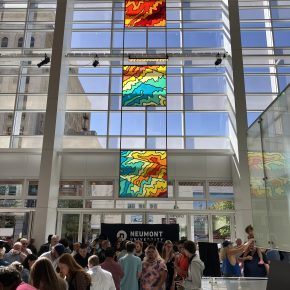
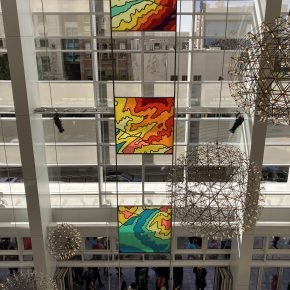
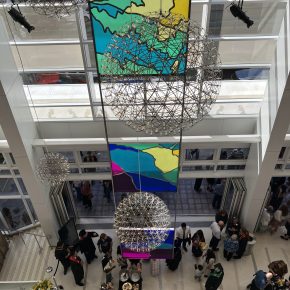
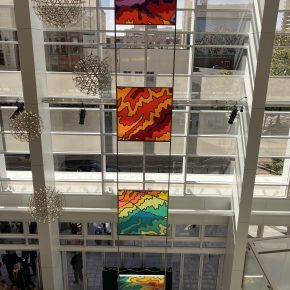
What matters most, however, is the panels themselves. Their material substance admits the light, but not the view. In glass art, this is properly styled “translucent,” the midpoint between opaque and transparent. All the material looks the same, an even suffusion of color so that they end up like so many artists’ prints, strictly two-dimensional designs with no representation of depth present. Further, the designs they display go far beyond what could be done in glass. It’s not that modern lasers or water jets couldn’t cut such shapes from glass as well as plastic, but that temperamental glass wouldn’t survive the handling it would require and the accidents the panels would be subject to. In fact, watching them here and now, they can be seen to sway back and forth in the air currents a modern building is subject to: a way to which no traditional stained glass would be subjected.
In his statement, Farnes has connected their designs to Nature, specifically to the topography and elevations of local settlements and vertical features. But the reference does not appear to be literal. It’s more of an impression, but one that has produced spiky, even flame-like geometry that draws the eye back and forth without ever giving the viewer a single focal point. Rather, they massage the eye while keeping eye and attention moving. At the same time, the production value is very high. Much as stained glass is divided by lead lines that hold the glass together while imposing a design upon it, these various colors are separated by the design. But here, the opaque divisions appear to be pop-riveted onto the colored material using an exquisitely high standard of execution. Craft, so much a part of stained glass, plays no additional part in this work but to bring it forth, which seems to have come about without assistance from the human hand. But to suggest Elevations of Light demonstrates an inferior approach to craft is ludicrous. This is a brilliantly planned project that projects as high a standard of design and execution as any such work could.
In stained glass, further, the lead is structural; it forms a kind of web or network that holds and supports the weight of the glass. For this reason, lead lines are seen to intersect and apparently cross each other frequently. Here there is no such need: the plastic shapes support themselves from one edge of the panel to the other. This liberates Farnes to far bolder uses of form and color than glass would allow. Some of the panels are akin to maps, with features one might see in one or another location. Occasionally a line cuts across these parallel forms, creating cross currents to the dominant pattern. Again, prints, with their strong graphic quality, come to mind. In the aftermath of the destruction of so many European churches during World War Two, something similar happened in stained glass, beginning in Germany and spreading to the rest of the continent. There color became less important, so less visible, and graphic line became the subject matter. Chad Farnes has nodded to this welcome development, but not allowed it to curtail his vivid use of brilliant colors. Each panel has a small set of sympathetic colors: red, brown, purple here; blue, green, yellow there. The brilliance of these hues allows the relatively small panels to stand out in the huge space they incompletely occupy.
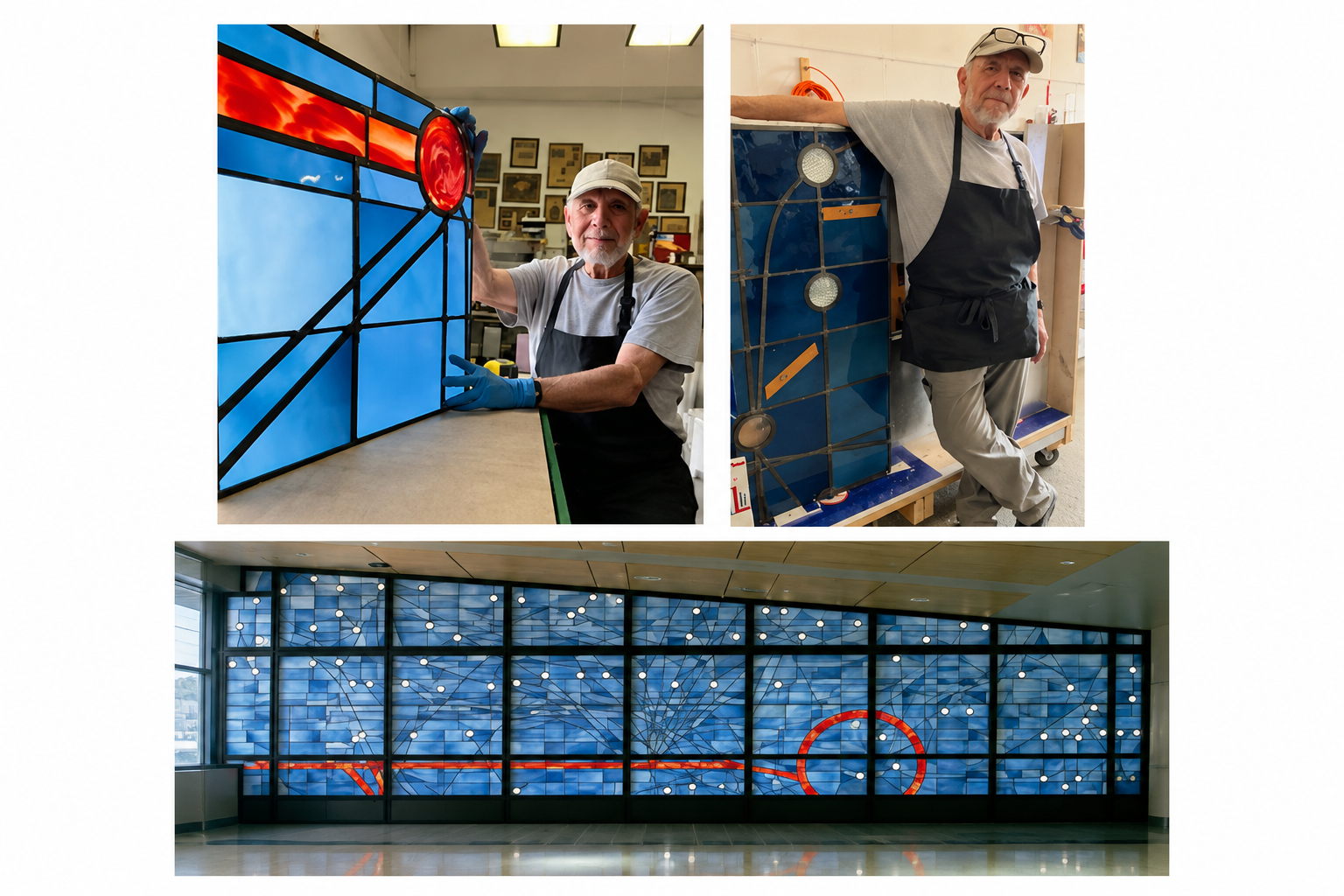
Jenkyn Powell and the stained glass project he is retrofitting for the Salt Lake City International Airport.
**
I’m actually eager to show this installation to Jenkyn Powell, the last surviving member of Powell Brothers and Sons Stained Glass, a major Utah stained glass studio for more than sixty years and a participant in the giant studios back east that supplied stained glass to architects and their patrons over at least a century. Jenkyn Powell is currently about to install a totally traditional window in a church in Logan. I don’t expect him to eagerly take to Farnes’ approach, but it’s possible that over time he will appreciate its very different virtues. A congregation of conventionally religious individuals and families will, of course, be aware of the look and feel of the craft-forward, painted imagery they expect in their churches. They will respond to the Good Shepherd image in a way they might never take to Chad Farnes’ approach. Powell connects them to the long history of Christian religious expression. But these windows, the materials of which might almost be called tortured, though it would be more accurate to call them sympathetic to the passions of their subject matter, still connect the congregation to the stories that mean so much to them.
Jenkyn Powell is nothing if not versatile, and it might be more appropriate to compare “Elevations of Light” to another of his works: the restoration nearing completion in his Fort Kearnes studio. This is “You Are Here,” a window he created for the Salt Lake City International Airport three decades ago. To tell the story of this work would take more time and space than we have here, but know that it takes a modern scientific story and presents it in glass remarkable for its congruence with the windows of both European gothic cathedrals and post-war trends. Forty-feet long and fifteen-feet high, it makes a more united statement than Farnes’s fragmented one, though it is arguably more akin to other examples of 20th-century masterpieces. But in the context of the immense Eccles wall of light, a greater departure from the classic norm needs to be made. That’s where Chad Farnes comes into his own. At a certain point, both works call for help in making their statements. But no one should dismiss either, or else be guilty of prejudice. Rather, we should consider that the thousand-year success of the component parts shared by both artistic schools remains accessible to an artist who takes them seriously. As should we.
Related posts:

Categories: In Plain Site | Visual Arts