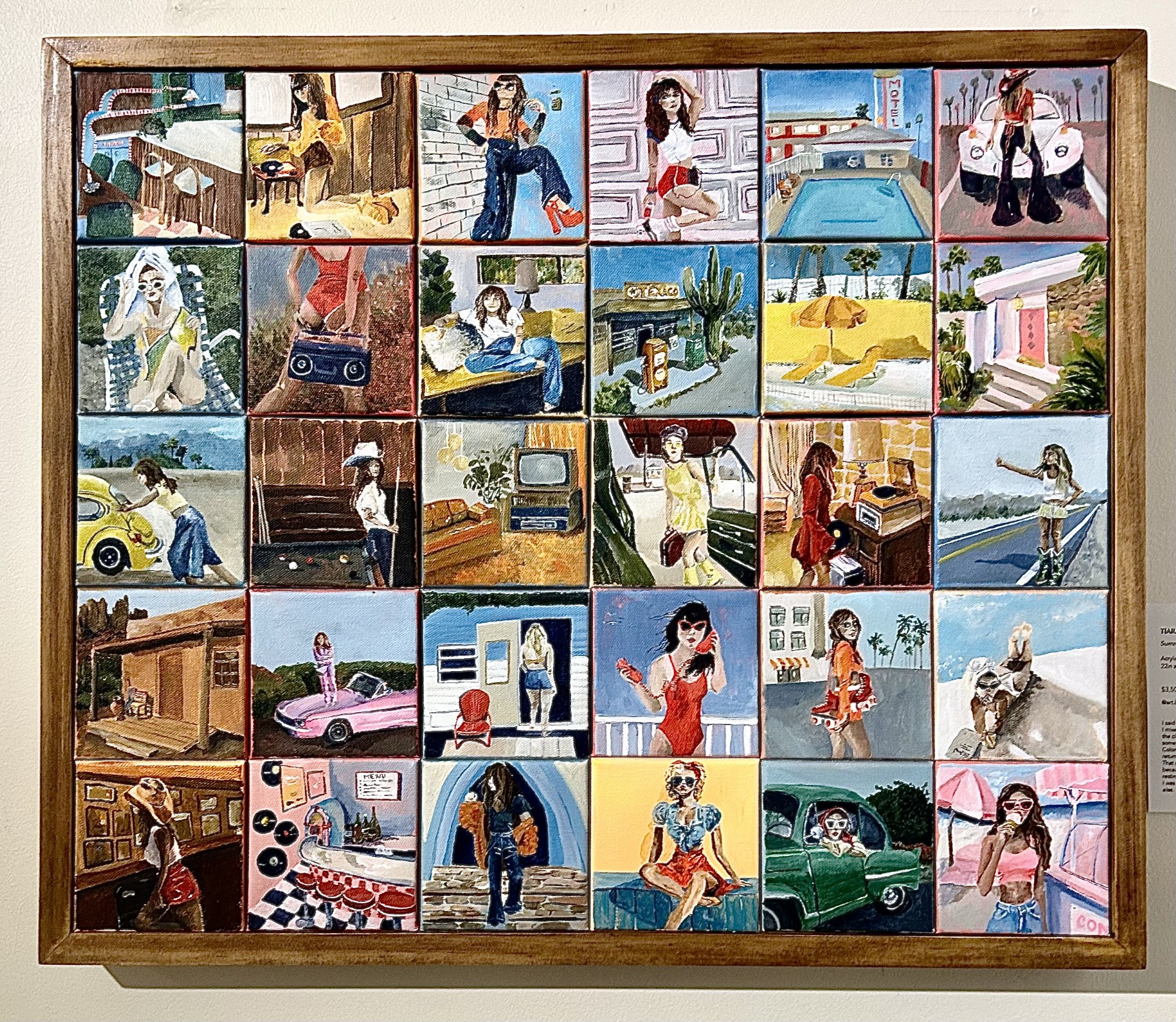
Tiara Cook, “Summer”
While the celebrated playwright George Bernard Shaw’s maxim, “He who can, does. He who cannot, teaches,” might be droll, it is not accurate. Artists Who Teach, at the Bountiful Davis Art Center through November 23, brings together ten educators whose work ranges widely in medium and subject, while suggesting the truth of art educator Elliot Eisner’s observation: “The arts teach that problems can have more than one solution and questions can have more than one answer.”
That range is evident throughout the exhibition. Joyce Banda works primarily in oil and charcoal, in a style she describes as existing “between vibrant contemporary expression and academic realism.” Teaching has deepened her understanding of why art matters. Tiara Cook uses acrylics to explore the emotional and physical landscapes of grief. “Following the unexpected loss of my brother,” she says, “my artistic practice became a way to navigate memory, healing, and transformation.”
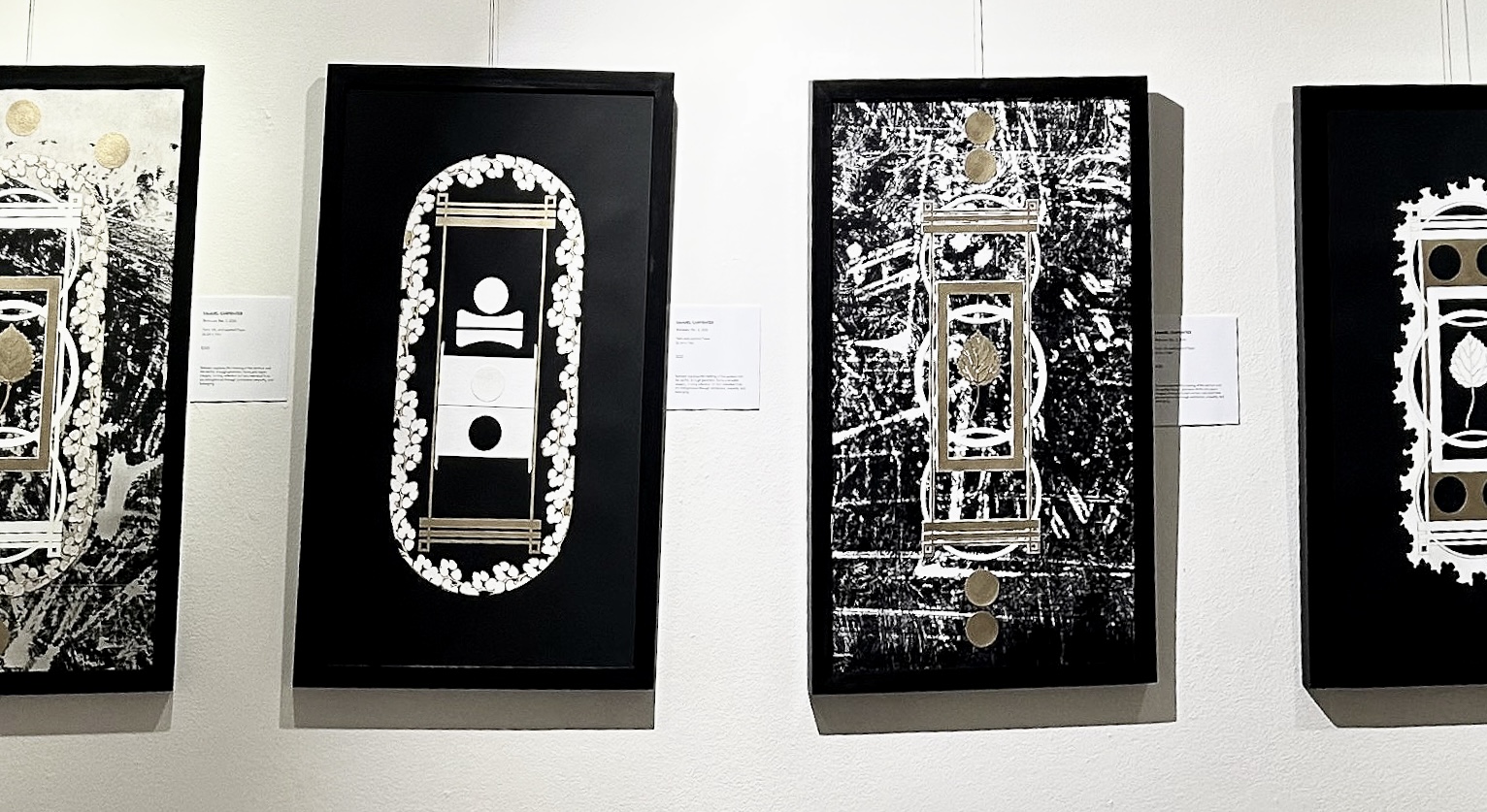
Works by Samuel Carpenter
Breadth of subject is matched by breadth of practice. Megan Wilson combines close observational drawing with hand-painted, textural surfaces and occasional printmaking techniques in mixed-media works concerned with memory, decay and renewal. Jillian Elder-Pope moves among ceramics, sculpture, painting and photo-based work to “explore ideas around body size; particularly how larger bodies are perceived.” The work is visually potent as well as socially relevant. Susan Flores’ ceramic art is both utilitarian and sculptural, but she is a multidisciplinary artist who also works in video, mixed media, digital imaging, printmaking and textiles, exploring motherhood, domesticity, gender roles and sociopolitical topics.
The exhibition is convincing when individual works begin to eclipse the premise that brought these artists together. With laser-like precision, Samuel Carpenter combines printmaking, sculpture and mixed media in explorations of spiritual reflection. His five works, “Between Nos. 1, 2, 3, 4, and 5” (each 26.5 by 16 inches), float on chaotic fields of abstract-expressionist flora joined by meticulously stenciled geometric fauna. Pamela Beach’s “Nancy Andruck,” a 2024 oil on panel measuring 36 by 48 inches, nearly mimics Matisse as it calls down from the exhibition wall. Bold and delicate brushwork and seemingly every conceivable color work together in a harsh yet pleasant harmony. “I use painting and drawing,” Beach says, “to explore the many facets of human experience.”
-
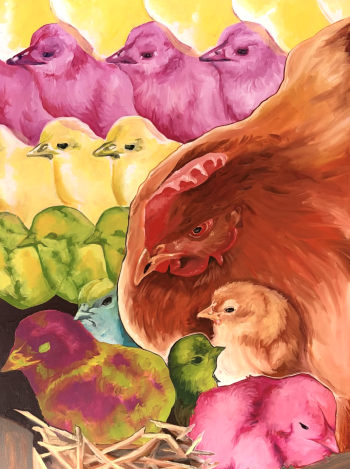
- Hannah Anderton, “”Is it the size of the nest or the span of her wing,” 24 x 36 in.
-
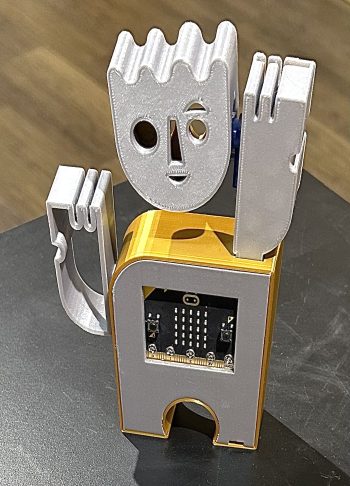
- Ben Evjen, “Ghost Boy, ” 2025, 3D print, Microsoft Micro and servo, 7 x 5 x 1 in.
But it’s important to note that the classroom finds its way into the work itself. Hannah Anderton explores themes of femininity, motherhood and the role of an educator. In her 2026 oil on canvas, “Is it the size of the nest or the span of her wing,” a mother hen is surrounded by her brightly colored brood. As we investigate the image, the hen’s predicament becomes apparent: Can she protect and nurture them all? Is her nest large enough? Is her wingspan wide enough? An accompanying statement makes the metaphor explicit: the varied brood represents the differences among Anderton’s many students.
With a focus on new technologies, Ben Evjen relies heavily on experimentation and conceptual thinking. When you first encounter “Ghost Boy,” you might feel as though you’re in the presence of a playful child born of mixed parentage: Tinker Toys and Legos. However, on closer examination, you discover that the work—which is a thing of ordered beauty—is a therapeutic tool, or toy, for children whose caretakers suffer from epilepsy. “The sculptures aid in the development of coping strategies and finding peace when these moments inevitably arise.”
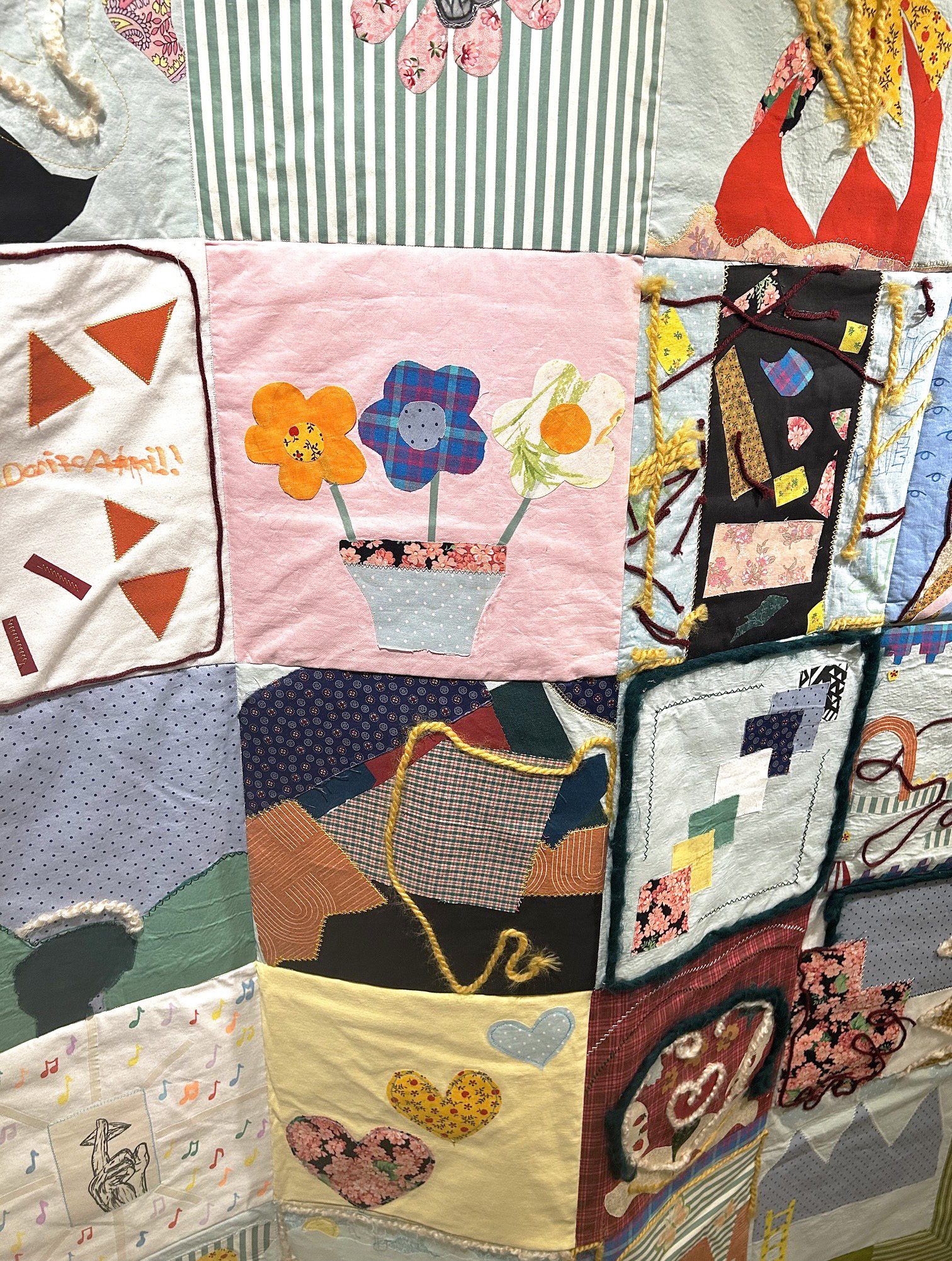
Sydney Porter Williams, “Interwoven,” 2024, fabric, heat-activated adhesive, embroidery and quilt batting, 84 x 60 in.
Sydney Porter Williams’ 2024 work “Interwoven” is an impressive résumé of her practice, demonstrating how she enlists students and community members to help create her art. Every quilt block stitched together in Interwoven is a powerhouse of design, color, texture, message and meaning. Whether viewed up close, with your nose just inches away, or from a distance, taking it all in, the work is an exercise in visual virtuosity.
Artists Who Teach is ultimately a successful and optimistic show that leaves visitors with a hope that at least a handful of these teachers’ students will embrace Eisner’s thinking and follow in their teacher’s footsteps, becoming successful artists themselves while teaching art education with conviction.
It would be great for the future of students.
Artists Who Teach: Art Educators’ Group Exhibition, Bountiul Davis Art Center, Bountiul, through Nov. 23.

Dave Gagon has been writing for more than 30 years, including 19 years as the visual arts writer and editor at the Deseret News in Salt Lake City. During his tenure, he reviewed the work of more than 100 artists from across Utah and received multiple writing awards from the Associated Press and the Society of Professional Journalists. Gagon is the author of Honorable Release (Signature Books 1992), a young adult novel, children’s stories and picture books, and songs that he has written and recorded. He also pursues photography through his ongoing A.I.P.S. (Abstraction In Plain Sight) project.
Categories: Exhibition Reviews | Visual Arts