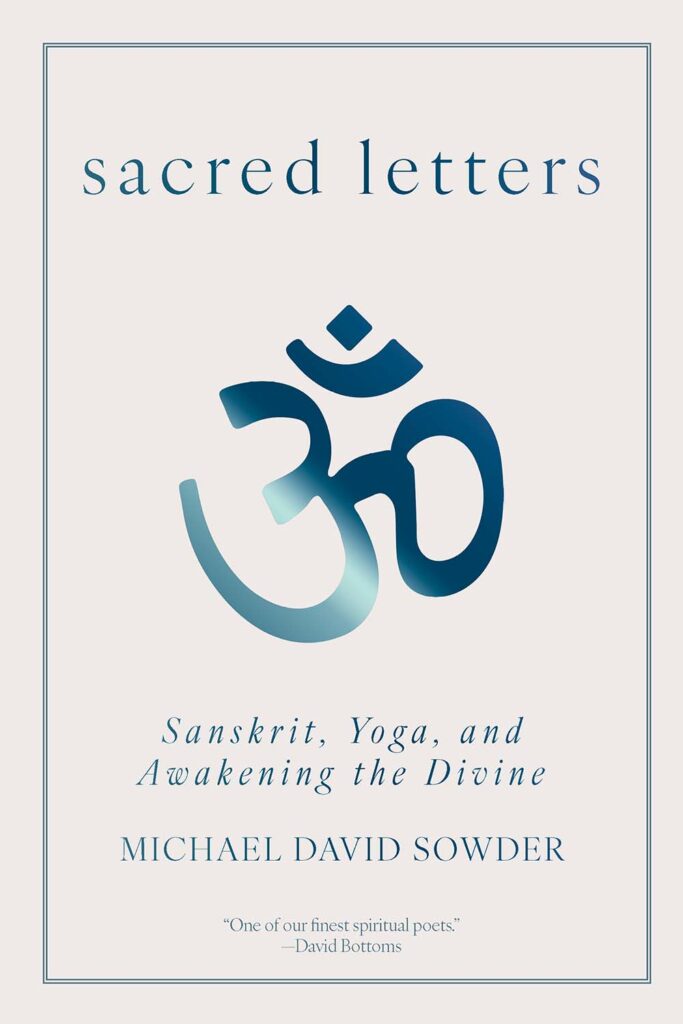
 A good book can be hard to enter. It is often written at a frequency the mind rejects. That resistance is also where the chance of being changed lives. There is a rarer kind of book that asks you to retune first, so you can digest what is on the page. Sacred Letters is that book. It is slow and rhythmic. It wants to be chewed. Read fast and you get an alphabet. Read as Sowder asks you to read, and you get a meal. I resisted it, stayed with it, and was rewarded.
This is a book of poetry that is not a poetry book. A record of a private heart that is not a memoir. A teaching that is not a textbook. Sowder calls the Sanskrit name for divine play līlā: something done for its own sake, its own joy. “All art affirms this,” he writes, “or should.” The book was made in that spirit. I am being taught, but not lectured. I am reading a life, but not a genealogy.
The structure is simple and strange. Each piece takes a letter of the Sanskrit alphabet—devanāgarī, the script whose name means “city of God”—and opens it. Pronunciation, root, mantra, story, memory. Personal narrative sits next to metaphysical speculation, linguistic play next to a walk in Logan Canyon. Sowder anchors the whole in the devotional Tantric, Śaiva-Śākta tradition, with its attention to the Divine Feminine, then lets Western mystics wander in: Thomas Merton, Teresa of Ávila, John of the Cross, and Meister Eckhart walk beside Yogananda, Ramakrishna, the Upanishads and the Bhagavad Gita. Mary, Sophia, Kuan Yin, Tārā, Durgā, Pārvatī, Lakṣmī, Sarasvatī move through the same rooms as Emerson and Thoreau.
Sanskrit, he reminds us, is famously polysemous. Roots throw off many senses; the same surface shifts with context. He quotes the scholar’s joke and does not flinch from it: every word means itself, its opposite, a name of God, and a position in sexual intercourse. Hallelujah, he writes. A lingam equals infinity. The alphabet is not a dead code. It is a cipher still in use.
The man who wrote it has been practicing and teaching yoga and meditation for nearly fifty years. Born in Cincinnati in 1956 and raised from the age of nine in Birmingham, he took a law degree, clerked for a federal judge, and practiced in Atlanta before poetry won him back. An MFA under David Bottoms at Georgia State became The Empty Boat, which Diane Wakoski chose for the T. S. Eliot Award. A Michigan dissertation on Walt Whitman became Whitman’s Ecstatic Union (Routledge, 2005). Bottoms has called him “one of our finest spiritual poets.”
He is emeritus professor of English at Utah State University, and affiliated faculty in Yoga Studies and Religious Studies, living at the foot of the Bear River Mountains. In 2014 he was a Fulbright Scholar in India. In Logan he founded the Amrita Yoga Meditation Foundation. Before that, in 1978, he started what he describes as the first meditation program in the Alabama prison system, and later brought writing and meditation into the Pocatello Women’s Correctional Facility and the Cache County Jail. Sacred Letters is the late fruit of a decision, about a decade ago, to stop chanting Sanskrit and start learning it—a poem, or a meditation, for each letter, built by reading the dictionary until something caught.
What caught, for me, was the poetry of it. “Dancing leaves that splinter the sunlight.” “The ocean adorned with waves.” “Clouds that catch their hem on a peak.” He writes of a waterfall: “The water tumbled white, danced free over the lip of the cliff, into vast nothingness.” On a climb he calls the Theater of Shadows he writes, “Technically, I’m safe,” and then, if he thinks about it too long, fear rushes the body and he counts—one, two, three—steadying the breath. That one I recognized.
Place is as present as the saints and mystics. A mother’s kitchen table in June, lemon meringue pies in the oven. A sunny October before the Tetons. Feet wet and sticky with blood on a walk through Kalighat and a tin-roof stone shelter in the Appalachians. Limestone, aspens, and firs in Logan Canyon, gleaming in moonlight. Sowder writes that we do not listen to Tchaikovsky’s Fifth in order to do something else. The same is true here. The book is read for the pleasure of being carried.
The theology is not shy. God, guru, self. Surrender to the divine. Issa: “This dewdrop world is but a dewdrop world — and yet.” Of Ramakrishna: “intoxicated by bliss, thought mad by some, an Incarnation of God by others.” A monk tells him: “We cannot live without harming. This is the great tragedy of life. So we dedicate ourselves to serving.”
Sowder never became a monk. “I found another way. A different kind of sacrifice. Partner, children, work, friends — avatars, your incarnations all.” That sentence is the book’s grounding argument. Contemplative life is not reserved for the renunciate. It can be made at a kitchen table, on a canyon trail, in a prison classroom, over a plate where “sweet pickles swam like dolphins.”
Plato arranged beautiful things as rungs on a ladder toward the Good. Sowder arranges letters. You climb by sounding them. If you want a manual, look elsewhere. If you want a book made for its own joy—līlā made manifest—stay. Chew slowly. The nourishment is in the pace.
Sacred Letters: Sanskrit, Yoga, and Awakening the Divine
Michael David Sowder
Monkfish Book Publishing
2025
112 pages.
Samantha da Silva is a Salt Lake City–based abstract artist and the author of Fearless Artistry.

Samantha da Silva is a Salt Lake City–based abstract artist and the author of Fearless Artistry.
Categories: Book Reviews | Literary Arts