
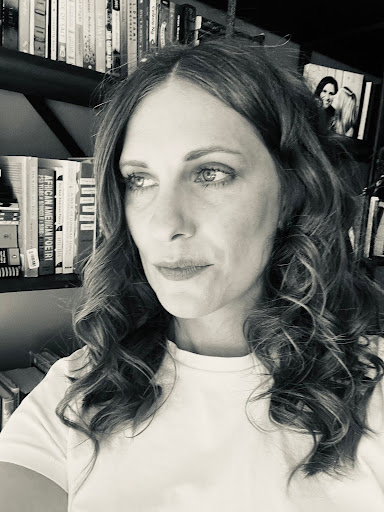
 For poet and book artist Jess Challis, the boundary between writing and visual art has never been a firm line. Her work moves fluidly across mediums—poetry, image, book objects, multimedia—guided less by genre categories than by instinct, material, and the body’s experience of making.
“I’ve never felt the two were entirely separate,” Challis says of writing and visual art. “I come from a family of artists and makers, where the lines between trade and creative identity (carpenter/sculptor, draftsman/artist, doctor/poet, mother/musician/actor) were often blurred. That afforded me a malleable definition of art and what it means to be an artist.”
Challis began identifying as a writer at eight years old, but even then her stories arrived with visual companions: illustrations in the margins, stylized lettering for emphasis. Still, she remembers feeling more confident with words than with visual art, and she leaned into writing through her teens and early adulthood.
“The first time I consciously created hybrid work was my senior year of undergrad, after I’d been teaching visual art classes to children and teens for several years. I was beginning to define myself as an artist, and I realized that dexterity with visual media was one of my strengths. I won an award for a videopoem I created, and the arbitrary lines between literary and visual art shattered as I realized the endless possibilities multimedia offered.”
At first, Challis believed her writing and visual practice would exist separately—two lanes running side by side. But two years ago, after contracting COVID, those lanes collapsed into each other. Previously healthy, she suddenly found herself living with long-term effects: cognitive delay, brain fog, mental fatigue, and more. Her symptoms were peaking just as she learned she’d been accepted into the University of Utah’s Creative Writing MFA program. This forced a decision—step forward, or step away. She chose to attend, though with a fear that she wouldn’t be able to do what her “old body” could do.
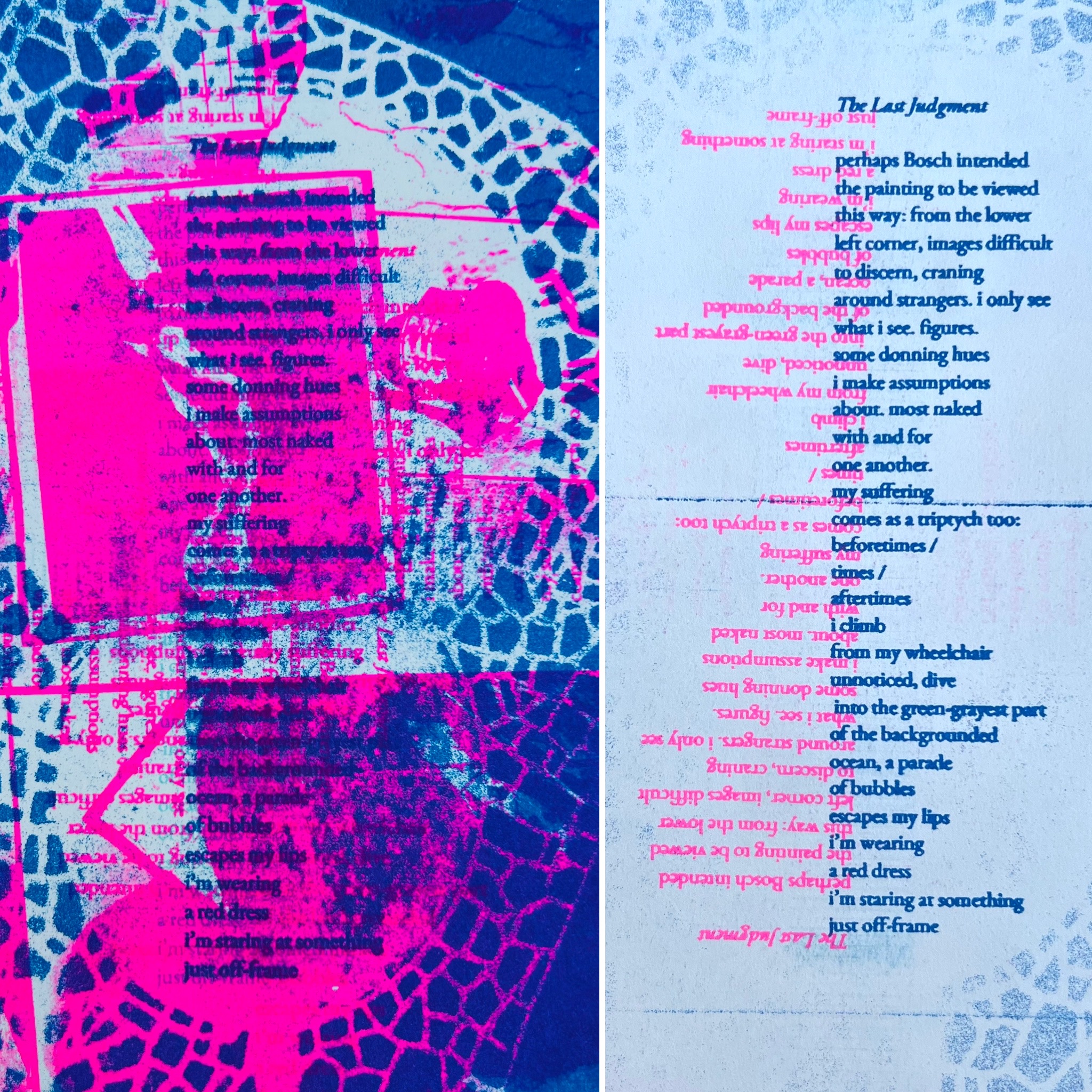
Jess Challis, “The Last Judgment,” risograph print
“That was a period of intense creative output,” she says. “While I was mostly bedridden, I wrote constantly—hundreds of pages in a few months. The writing was not refined, but rather a sort of narration, a place to settle and process the chaos within. And when I wasn’t writing, I was gathering material: painting, taking photographs on my phone around the house and on the way to appointments, and making paper from old cloth in my kitchen sink. As I leaned into those other skills, especially creating in ways that demanded less linguistic strain and allowed the slow movements of the body to do the work, I realized that when words escaped me, there were still ways to make meaning. That quickly became my superpower.”
Challis doesn’t always decide upfront whether something should remain a poem on the page or become a book object or visual-textual piece.“I think I learn mostly through doing and redoing,” she says. Her projects go through many revisions, but in book arts, prototypes are central. She keeps “dozens of failed attempts” in her office—“saved as trophies.” Seeing the work as a physical object, she explains, teaches her what it wants to become. Sometimes a poem belongs on a flat page. Other times it finds a better home in three dimensions, where structure can amplify tension or release. Often, she says, “the materiality makes the final decision.”
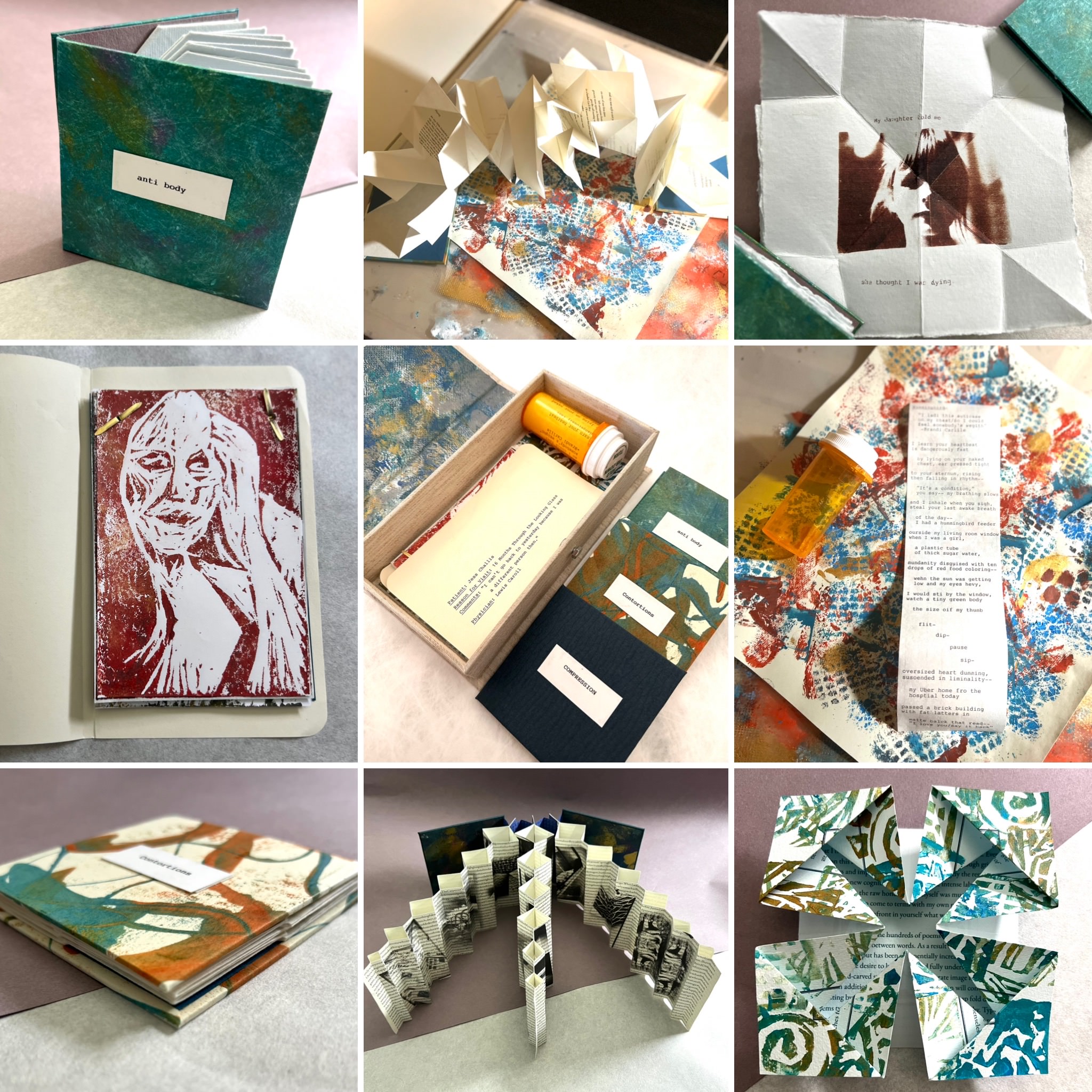
Several views of Jess Challis’ “body less”
Her best-known piece, “body less,” housed in the Marriott Library’s Rare Books Collection and currently on view in the Booking a Brouhaha exhibition, is a multi-part book work that transforms reading into a physical act. Folded map structures open “like a spine, or birds taking flight,” while other sections compress text into dense, unbroken blocks, mirroring bodily pressure and constrained mobility. Across the work, the effort required to handle, unfold, and navigate the pages becomes inseparable from the poems themselves, using material resistance and altered pacing to reflect illness as an ongoing, lived condition rather than a narrative with closure.
“I have an instinct for spatial relations,” Challis says. “I can often see and feel a material concept in my mind before I assemble it…That ability to anticipate bodily reaction—how a reader might respond to and engage with the work—has helped me tremendously, especially alongside word-finding struggles.”
Binding, assembling, and constructing forces slowness—especially when she’s making editioned work and repeating the same physical actions over and over. Her poor health prevents her from participating in some book arts techniques such as letterpress, so she has had to adjust her expectations.
In “Deeper,” a recent work, Challis works with cyanotype on bugra paper, using a modified, custom alternating and continuous “Turkish map fold” to produce a seven-piece limited edition composed of multiple two-sided books. Each piece was hand-coated in chemical solution and exposed individually, layering text with blueprint drawings printed on transparencies alongside lace, thin paper, tools, and other small objects. Structurally, the books contain hidden magnets that allow them to connect “cover to cover in a circle,” creating a form that can be manipulated, rolled, and handled—“like a fidget toy”—as the strong magnetic pull encourages tactile engagement and play as part of the reading experience.
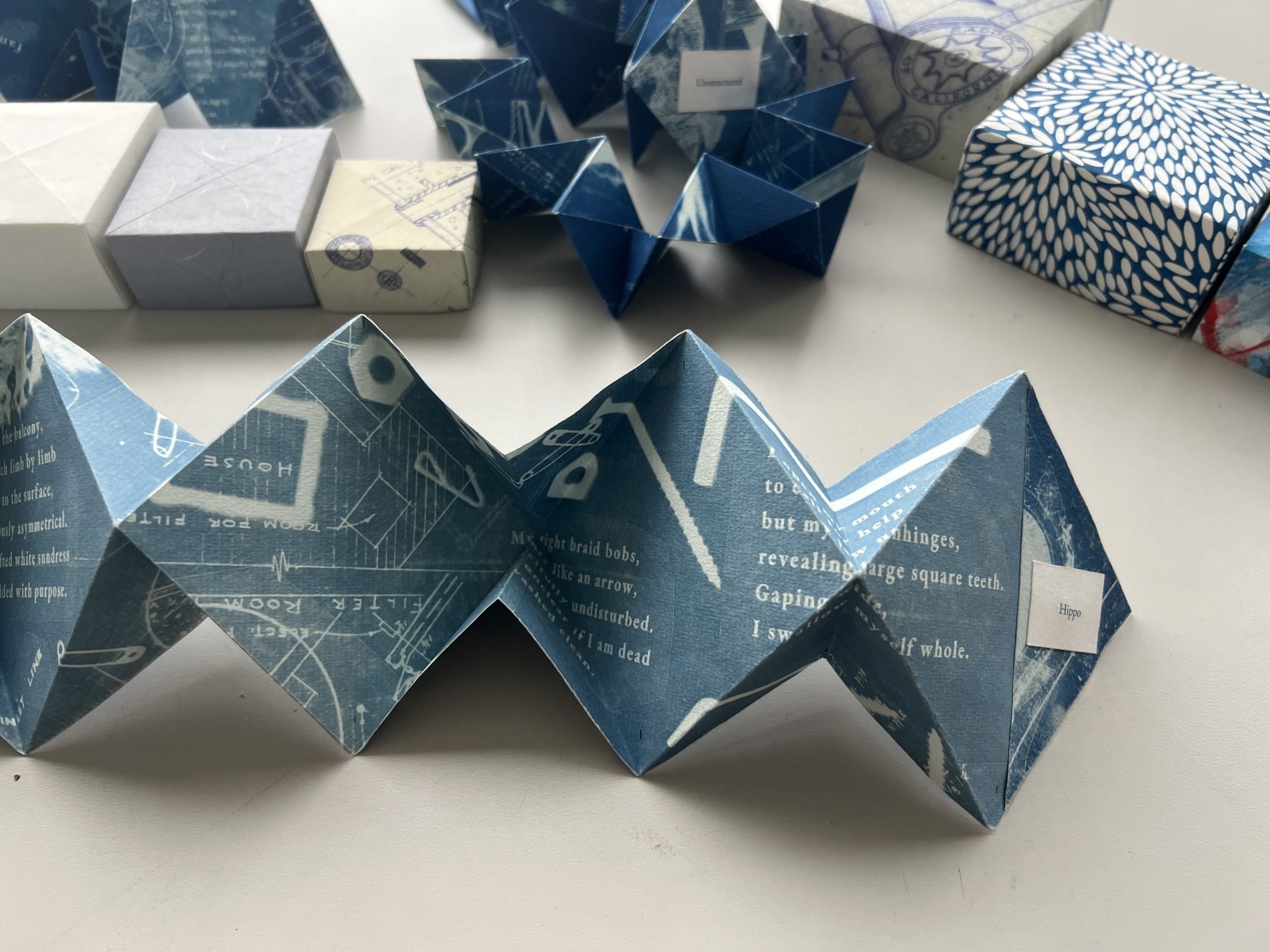
A zigzag fold from Deeper stretches the poem across space, turning reading into a physical act that unfolds over time.
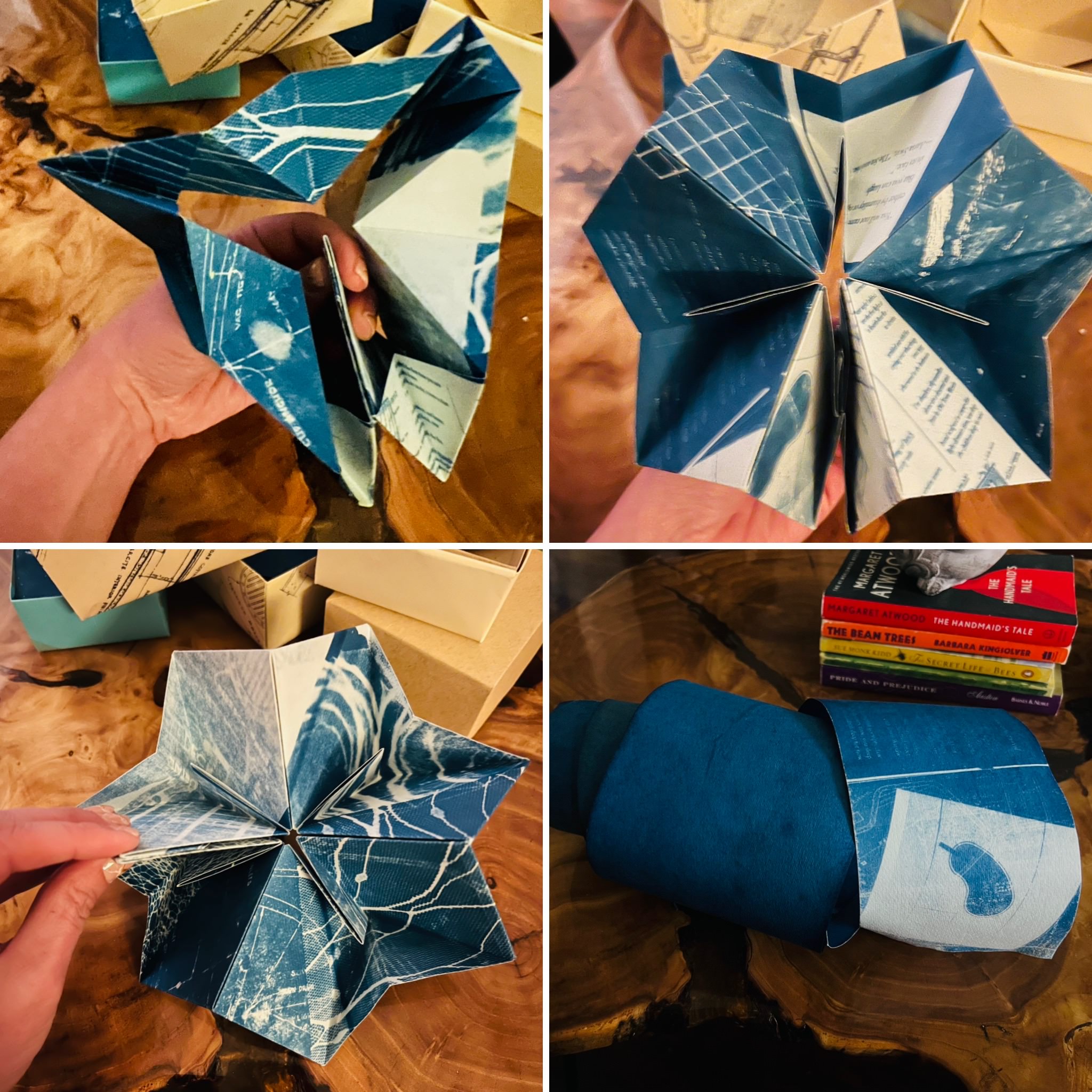
Multiple views of Deeper demonstrate how the book shifts between states—opening into a star-like form, collapsing into a compact bundle, or rolling into a cylinder held together by hidden magnets.
“In adapting to chronic pain and fatigue and the need to sit or lie down most of the time, I developed a passion for inventing and modifying folded forms,” Challis says. “I can often be found working a sheet of paper into a new shape, and I often invent new folds in my mind.”
Moving forward, she wants to push the boundaries of “bookness” even further—toward work that is sculptural, functional, and accessible. Her next project is a chair made only of book-making materials, with some text visible and some hidden. The piece, she says, will explore “the grief and gifts of limited mobility in a world that values constant movement.”
That forthcoming chair—part sculpture, part book, part tool—distills much of what has shaped Challis’s practice in recent years. Her practice continues to expand across mediums, not in spite of limitation, but in response to it—proof that when one mode of expression falters, another can open. “Creating never gets old,” she says.
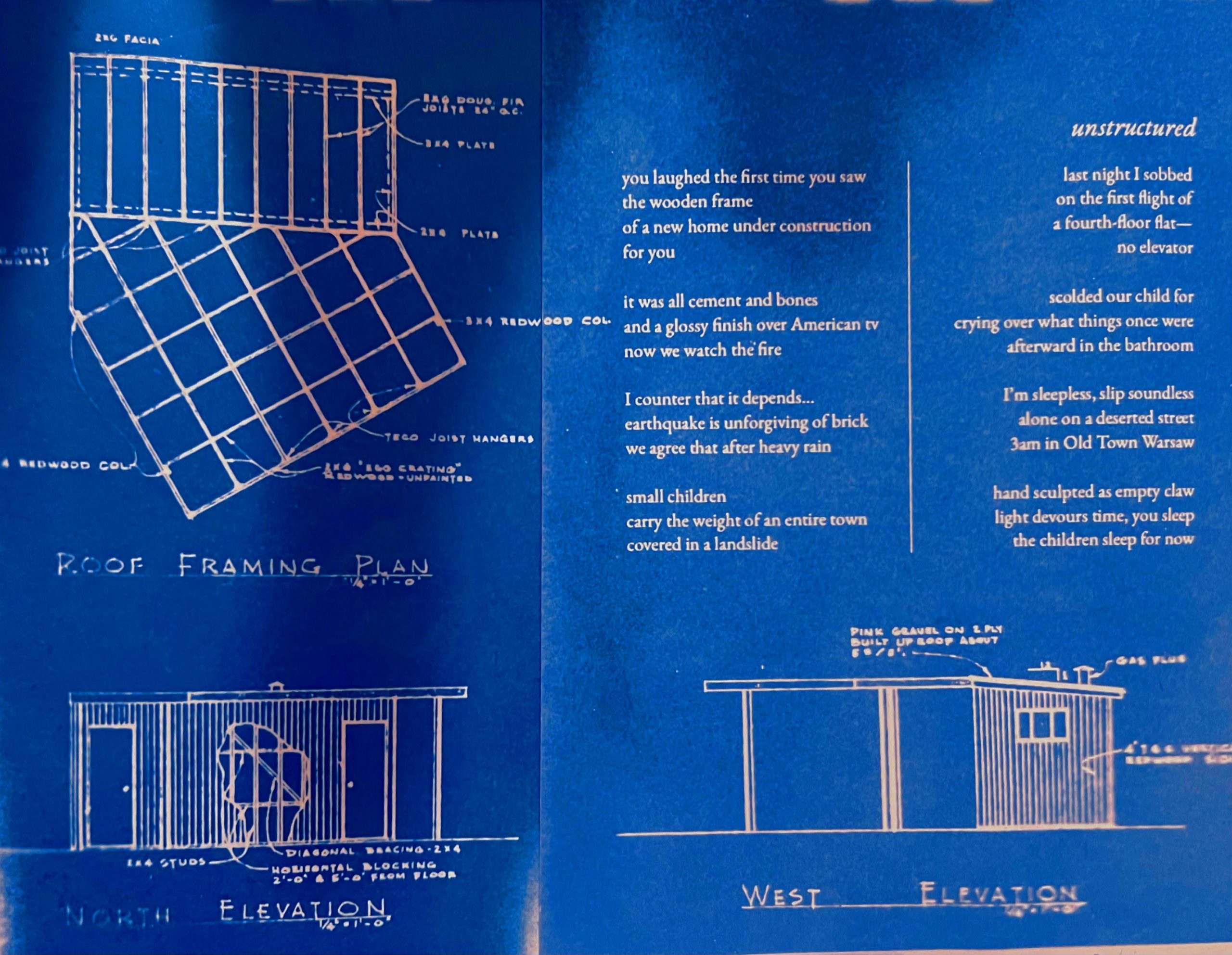
Jess Challis, “Unstructured”
Booking a Brouhaha, Special Collections Gallery, J. Willard Marriott Library, Salt Lake City, through Feb. 28.
All images courtesy of the artist.
DID YOU ENJOY THIS ARTICLE?
Help make more like it possible.
VENMO us a donation at artistsofutah

Or use PayPal to MAKE A DONATION.
15 Bytes is published by Artists of Utah, a 501 (c) 3 tax-exempt nonprofit.

The founder of Artists of Utah and editor of its online magazine, 15 Bytes, Shawn Rossiter has undergraduate degrees in English, French and Italian Literature and studied Comparative Literature in graduate school before pursuing a career in art.
Categories: Artist Profiles | Literary Arts | READ LOCAL First





I wonder where she finds the energy, the passion and the skills given her diagnosis. I had an easier version of the virus but could only sleep most of the day. Do you know how long the exhibit will be at the library? It would be worth a trip to slc by itself (now that we have our own Trader Joe here in Ogden)
Thanks Roberta! Jess here. 🙂 It is difficult for me to complete projects. I have to take breaks, even days between. I also have to modify my expections. Small works are usually the best for me, and projects that can be completed in stages. Sometimes I can only give 15 minutes to it. Luckily, this is my “job” while I’m in grad school, which gives me a good excuse to carve out the time and prioritize my creative work. The show is over, sadly, but you can make an appointment to view “body less” at the University of Utah library rare books when they have it ready to go. And that is even better than seeing it in cases because that book in particular is meant to be handled and for the reader to have time with it. And I would be happy to show you the others if you have time.