

The day young Vaughn Reid came home from a summer of falling timber and mentioned he was thinking about buying old Harry Gordon’s scrapyard, his father wasn’t having it. “You’re not gonna be a damn junk man, boy.”
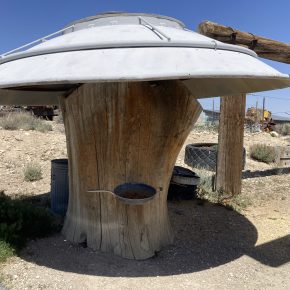
Old man Reid is buried a few miles from this dry stretch of gray earth that skirts State Route 10 in Emery County. To the west, South Horn Mountain rises above the valley, its summit around 8,500 feet. To the east, though there is little indication of it across the dry expanse of scrubland, lies the mysteries of the San Rafael Swell. In between, 20 yards off the highway, is a UFO buried in the ground.
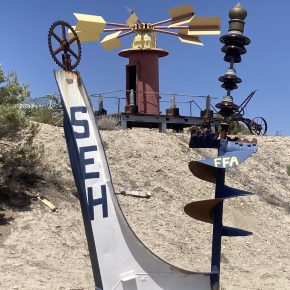
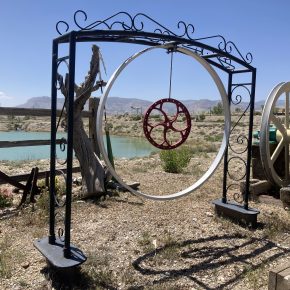
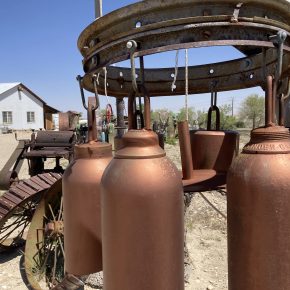
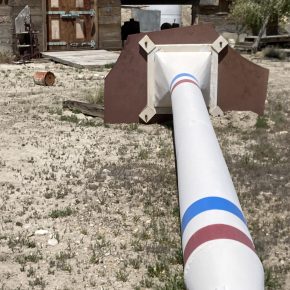
Nearby, a maroon tower rises off the hillside like a lighthouse crossed with a rocket, a spoked wheel of yellow paddles spinning at its top to catch the wind. An airplane tail fin marked SEH juts out of the sand next to an old post-hole auger painted blue and stenciled FFA, planted upright like a flower. There’s a rocket-shaped tank that lies nose-down in the dirt, striped red, white, and blue, pointed at the door of a building marked the Engine House. A row of cut-off gas cylinders hangs from a steel wheel rim like church bells, chiming when the wind gets into them, next to a rusted-out combine and a tractor wheel still wearing its metal tread.
At the end of it all is a log cabin built around the trunks of three cottonwood trees, its porch strung with steam-engine whistles. A sign hangs off an antique cabinet by the door, hand-painted in blue and red: THIS AIN’T NO MUSEUM! THIS JUNK IS FOR SALE.
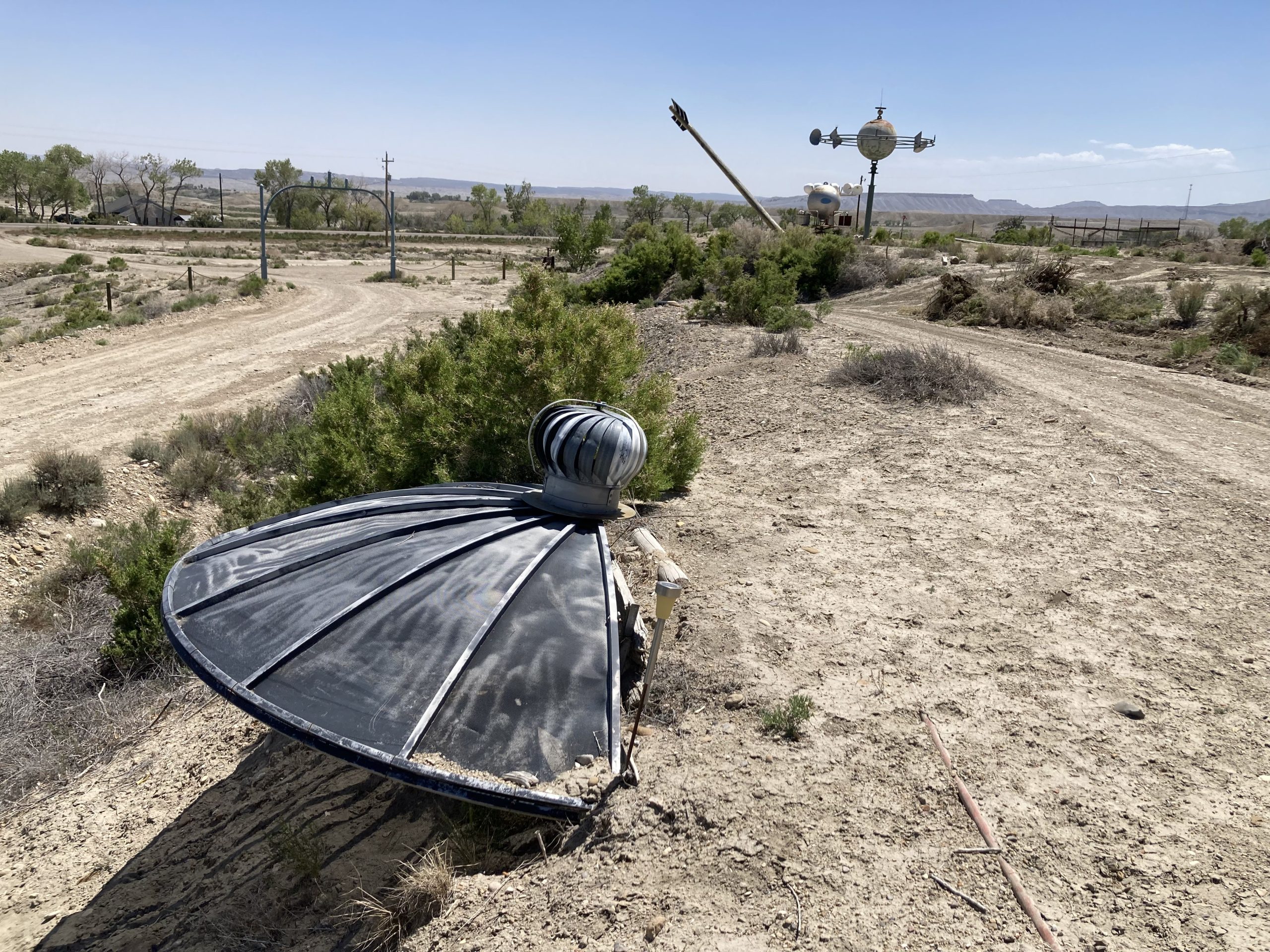

You could call it junk. Reid calls it the Museum of Creativity.
Emery County is rough country. Vaughn’s people have lived here for generations, ever since his great-great-grandfather homesteaded the area back when Brigham Young was still calling men to fill in the empty spots on the map. Reid’s family story has it that Young himself made the call to come settle Emery County, and that two weeks later Young died. His grandfather always took this as evidence: if you’re going to treat people bad enough to send them to Emery County, the Lord’s just going to have to bring you home.
It’s a place of too much wind and too little water. Reid’s grandmother would say that Emery County never knew when the Depression came, and it sure as hell never knew when it left. As far as she was concerned, it had been 1930-something ever since the first wagons stopped in a canyon full of wind and decided, well, this is as good a place as any to make camp. His grandfather used to tell another joke while tending bar in his later years. A stranger would ask how much rain the area gets. His grandfather would bring up the forty days and nights out of the Bible. Remember that, he would ask? We got an inch and a half that whole year, and it hasn’t rained since.
Reid’s childhood recollections aren’t nearly that rough. He remembers three creeks running heavy every spring when he was a boy—the Ferron, the Cottonwood, the Huntington—enough water, briefly, that nobody knew what to do with it all. By August it thinned to a trickle, and a good year meant three cuttings of hay. Things have gotten worse, though. In Emery town today, he says, there’s no secondary water left for farms or people, and the only spring anyone can still draw drinking water from sits twenty-five hundred feet underground.


Reid was born in 1938 in Orangeville, four miles from where he lives now in Clawson. He worked from the start. He graduated high school on a Friday, and by Monday morning he was up in the mountains falling timber, a job that kept him through the summer. He only came down when it was time to get ready for college. His parents had already been up to campus without him, picked out his classes and lined up a job—a man named Jensen needed someone to push a wheelbarrow and empty garbage cans. But Reid had run into Harry Gordon’s widow, who couldn’t run the scrapyard alone anymore. Young man, she told him, why don’t you buy this place? I think you could do good here. The price was nineteen thousand five hundred dollars, business and house together. Reid told her he’d ask his father when he got home.
“You’re not gonna be a damn junk man, boy,” his father told him with disdain in his voice. “I’m sending you to college to be something other than a junk man.”
That fall Reid started at Carbon College in Price. By the time he finished, the mining jobs in Emery had dried up, so in 1960 Reid bought a piece of ground west of Provo, in farm country near Utah Lake. He spent his working life as a master machinist and blacksmith, fabricating steel for the mills—McNally, Mountain States and finally Geneva. It was steady work, and it kept him around steel and scrap and the kind of material most men were happy to see hauled away. “When you work for yourself,” he says, “you have to gather up a bunch of junk and then try to work with it.”

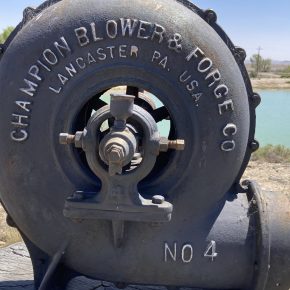

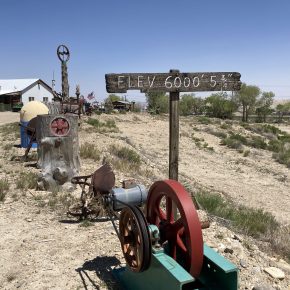
Despite his father’s injunction, Reid did plenty of gathering. He built wash plants for gold-mining operations, work that put him behind the wheel of a truck all over the western states, and he’d bring something back almost every time. He joined an antique machinery club that met in West Jordan, where members brought out the machines they’d collected and restored. One year Reid brought a machine that did nothing at all.
It had a water tank, a wheel rigged with old buckets, a pump jack running off a hit-and-miss engine—all of it moving, hauling water up and over, accomplishing exactly nothing. He called it the Do Nothing Machine, and he built a bench in front of it so people could sit and watch. One woman did, for more than an hour, before she finally gave up and asked him straight out what the thing was for.
“Nothing,” he told her. “This is a Number 12 Do Nothing Machine.”
She wanted to know who in the world would build a machine that does nothing.
“Well,” Reid said. “Me and the federal government.”

The story of why he left Orem depends on whom you ask.
Vaughn tells it as a numbers problem: two neighboring farmers, one who died and one who got sick and sold out, and inside of a year there were scores of new houses standing where there’d been open ground. “I had seventy-eight new neighbors,” he says. “It was time for me to get the hell out of here.” He’s a man who says he’d rather take the death penalty than go live in New York, and the subdivision going in next door was, as far as he was concerned, close enough.
Elna, his wife of a decade, also a native of Emery County, tells it as a story about a fence. The city surveyed the property and decided he’d built twenty-five feet over onto the road—never mind where the line was supposed to have been. They city just decided to move it. While he was out of town He came home to find his fence relocated and a good part of what he’d spent years hauling back from job sites and antique shows disturbed along with it.
So he packed up and came home. To an empty piece of land off Route 10.
Reid cleared brush and put a cabin up around the trunks of three cottonwood trees, building it in pieces as he had time and material. It was around then that he met Rich Fairbanks, a longtime auto mechanics teacher at Emery High. Reid had been doing the blacksmithing demonstration for the county pageant for years, but after a knee replacement he knew he was in trouble, and he’d heard Fairbanks had blacksmiths somewhere back in his own family. He asked for help with the pageant. Then with the cabin, and finally the landing site.
It started, like the Do Nothing Machine before it, as an experiment with wind and buckets—dozens of them, bent into cups and mounted on three spacecraft frames, spinning whenever the wind came through, which in Emery County is close to always. Fairbanks rigged solar lights to each one so they’d keep turning after dark. They ran a telephone pole out at an angle and dressed it up to look like an arrow shot down out of the sky by Orion. Then Reid found a low spot on the property that had never held water, made a deal with the local irrigation company to run some of their canal supply into it, and set two rowboats floating where there shouldn’t have been a pond at all.
Somewhere along the way, gathering useful things became making things that didn’t need to be useful. Buckets became windmills. Gas cylinders became bells.
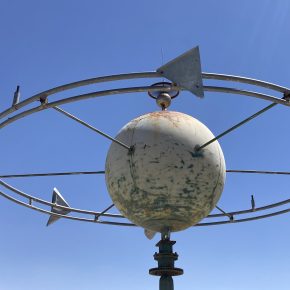
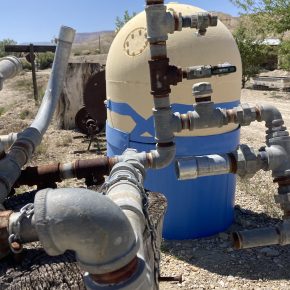
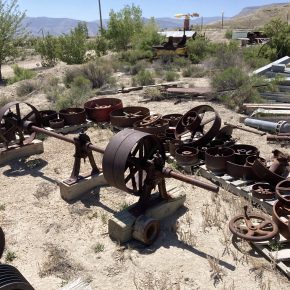

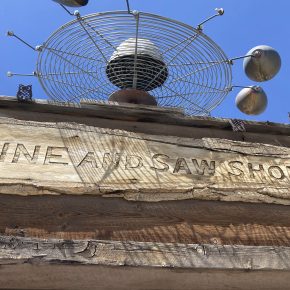
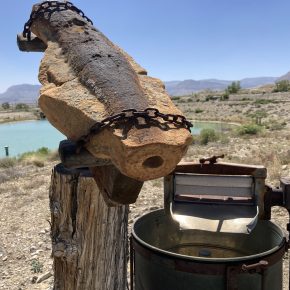
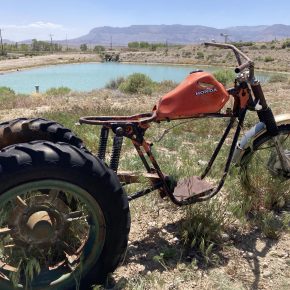
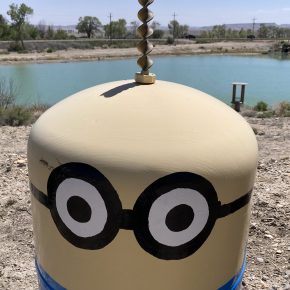
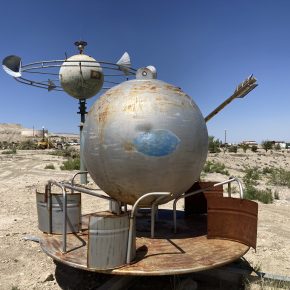
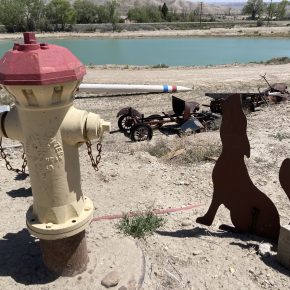
The Museum of Creativity has become a local landmark. You’ll find it on Google Maps. For years, Reid’s been at it—adding this, clearing that. He is still out there most days, in one shop or another, putting something together. A litter of steel parts along the west side of the property suggests he’ll be at it a while longer: pipe, saw blades, buckets, valve fittings, the bent tail section of a wing, all waiting their turn to become something else.
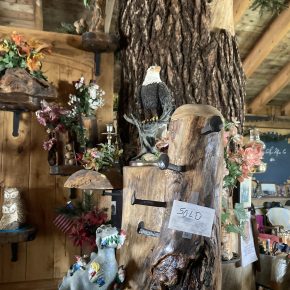
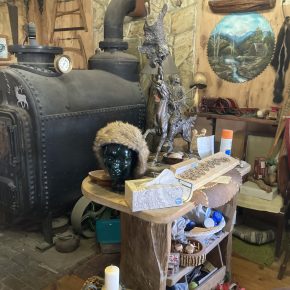
Inside the cabin it’s just as full. A taxidermied black bear stands on its hind legs in the front room, teeth bared, paws raised over a boiler pulled from a job decades gone, silk flowers and candles arranged at its feet, a hand-lettered “LOST DOG” flyer taped to the wall beside it. Timber tools cover one whole wall—crosscut saws, hand saws, axes hung in rows beneath the roof beams, framed black-and-white photographs of the family’s old sawmill operation tucked in between them. In the center is a saw blade the size of a truck tire, painted over like a chalkboard and signed in cursive with the mill’s name. It was Reid’s grandfather’s. He found it at a junk sale.
Vaughn and Elna live in rooms attached to the original cabin, as if the residence were an afterthought.
There’s no posted schedule. No entrance fee. If the gate is open, the museum is. Drive in, wander around. Someone will eventually come out to meet you—Vaughn, or Elna, or the dog that belongs, technically, to a family a mile up the road but decided some years ago that this was where it preferred to spend its days.
Elna is the one who walks most visitors through, pointing out what things used to be before they were this—the Nevada pipe, the rivets, the water line that came before the modern kind. Cars stop most days. She counted two the afternoon before we talked, one of them carrying a family from Germany, a little girl in the back seat still working out her English. She stood in the yard taking in the spinning buckets and the arrow shot down from Orion same as everyone else does, like she’d been let out of somewhere and told to run.
“It’s Wonderland,” Elna says.

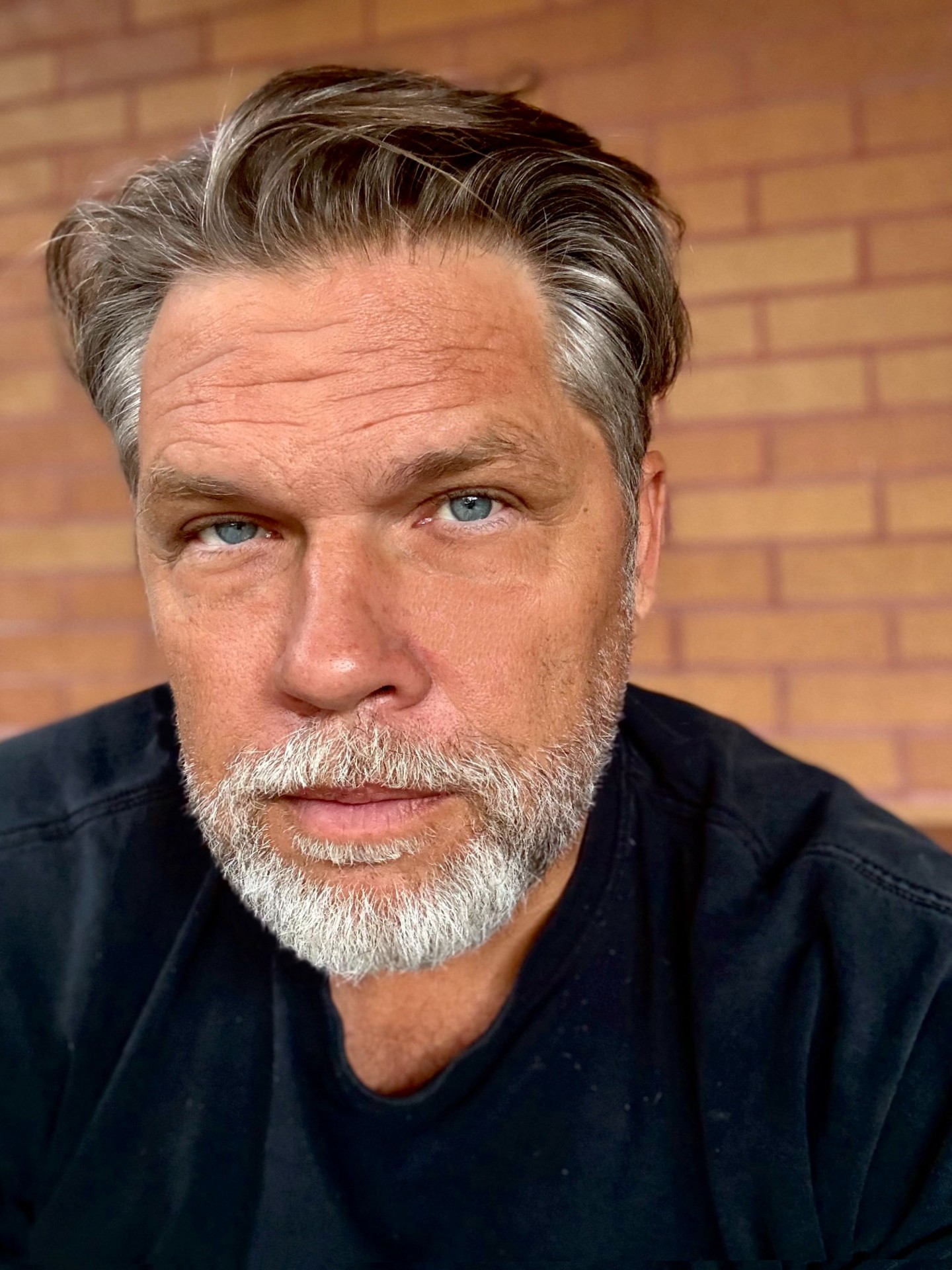
The founder of Artists of Utah and editor of its online magazine, 15 Bytes, Shawn Rossiter has undergraduate degrees in English, French and Italian Literature and studied Comparative Literature in graduate school before pursuing a career in art.
Categories: Artist Profiles | Visual Arts







So well written, and it captures rural Utah beautifully. Makes me think a bit of Wendell Berry’s Jayber Crow, which I am currently reading.
Shawn, thanks for this wonderful description of a singular man. I’ve seen some of these sculptures from the road and they always make me smile. Next time I’ll stop. Other passionate artists come to mind — Ralph Plescia’s Christian School sculptures, and Thomas Child’s Gilgal.
Best aricle ever, you have surpassed yourself. I must say that in Wyo we pride ourselves on never throwing anything away. The kids can haul off that old truck if they ever stop by but in the meantime it will work as a chicken coop until the skunk finds out. . .same w/ that old water tank. . .now I’m getting new ideas. Check is in the mail.