

Still from Jon Forsyth’s “Mazeopoly.”
Another year, another Springville Salon, another chance to reflect on the art scene in Utah. As the recently closed Salon 100 show at Springville demonstrated, the Salon has a storied past. Perhaps most importantly, its more than 100-year history illustrates Utah’s ongoing commitment to the arts, even during times of economic hardship. The Great Depression arrived within the Salon’s first decade, and the museum’s gorgeous current building was dedicated in 1937 during a particularly difficult year. The works in the Salon 100 retrospective and its playful catalog, still available to view online, give a sense of the Salon’s consistencies and variations, but are less helpful in indicating the trends of any given year. This review attempts to distill a few of the trends for 2026.
Spiritually-minded Abstraction
If the Springville Salon has a central message, it is that the Utah art scene is overwhelmingly dominated by figurative painting. Except for a few compelling textile pieces and an occasional sculpture or photograph, most of the work on display is painting, and most of the paintings are representational. Despite their scarcity, the few abstract works on offer add depth and variety to the display. Geoff Wichert’s review of the Salon does a fabulous job highlighting some of the works that bridge abstraction and spirituality, but I feel compelled to mention a few more.
Probably the most well-known artist producing work of this type in Utah is Paige Crossland Anderson, who is represented at the Salon by two expertly balanced, symmetrical compositions. While stunning, the works feel a bit too tightly controlled and didactic. More interesting are printmaker Robert Buchert’s “25 Instructions” and fiber artist Linda Bergstrom’s “Field and Fiber.” Both works are enriched by their creators’ willingness to experiment across materials and disciplines. They are things that defy categorization and feel unique among the myriad objects on display. In Buchert’s case, the final project is a portfolio recording his collaborations with a musician, made using an annotation that is not fully explained. The work can feel amorphous, but its serial structure suggests a mystery waiting to be unraveled. Bergstrom’s wall piece is neither painting nor sculpture, but feels almost like a living thing. Combining organic and manmade materials, the work is among the most effective evocations of more-than-human relationships in the Salon.
-
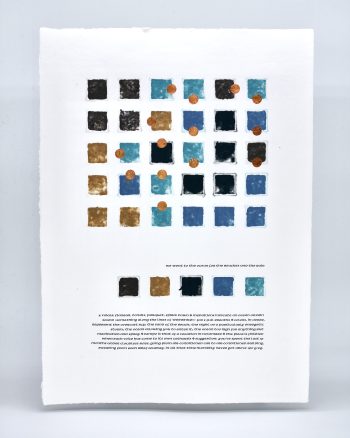
- Robert Buchert, “25 Instructions”
-
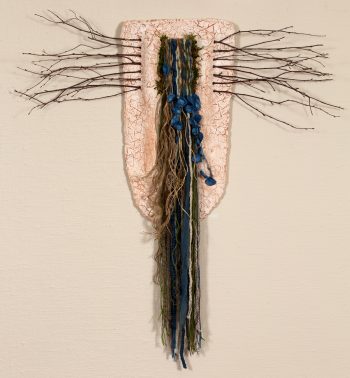
- Linda Bergstrom, “Field and Fiber”
While not strictly an abstraction, one piece not to be missed is Jon Forsyth’s “Mazeopoly.” This video work shows a human figure crawling through a maze-like digital landscape, passing by, around, and through various logos and brand images. It is Pac-Man-esque, and while the cultural critique can be a tad blunt, the game is nonetheless fun. The artist invites viewers to consider which icons and symbols they can identify, an activity that is interactive and entertaining for all but the youngest children. It is also the only time-based new media work in the exhibition, demonstrating Utah artists’ reluctance to experiment with the form, which has been around for more than 60 years.
Metaphorical Still Lifes
This year’s Museum Purchase Award goes to Ben Steele’s “Formed in Utah,” a painting of children’s art supply boxes decorated with Utah landmarks including Delicate Arch, the Manti Temple (as captured in the famous photograph by Ansel Adams), and the Golden Spike. It lightheartedly pokes at Utah history and culture while immaculately rendering the sheen of the waxy crayons, the grainy colored pencil scribbles, and the broken-down edges of the cardboard boxes. The painting’s combination of technical perfection and cheek make it a natural, if predictable, choice for the purchase award.

Vincent Cobb, “3 and 2 Contrasted”
Similarly polished, but less flashy, are Vincent Cobb’s two entries, including “3 and 2 Contrasted,” which won an Award of Excellence. Both of his compositions feature meticulously-rendered cardboard boxes—some in maze-like compositions reminiscent of Mazeopoly—that suggest our ever-increasing dependence on online ordering and delivery services. Cardboard boxes are not a new subject for Cobb; similar works have appeared in the Springville Salon since at least 2012, but the subject has only become more prescient with the passage of time.
Quieter exampes of the still life include Fred Graham’s “Dinner for One,” which makes a poignant statement about the oft-publicized loneliness epidemic and is also a stunning rendering of a mundane interior. Cali Ward’s “Delicate and Dried” looks like it was recovered from the 19th-century Pre-Raphaelite movement, which valued vibrant colors, meticulous detail, and a sincere study of nature above all else. Melinda Woolf Harris’s “Lettuce with Half Orange Rising” is both homey and uncanny. There are plenty of other works in this vein, but I will let you discover them on your own.

Crystal Gonzalez Callison, “Building a Village From the Ground Up”
Vibrant Underpainting
Perhaps my favorite trend to track at the current Salon was painters’ use of vibrant underpainting to amplify the tone of their works and draw visual interest. Often unnoticed, underpainting plays an important role in shaping the mood of a painting. The Utah art scene bends toward academicism, as evidenced by Salon 100 and this Salon’s overrepresentation of traditional painting, but it can be insightful to notice how artists innovate within the parameters of primarily representational painting. Academic painting has traditionally used neutral tones like burnt umber, raw sienna, and grays to create depth, model forms, and determine the warmth of an image. Contemporary Utah painters are still using underpainting for these purposes, but choosing colors that radically depart from the traditional hues and, as a result, broaden the range of emotional responses.
One good example of this is Crystal Gonzalez Callison’s “Building a Village From the Ground Up,” which is painted over a fiery orange underpainting. The color bleeds into the foreground in the colors of sun-baked corn stalks and a garland of ruffled cempasúchil (Aztec marigold) on a memorial. Gonzalez Callison’s title references her desire to build community, while her imagery references ancient practices of corn cultivation and ancestor remembrance. The rich warmth of her underpainting binds her visual symbols to their deeper meaning.
Tonal contrasts between the overlayers and underpainting were sometimes so sharp that they drew the eye from across the gallery. Two examples of works that produce this atmospheric glow are Annie Wang’s “Ruby” and Diane Conner’s “Dawn Stone.” In both works, the artists chose a nearly fluorescent pink as their base layer. Wang’s portrait of Ruby is composed in cool China Blue that feels culturally significant to her subject and gives the work a sense of decorative flatness. The hints of bubble-gum pink popping out from the veins in leaves and radiating from patches of Ruby’s skin suggest that the painting is alive and vibrating behind its porcelain veneer. Likewise, Conner’s landscape balances the grays and greens of a rocky mountain scene with a coral underpainting that alternately suggests the rich light of golden hour and the intense heat of a wildfire.
-
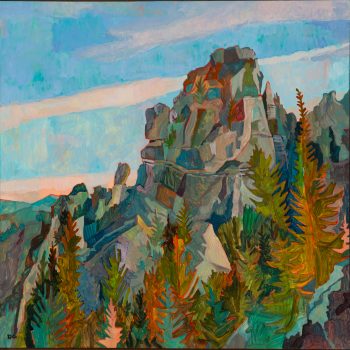
- Diane Conner, “Dawn Stone”
-
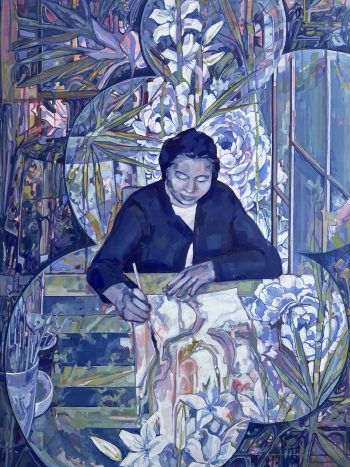
- Annie Wang, “Ruby”
These are just a few of the many possible ways to organize the offerings of the 102nd Salon, but I hope that the selections invite visitors to reflect both on what they see and what they don’t. As Salon 100 demonstrated, the Utah art scene has come a long way in the last century, but the advent of the Salon’s second centennial reminds us not to rest on our laurels—there are still broad avenues to explore.
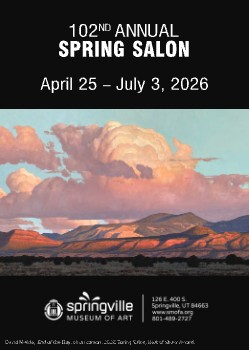
102nd Annual Spring Salon, Springville Museum of Art, Springville, through July 3

Danielle Stewart is Curator and Head of Academic Initiatives at the Nora Eccles Harrison Museum of Art on USU’s Logan campus. She received her PhD and MPhil degrees from the Graduate Center, CUNY, specializing in Latin American art and the History of Photography. Before coming to USU in 2023, she completed a fellowship with the Princeton Mellon Initiative in Architecture, Urbanism, and the Humanities and held an Assistant Professorship in Modern and Contemporary Art of the Americas at the University of Warwick in Coventry, UK.
Categories: Exhibition Reviews | Visual Arts




Not everything has to be multidisciplinary. The Springville Museum and, by extension, the Utah art scene does not need to make a wholesale swing away from traditionalism toward “new media” in order to be considered valid. Different institutions exist precisely so that different voices and priorities can flourish. Private galleries, nonprofits, and alternative spaces all contribute to that diversity. No institution or artistic space can reasonably be expected to satisfy every ideology or constituency attempting to set the terms of the conversation.
The director of the Museum, Emily Larsen, has done an admirable job of balancing newer media with respect for what remains the dominant artistic tradition of the region. Whether one values it or not, traditional academic painting is undeniably part of Utah’s cultural landscape, and its continued prominence should not be viewed as a failure to keep pace with contemporary concerns.
As for the discussion of underpainting, I was surprised to see no mention of Olivia Christensen’s work. She exhibited two of the most conspicuously underpainted paintings in the exhibition, one of which received Best in Show. Given the prominence of both the technique and the award, that omission struck me as noteworthy.
The coverage by Artists of Utah / 15 Bytes, like the works on view in various galleries, is fundamentally determined by the writers (and artists) who choose to submit, abetted by juries, and only then by the publishers or directors. If “Greg” wants something different, he might consider creating and submitting it, as was done by everyone you see or read here and there. One of the great things about art is that there is almost always something new to say, even about a familiar artist or work: witness Shawn Rossiter’s articles about Bruegel and the artists, now gone from among us, who painted during the settlement of Utah Territory. That said, many of us prefer to explore new approaches, which, like this commenter’s observations, is a personal preference we are all entitled to.