
Although I said nothing aloud at the time, I was disappointed in the recent Spirituality and Religion exhibition at the Springville Museum of Art. It seemed as though the show’s title had been reversed. While there were countless narrow images of specifically Christian traditions, and even more of the same to be found in unusually wordy and predictable artist statements, there were virtually none of the images drawn from the wider, refreshing and encompassing spiritual subjects that are usually the great strength of this annual outing. While it’s impossible to know how much the judges influence this sort of thing—after all they have to create their vision from what the artists submit—there seemed to be an overall retreat under way, perhaps in fear of reaction from the national mood for reversing decades of social and civil progress and taking the country back to what is both celebrated and demanded by our ill-chosen leadership.
So when I had a chance to take an advance look at the Spring Salon, I approached the request cautiously. But I needn’t have worried. Not only is this year’s Salon one of the best in memory, but specific examples of restlessness demonstrated by strong artistic impulses abound. As I walked through the rooms seeking that special experience, one after another strong excursion forced me to stop and appreciate the originality that is an essential part of our familiar excellence.

Linnie Brown, “As of Now”, acrylic on panel, 2025, 36×36 in.
Consider, for example, Linnie Brown’s subtle, yet radical departure from her abstracts built from cubist quotations of domestic architecture. By fragmenting what she sees and turning the parts variously transparent, so that she can layer them into virtual landscapes, she has led the way towards the next step in cubism that some of our leading 20th-century critics named as the necessary next step to resuming the progress of Modernism. Her new direction steps back from the depiction of suburban vistas and concentrates on the sheer pleasure of color and form that underlay her semi-representational works, liberating her strength as a pure painter who is also arguably our best surviving academic artist.
Two more seismic shifts demonstrate that while there are new materials, there are also still unexplored uses of traditional media. Margaret Abramshe has been receiving some overdue attention since her appearance in last year’s Salon, and in that context “Oh Patience” seems more than a bit autobiographical. Here we are told nothing about what the subject awaits: a train, a plane, an absent-minded husband? Her posture demonstrates the title virtue of a nation of women who waited endlessly for the human rights they began to successfully demand only a few years ago, and are now seeing stripped away again by a last gasp of reactionary greed. Azalea Rees, meanwhile, in her “Self-Portrait 2026,” uses stitches almost like engravers’ marks, only the way she layers them up argues for brush strokes, in contrast to the manufactured weave of her supporting canvas. The sheer intelligence and discernment she visually claims for herself is brought to life along with a streak of skepticism recalling a favorite form of creative spelling: one that replaces the P in skeptic with a question mark.
-

- Azalea Ree, “Self portrait,” 2026, fiber
-

- Margaret Abramshe, “Oh Patience,” fibe
-

- Trent Alvey, “Deep Time Oscillations,” monotype
These forays into the use of stitches as lines find a sympathy and support from a more traditional direction, expertly executed. Trent Alvey, whose revolutionary neon line can be seen in the permanent collection, upstairs, demonstrates some less planned, abstract, but equally effective variations on the real-world life of linearity in “Deep Time Oscillations.” No rules were broken in this example of keeping it eternally fresh.
One departure that could have done a lot to bolster Spirituality awhile ago is Ron Richmond’s “Requiem for a Badger.” This supreme realist usually combines visual specificity with interpretational ambiguity, so that his incandescent visions draw us out of ourselves and into an infinitely deep well of speculation and possibility. Here, however, he plunges just as sharply into the specifics of material being, in a reversal I can’t imagine ever asking for, but am ever so grateful to witness.
-
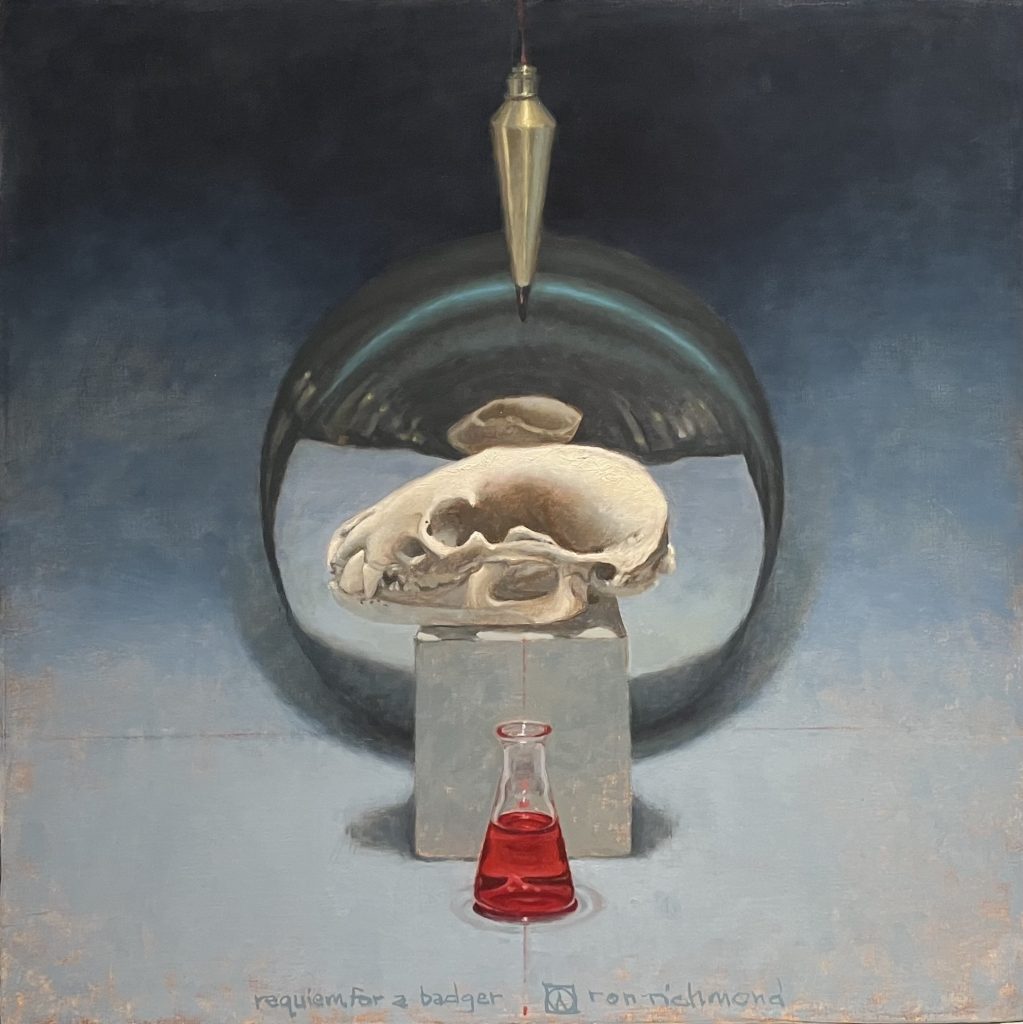
- Ron Richmond, “requiem for a badger,” oil on board
-

- Olivia Christensen, “Tired Feet,” oil on canvas
A surprisingly powerful vision of the past, Eric Overton’s “Service and Sacrifice” feels like a love song to a thousand years of technology. As we ponder how much more our darlings, computers, from which we expected so much, can damage our cultural and social networks, Overton recalls in searingly precise detail the climax of adaptation to equine anatomy that was achieved among our ancestors over centuries. The almost instantaneous disappearance of working horses before the curse of the internal combustion engine is routinely commented on today, but their genetically perfected beauty was once fully matched by the instruments of their lifelong forced labor. The turned head of the near animal reveals its unique identity in a way that could break a viewer’s heart. More than a sculpture, Overton has fashioned an inquiry into a gigantic, yet shameful accomplishment of human nature.
Our artists seem to be telling us that if we wish to save ourselves, we must begin with honest self-examination. John Sproul’s ongoing philosophical examination of our lives through the microcosm of the subway may have climaxed with “Napoleon Dans le Metro,” which appears to draw on French filmmaker Louis Malle’s 1960 surreal comedy, translated as Zazie in the Metro (or Paris subway), for the not-entirely facetious implication that everything important to know about us today can be observed while riding our underground systems of mass transportation. Olivia Christensen lends similar weight to another mundane vision of humanity at its lowest and highest, revealed by the consequences of our bipedal nature in “Tired Feet.”
-
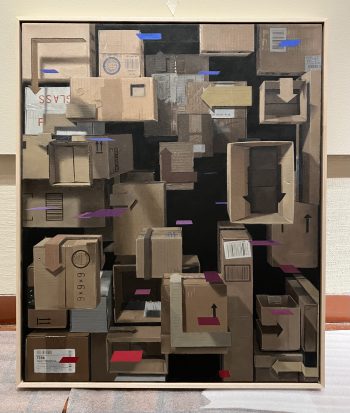
- Vincent Cobb, “Single Point Toured,” oil on canvas
-

- John Sproul, “Napoleon dans le Metro,” acrylic on canvas
Finally, there is one work that plays on our contemporary symbol of outstanding human cultural and economic achievement—the cardboard shipping box—to let Vincent Cobb, in “Single Point Toured,” make a statement about the brilliance of human achievement and our further potential. The incredible ability of our senses to inform, but also to fool us—trompe l’oeil—is the key to art and so many other things, while the similarity between an assembly of boxes and an aerial view of any of our modern cities speaks to the complexity of our accomplishments: what we actually do with the capacities we possess. There is much here at the Springville Museum of Art to worry the conscientious mind, but a cause for joy at how our many artists, far more deserving than I can gather here, rise to the challenges we together represent.

Eric Overton, “Service and Sacrifice”
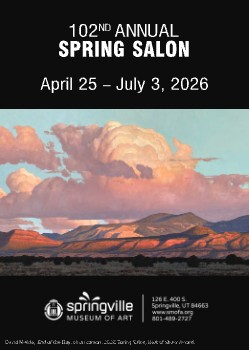
102nd Annual Spring Salon opens at the Springville Museum of Art Friday, April 25 and continues through July 3.

Geoff Wichert objects to the term critic. He would rather be thought of as a advocate on behalf of those he writes about.
Categories: Exhibition Reviews | Visual Arts



Geoff, thanks for all your kind words about the Spring Salon! It was great to have you down for a sneak preview. It’s amazing to see the work of our Utah artists.
Did you come down for the 2025-2026 Spiritual & Religious Art of Utah Exhibition or are you referring to the last one you reviewed in 2024? Though my opinion is probably as biased as they come when it comes to Springville — I thought our most recent Spiritual show had some really powerful complex and spiritual work outside of a Christian or LDS perspective. I’m surprised you found it so one note. The performance piece by Beth Krensky that the jurors gave an award to, and the Antra Sinha piece we purchased for our Collection are two that immediately come to mind as spiritually stirring. I also loved the large installation piece by Sara Serratos and a meditative piece by Pamela Beverly Quigley.
Maybe we’ll have to tap you as a juror for a future spiritual show … would be fun to see what you pick!
Couldn’t agree more, Emily. I found this year’s show expansive and reflective, within and without Judeo-Christian frameworks. But individual experience and perspective is nontransferable, and one’s mileage may vary as they say.
In the months following the show opening, some especially striking pieces/artists/statements have really stuck with me:
– Tyler Gathro’s use of braille in “Grace into my Skin”
– Elizabeth Wheatley’s Palestinian deconstructed embroidery piece “Hope Interrupted”
– the collaborative “A Thousand Knots” by Pamela Quigley.
There are many more pieces that were beautifully crafted, these particular pieces resonated especially with me in this season.
Thanks for all the work you do to make such stellar gatherings of contemplative art happen ❤️
Thank you for highlighting my entry. I work from photographs taken around the year I was born, and the women in them lived in a world of enforced patience. Making feminist work from their images feels both personal and urgent — especially now.
Thanks Geoff, for your continued support of the art community through your words and thank your generous mention of my work in the article.