
Cristall Harper’s work at David Ericson Fine Art in Salt Lake City.
Once upon a time, art was all about content. Hard as it may be to believe, for the longest time technique didn’t really enter into it. The dubious may want to check out an early exception: public sculpture in ancient Rome, where eventually two forms existed side-by-side. One, used for official monuments, was based on Greek art, and may have been executed by guest Greek artists. This is the work most of us are familiar with from triumphal arches, marble copies of lost Greek bronze originals, and figures of emperors and such. It looked as much as possible like the way the subject matter would have looked to the educated eye of the beholder. The other version, seen on popular rather than official monuments, was more relaxed, with expressive figures anyone could recognize in isolated vignettes, each with its own characteristic gravity and point of view, sharing the same blocks of stone. Examples of that approach are paradoxically better known today mostly to specialists in the era’s art.
Something like that contrast in styles was what gallery director David Ericson had in mind when he matched Abigale Palmer and Cristall Harper in Love and Renewal. His intention was to compare Abigale Palmer’s expressive way of depicting the way a scene feels, so to speak, with Harper’s way of depicting what it looks like, even as both possess the abstract color and design qualities that Ericson regards as the glory of today’s art. Susan Krueger-Barber has done an excellent job of conveying the feeling of Palmer’s art here, which climaxes in her assessment that in Palmer’s art, “paint is paint.”

Cristall Harper, “Incoming”
Meanwhile, Harper’s optical vision may require a different form of description. Take, for example, any of her revelatory studies of dogs. “Incoming” vividly captures the arched back and spread legs of one of them as she flies over while diving into a body of water, presumably in pursuit of whatever was tossed ahead for her to chase. The entire and complete focus of the huntress is captured, as is the splash raised by the object of her desire, almost as if they were caught in a camera’s flash. The rings of water displaced by her energy, meanwhile, are represented more as pure light, neatly arranged to lead our eyes to the inevitable, if forever to be anticipated, conclusion of the scene.
The universally popular retriever in “As Sweet As Cotton Candy,” on the other hand, could almost have been painted by Abigail Palmer, so expressively does she present the shapes of its face, especially the tongue, and the flow of its shaggy fur. One checks out the spiral that shapes the nose, and notices that ancient artist’s trick: one focus of attention, the eyes, are actually implied rather than seen, while the animal’s primary sense organ and weapon, the parts that otherwise might frighten anyone confronted by them, here become the source of joy and locus of good fellowship.
-

- Cristall Harper, “As Sweet as Cotton Candy”
-
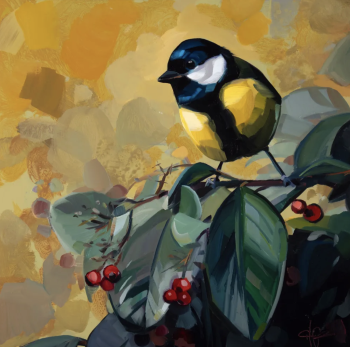
- Cristall Harper, “She’ll Keep You Safe”
Many similar comments could be made about Harper’s exquisite birds and light-struck florals. The point, however, is to realize that where her technique serves them well and is suitable to the mood of each, her subject is whatever she chooses … or she might say, that chooses her … as much as what she feels about it. Sometime in the 1900s, some artists who shared her perspective felt compelled to apologize for being out of date. Fortunately, we live today in an art era that recognizes the freedom of artists to treat these not as two opposing choices, but as a range of equally good possibilities along which each work can find its place.
Love & Renewal: Cristall Harper and Abigale Palmer, David Ericson Fine Art, Salt Lake City, through Mar. 13

Geoff Wichert objects to the term critic. He would rather be thought of as a advocate on behalf of those he writes about.
Categories: Exhibition Reviews | Visual Arts