
Roland Thompson in his studio.
Roland Thompson breathes color into minimalism with exceptionally crafted painted aluminum works. The paintings are non-pictorial — no image, no story attached. Their straightforward outer shapes hold a spot on the wall that begs close examination. Their bold colors and patterns are at once reminiscent of something you can’t quite identify while also being fully abstract in their forms.
On a recent studio visit to his home in Lindon, Thompson shared his goal for these works. “I think of myself as a painter, but I also find having more body and volume to the pieces, making them more sculptural, is very helpful. I want to create a tension, a contradiction, an illusion of depth, and an assertion of the literalness of an object.”
Thompson’s approach took shape at Virginia Commonwealth University in Richmond, where he studied from 1999 to 2002. “It was hard there, but it was a really good match for my work,” he says. “I was interested in using systems and algorithms to make art. I wanted to really understand conceptual abstraction.” He credits VCU professor Richard Roth for the art theory and historical grounding that still inform his thinking, but it was a visiting artist, New York-based painter James Siena, who gave him his medium. “I was painting on foamcor and trying to get pictorial fragments gathered into a sculpture. But I didn’t know how to do it. Siena introduced me to aluminum. His works were rectangles, but I realized I could cut the aluminum into any shape.” Thompson still calls the encounter “serendipitous.”
Other VCU influences worked more indirectly. Painter Shirley Canada’s precision struck him at the time as something out of reach — “way beyond my understanding back then,” he says now, “but I see her as a strong conceptual abstract painter.” Her craftsmanship became something of a fixation. “For a while I obsessed over craftsmanship. Now I try not to obsess, I let anomalies be a part of the work. I guess this is what I got from New York artists like Siena — don’t overwork things.”
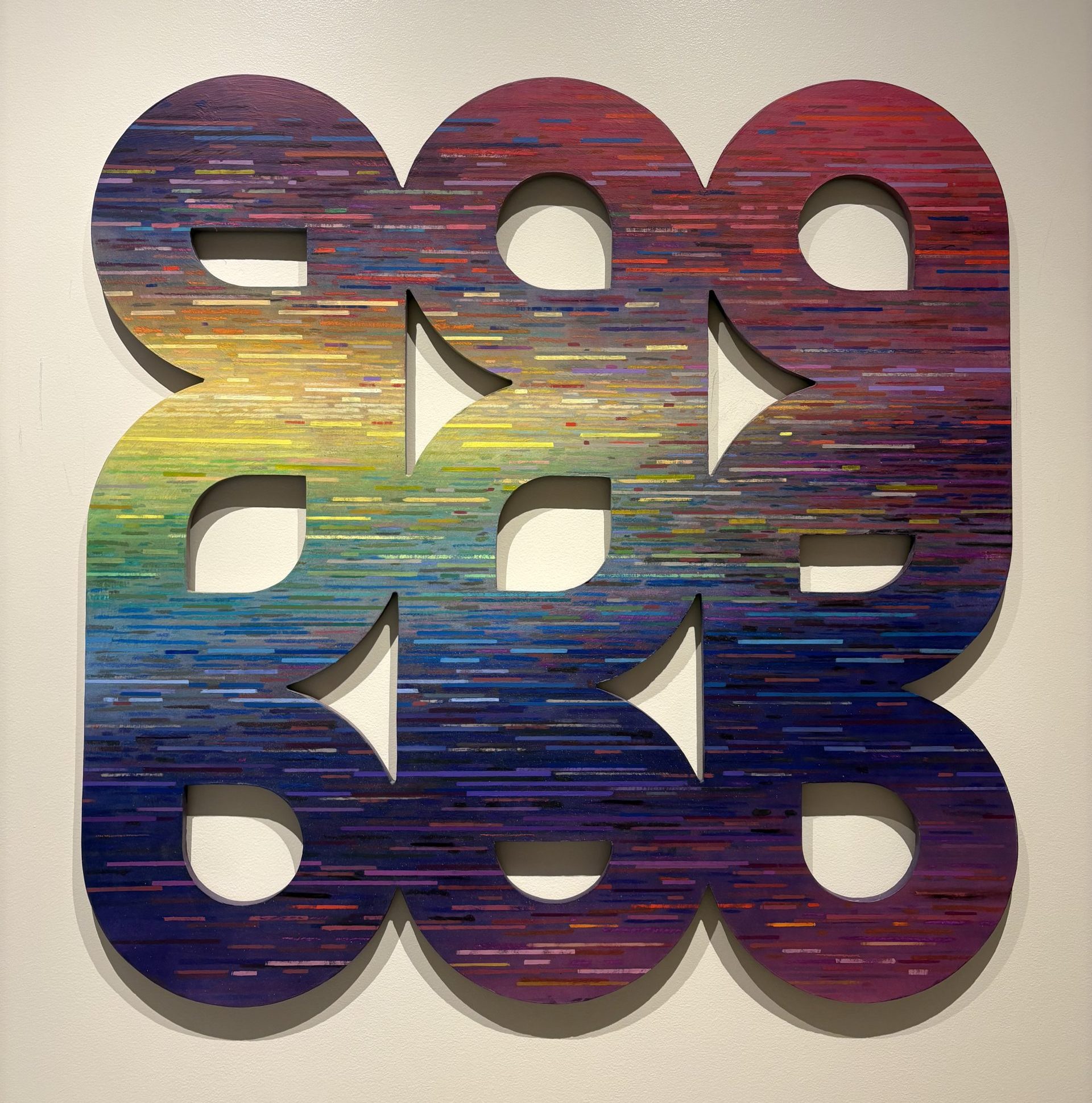
Roland Thompson, “Record Tape Disk (Post Punk Mix)”
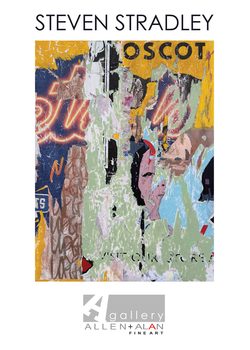
That thought was floating in my head as I walked around A Gallery (Allen + Alan Fine Art) in Salt Lake City, where Thompson’s art is on display through August. More than a dozen pieces hang in the center section of the back gallery. Each piece reflects the artist’s intention to allow for imperfections and elements that belie the sharp precision of the foundation material of metal. “I’m fascinated by machine-made things, but what I think we need now is handmade work. I’m reacting to a screen-based culture. I mean, I’ve probably spent 65,000 hours watching TV. People are constantly on screens. But we need to take a break, slow down, be aware of our bodies, our spaces, and look at things carefully. A handmade texture and edge will help with that.”
The edge Thompson is referring to is part of his latest foundational medium – honeycomb aluminum. After working on solid aluminum panels for years, he switched to the lighter material for practical and artistic reasons. Mostly used in the aerospace, architecture, and transportation industries, it is considered a high-performance material that is very durable and rigid while also being extremely lightweight. “As I’ve gotten older, I really needed something lighter to work with and this material is still very stable and rigid. I do use a lot of auto body techniques to prepare the aluminum.” He uses primer as the base coat, but also had to find a way to cover the open edges that have open pockets (thus the term “honeycomb”). After cutting with a water jet cutter, he fills the pockets with Bondo, a polyester putty commonly used in auto body repair. Those edges are then painted along with the face of the material.


He cuts these panels mostly at Brigham Young University, where he teaches two-dimensional design to graphic design students. “They have to pass this class to move on in the program.” He also teaches two-dimensional design at UVU to art students. “I find UVU to be very collaborative.” He experimented with other cutting techniques, including laser, but found it was “iffy with the aluminum.” Most of his works involve not just the outer edge cut, but internal windows and recesses, so the cuts are essential to the work.
During our studio visit, there were two pieces he’d held back from delivering to the gallery for the show because “they needed a little more attention.” While visiting the show at A Gallery, those two epitomized the artist’s balance between precision and allowing imperfections and his own human touch to show through. “Stem the Tide” at first seemed the same as when I watched him hang it on his studio wall. But the surface was both smoother and richer in its black matte finish. “Owns the Room,” lost a few of its ripples and gained another coat or two of luscious gloss over the hot pink paint. This piece is the closest in the show to a visual reference of the auto body techniques Thompson uses.

Roland Thompson, “Cassandra Reconsiders”
Other works, such as “Cassandra Reconsiders,” and “Treasured,” more loosely reference machine-made objects, and the artist’s intention of abstraction, but there is definitely something very familiar to those of us who’ve been around car culture: the first piece feels very much like a slot-car racetrack and the second looks like a paint job in the works with masking on its right edge. The only piece on canvas in the show takes that tape element to an extreme, “Felicity,” sings with layers and layers of “tape” strips in varying colors barely hiding the rough canvas backing.
Rich colors really are the stars of the show, especially in pieces like “Record Tape Disk (Post-Punk Mix),” where the artist mixes in pastels with the acrylic paint, and the exhibit’s signature piece, “Emily Echo Emi,” whose large central cut-out gives us negative space that amplifies the thousands of tiny, precisely painted horizontal markings that, upon deep inspection, show the slightest of brush marks and variation, celebrating the handmade nature of Thompson’s work.
It’s easy to imagine hints of recognizable objects in Roland Thompson’s paintings, but that’s not his intention. “I’m not going to say you have to lock into this story. I’m not imposing a narrative. Bring what you know to this. These are anti-escapism. The screens we all watch are exhausting; they say, ‘Let this rectangle take me to this other place.’ Hopefully these paintings will remind people to be aware of the now and enjoy how rich and wonderful life is.”
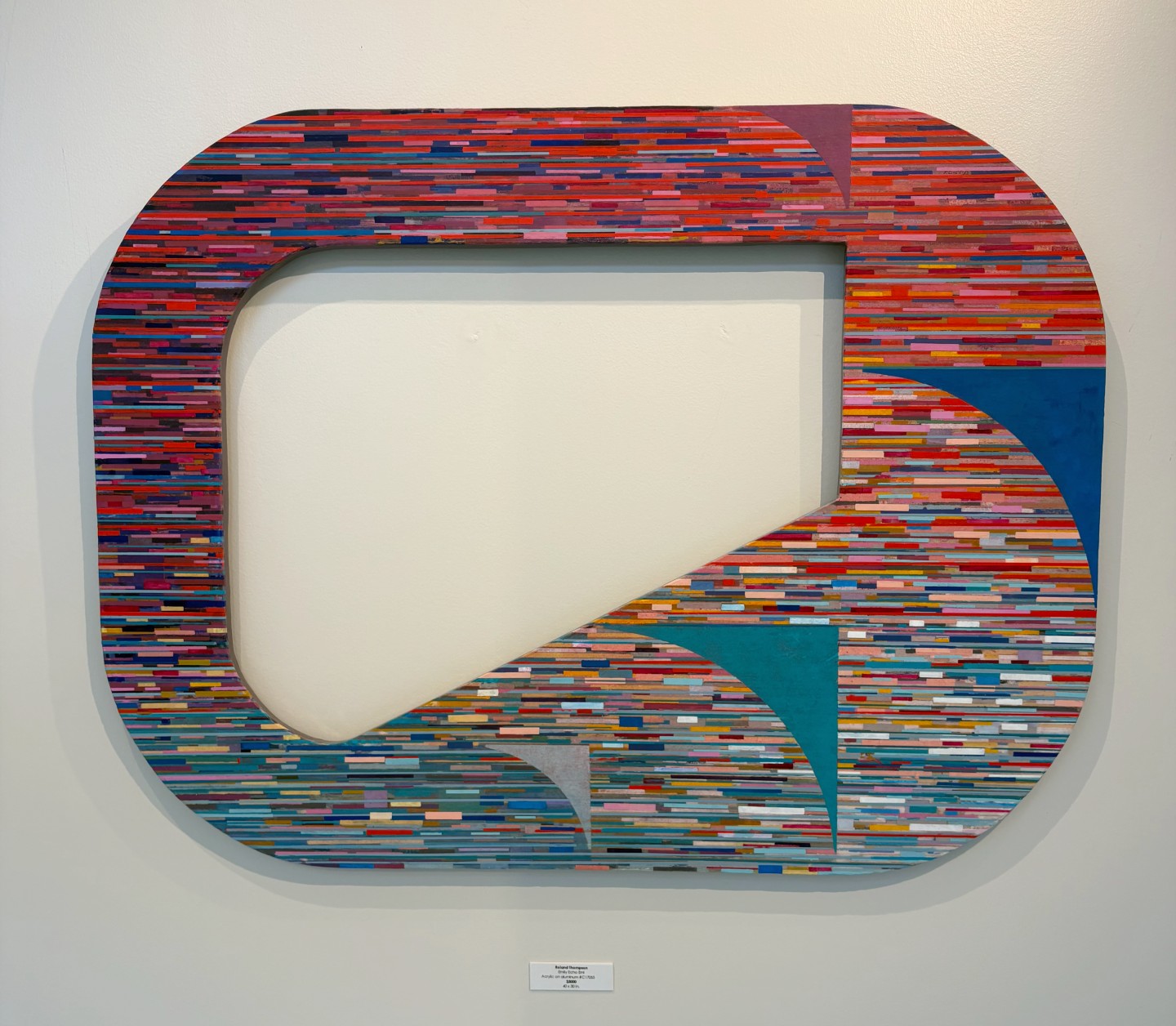
Roland Thompson, “Emily Echo Emi”
Roland Thompson: blip, ‘A’ Gallery, Salt Lake City, through Aug. 29.

Gina Cavallo has been a curator, registrar, and executive director in museums for over 35 years. She spent many years as an art critic for publications in Phoenix. She began her career at the Phoenix Art Museum and the Heard Museum, was a founding curator at the Scottsdale Museum of Contemporary Art, spent two terms managing exhibitions at the Virginia Museum of Fine Arts, and was the Executive Director at the Mission Inn Foundation & Museum in Riverside, California. Her current role is Director of Development for Taproot Theatre Company in Seattle where she also serves as the curator of the Kendall Center Exhibition Series. She moved to Orem in 2024 with her husband, a theatre faculty member at UVU.
Categories: Artist Profiles | Exhibition Reviews | Visual Arts