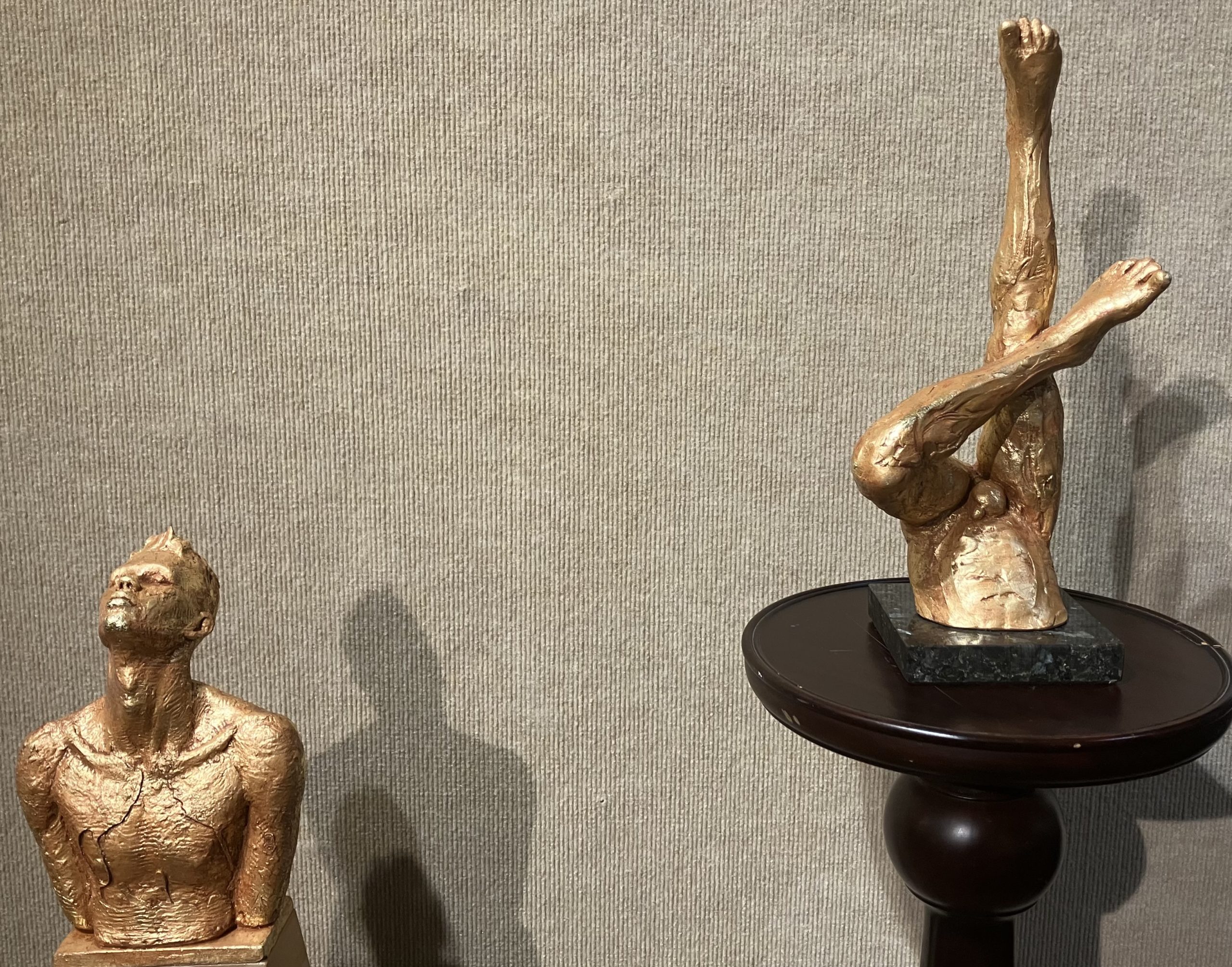
Heather Rison, “Dial Tone” (left) and “Hanged Man”
It seems like every year rumors circulate that the Face of Utah Sculpture may have run its course and might be cancelled. Glass artist Dan Cummings, who founded the event 22 years ago and shepherded it through the COVID-19 shutdown six years ago, admits that he and folklorist Michael Christensen, who manages and mounts the open exhibition for the Utah Cultural Celebration Center, did ask each other this year if the event still has what it takes to be relevant. Their decision to go ahead was vindicated in several ways. The turnout at the opening looked to be the largest in recent memory, and anyone who understands that art is as much a consumer phenomenon as a demonstration of creative energy among artists will appreciate that. Then a new award coinciding with the nation’s semiquincentennial—the 250th anniversary of the public release of the Declaration of Independence—eventually sent a couple of artists home with a dollar each for every one of those years. Finally, and arguably most important, the range and variety of the artworks on display continued to celebrate much of the best work of the last two years, even while pointing to new directions that promise sculpture will continue to be a lively player in the ever self-renewing Utah arts scene.
There are 32 artists participating in the 22nd Face of Utah Sculpture. Establishing the resonant combination of traditional craft quality and innovative expression that this show foregrounds begins immediately inside the door to the Pilar Pobil Celebration Gallery with Heather Rison’s two half-figures, “Dial Tone” and “Hanged Man.” These two Barbie doll-sized figures actually look as though they could have begun as a single male form that the artist chose to cut in half at the waist, thereby raising the possibility that their narrative subjects are somehow connected. The top half, “Dial Tone,” features a tightly-posed man, arms at his sides, with eyes closed and his head tilted back, the title possibly redirecting the impression from one of transcendent bliss to a sense of a patient waiting for whatever might happen next. Nearby, “Hanged Man” definitively adds a third dimension to the tarot card image of the inverted individual hung up by a rope, invisible in this case, tied around one ankle, leaving the other leg bent across it to produce an image like a most tactile numeral 4.
Compared to Risen’s expressively gnarly anatomy, Laura Lee Stay’s “Dream Catcher,” a full-length nude with a spiral of birds taking flight around her, stresses gracefulness. Dan Cummings’ extravagant—and extravagantly titled—“Loving the Art of Suncarved Glass,” which creates the illusion of a fully round figure inside the hallucinatory looking-glass world within a mirror, invokes the magic space through which Lewis Carroll reintroduced Alice after her adventures in Wonderland.
-
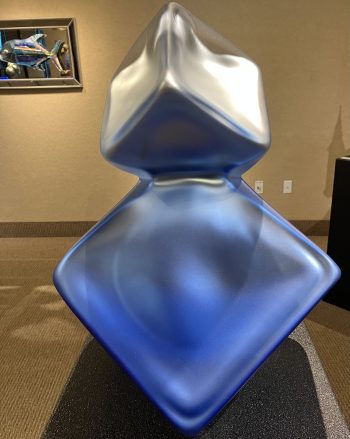
- Andrew Shaffer, “Salt”
-
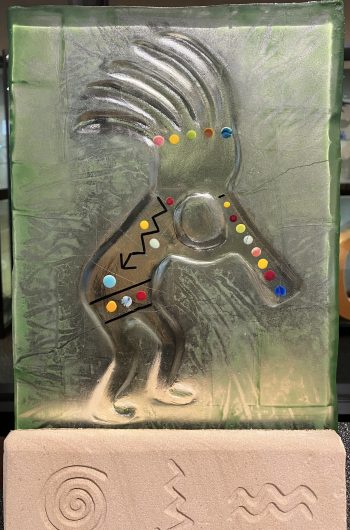
- Sheena Wolfe, “Kokopelli”
Glass, in fact, accounts for quite a few of the works here, perhaps in response to the recent energizing of this and several other traditional crafts materials. Shena Wolfe’s cast relief, “Kokopelli,” brings the hunchback, flute-playing fertility figure of the ancient Southwest cultures forth in a translucent embodiment. Andrew Shaffer’s blown glass “Cloud” and “Salt,” among the relatively few abstract forms here, trade in the brittle transparency of glass for something that feels pillow-soft, luminous, and gently inflected by the colors surrounding it. Suzanne Larson’s “Crosshatch” makes interwoven glass look like anything but glass. And Mitch Bedke’s “Giant Trevally” inverts Cummings’ trick by bringing the glass fish out in front of the mirror.
-
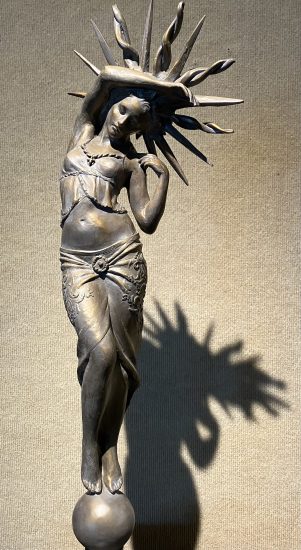
- Laura Lee Stay, “Star Dust”
-

- Mark DeGraffenried, “Father and Son”
-

- Frank McEntire, “Firewater”
There are two artists here who have long labored to celebrate and memorialize those who rescue and protect the public. Cache Valley’s Mark DeGraffenried, perhaps best known for a memorial to eight UVU students and their professor who all died in a 2005 van accident, represents himself here with a possibly whimsical bronze called “Father and Son,” in which a barefoot man in a short-sleeved suit appears to suspend a child, who himself looks like a grownup, against gravity in mid air. Note: these are not criticisms, but rather a catalog of intriguing anomalies that seem anecdotal, perhaps biographical, and appear without explanation in a fully competent portrait. Then there’s Frank McEntire’s “Firewater,” which features a tangled fire hose attached to a no-nonsense emergency valve, thus contrasting the orderly world of preparation for a potential disaster with the reality of ensuing chaos. More characteristic of his current work, McEntire’s threnody to the natural world, “Strangely Silent Where Once the Beauty of Bird Song,” similarly contrasts relative order, in the form of thistles and a wasps’ nest in their pristine states, with scarred and spattered examples of human self-expression revealed in multiple texts.
This iteration of the Face of Utah Sculpture takes up a couple of controversies that were once thought settled. It wasn’t that long ago that artists who worked with potentially or actually functional objects faced criticism on the grounds that art should be purely for its own sake. For example, vessel makers might poke holes in their objects to signal they were not for use. Far from the threat to painting that photography was supposed to represent, it turned out that the camera liberated painters to virtually start over. Yet here we have David Holz working unapologetically in a genre called a “functional art assemblage”—specifically lamps that unleash their ornamental potential. Thinking about them, a viewer may question if various toy-like objects are really any different. Ric Blackerby’s “Blue Jay Way,” in which the title bird defies logic by flying in an airplane, looks like it belongs on a desk and could make a splendid lamp, while Clint Call’s “Little Dipper” and Steve Dayton’s “Magnificent Purpur cat” beg to be picked up and explored for their secret functions. Here the wall between a pristine work of art and something that can be pursued beyond its iconic appearance seems porous indeed.

Clint Call, “Little Dipper”
Finally, the Doctorow Foundation, long a major supporter of this exhibition’s intentions, invited each artist to attach a few words linking their work to what the Declaration of Independence means to them on the occasion of its 250th year. As it turned out, only seven of those participating evidently felt sufficiently insulated from the prejudice against artworks that take a political position to oblige. Of course, asking them to incorporate reference not only to a current event, but a somewhat controversial one, was a bold move at a time when some of the most visible of our national leaders are busy trivializing the moment, if not outright hijacking it for their own personal purposes. And while no one should judge the majority who chose not to attach such a statement to their work, nor for that matter the decision of some who did to express anodyne, patriotic sentiments, yet some of those who did were able to sculpt some subtle opinions into meaningful visual statements.
Adam Larsen’s ironically titled “This Land Was Made For You and Me” consists primarily of a school teacher’s pull-down map of the United States—the sort of official view that many in the audience will recall having been shown to give an impression of the vast size and comprehensive variety of their nation. It can be dated from a detail: the Panama Canal Zone, resentfully returned to Panama by President Ronald Reagan, forms one of its inset details. In front of this vista, which the astute may have noticed can be rolled up, safely out of the way in a trice, an ice cube tray seems most likely to represent the vessels that for centuries brought immigrants to the colonies, then the states: ships at first, later buses and airplanes.

Adam Larsen, “This land was made for you and me”
Fourteen toy figures occupy the nearly identical compartments meant to form ice cubes. All are brown-skinned and each is dressed in a mode that signals an ethnic or working class identity, which significantly makes the point that most of those who come here from other countries do so with the intention to work hard, to fit in, and even as Reagan himself said in his farewell address, which Larsen quotes, to become Americans: hyphenated citizens loyal to both past and present. That said, their placement in a freezer attachment may suggest a conclusion about their coming reception, which may be something other than warm.

Abe Kimball, “American Cleanser”
One of the more visible innovations in Utah art in the last decade has been the advent of tabletop-sized (and recently, larger) model buildings that open up entirely new uses of scale in relating often universal patterns of local life, ranging from homes to houses of worship and presumably anything in between. If Larsen’s view of the immigrant’s welcome is problematic, Abe Kimball’s “American Cleanser” points out threats experienced by those already here, and even those born and raised in this country. Based on a cruciform church model, his building incorporates one of his signature elements, a suitcase, that resonates with the transient life that many Americans aspire to or identify with. Two other additions, both cleaning products, invoke the previously alien concept of “ethnic cleansing,” along with the historically grounded notion that some things in spite of being present here are decidedly un-American and should be repudiated, if not outright expelled. Or so ’tis said.
These two, along with many other works, argue that art has a role in the public discourse of the United States. They will be present in the Utah Cultural Celebration Center for consideration along those lines until August 26.
Face of Utah Sculpture, Utah Cultural Celebration Center, West Valley City, through Aug. 26.

Categories: Exhibition Reviews | Visual Arts





Thank you Geoff for putting Kokopelli and me in your wonderful story about the UCCC Sculpture Show. I’m very honored and appreciative! It was great meeting you!