 When Stephen Trimble published The Sagebrush Ocean: A Natural History of the Great Basin in 1989, the metaphor of his title seemed almost inevitable. Sagebrush blanketed nearly half of the Great Basin, the enormous sweep of basin and range country extending from Utah across Nevada and into California and Oregon. “If you picked the right line, you could actually walk across the hundreds of miles of the Great Basin in sagebrush all the way,” Trimble says.
Thirty-seven years later, Trimble has returned to the book, and to the country that inspired it, for a substantially revised edition. What he found is a landscape that is still enormously wild and still capable of surprising him, but one that in many places no longer looks like the sagebrush ocean he first encountered. “The Great Basin is now a place where we’ve lost half of those sagebrush communities, with 1.3 million acres disappearing each year across the West,” he says. “We’re adapting to sobering aridification. Cheatgrass and fire are overwhelming sagebrush in an era when climate change will only accelerate their destructive power.”
When 15 Bytes profiled Trimble in 2019 as part of our Utah’s 15 project, he recalled that before beginning The Sagebrush Ocean, he knew the Southwest well but knew little about the Great Basin beyond “headlights and late-night truck stops.” “I take enormous pleasure in learning about new country,” he told us then. “I fell in love with the Great Basin because it’s so enormously wild.” The book was his first freelance project, following earlier natural-history work for the National Park Service. It combined his photographs with an exploration of the plants, animals, geology and ecology of the region and became an important step in a career that has since moved between natural history, photography, Native peoples, conservation and activism.
In September 2021, University of Nevada Press director JoAnne Banducci contacted Trimble about updating the book before another printing, proposing a 35th-anniversary edition. Trimble was intrigued but wary of what a full revision might involve. “Writers are always loathe to revisit early work, and this would be a time-consuming project,” he says. “But I love the Great Basin. I’ve lived in the Great Basin, here in Salt Lake City, for nearly forty years. I had to say yes.”
At first he imagined researching and writing a substantial new introduction. Then the project grew. The press was redesigning the book, which meant converting the original text into a new digital manuscript. Trimble could rescan old photographs, add new ones and revise material throughout. What had begun as a new introduction became an opportunity, and in Trimble’s view a responsibility, to reconsider the entire book. The natural-history stories about desert plants and animals remain. Around them Trimble has added what he calls two generations of science and landscape change.

Stephen Trimble, “Monitor Valley”
Some changes to the Great Basin were obvious not long after the first book appeared. During fieldwork in the 1990s for Earthtones, a book pairing Trimble’s photographs with essays by Nevada writer Ann Ronald, Trimble realized The Sagebrush Ocean had become “an historic document pretty much on publication.” A resurgence of gold mining that began in the mid-1980s was pushing improved roads into remote mountain ranges. “Backcountry faith—‘this dirt track feels right and will go where I think it will’—no longer sufficed,” he says. “Lonely two-tracks were now graded, graveled, and sometimes even gated—blocking access to whole ranges.” Behind some of those gates were open pits and cyanide pools associated with new mining techniques.
In the ensuing decades, change has come at an alarming rate: climate change and invasive species, industrial-scale solar farms and transmission lines, geothermal development and lithium mines. Returning to the Great Basin for the new edition, Trimble encountered some of those changes in valleys he remembered as remote and empty.
“The sagebrush ocean has become the most endangered biome in North America,” Trimble says. “The Great Basin’s imperiled indicator species, the sage grouse, has become the spotted owl of the Intermountain West, the desert canary in the lithium mine—choose your own metaphor. It’s not just one iconic creature at risk. The entire ecosystem is passing through rapid and drastic change.” Some of the new photographs he made in Nevada and Utah’s West Desert give visual form to that transformation. They carry a caption that deliberately echoes and unsettles the title of his book: “the cheatgrass sea.”
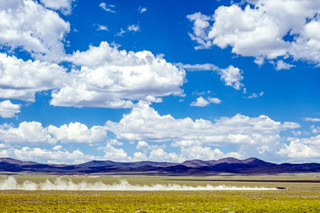
Stephen Trimble, “Antelope Valley”
He was equally struck by what hadn’t changed. There were “an even larger number of basins that remain remote and empty, with little signage on the dirt roads,” he says. “Still exhilarating backcountry, still an adventure.” One of Trimble’s favorite new photographs shows a cattle truck moving across Antelope Valley, a little-visited valley in eastern Nevada. After a day without encountering another vehicle, Trimble says, the first one to appear is often a local rancher. “The Great Basin remains today as I’ve described it in the past, ‘a wilderness, with cows.’”
His five years of research, photography and wandering those roads have only reinforced the attachment that began with the original book. “The ‘place’ is SO big,” Trimble remarks. “I can drive a transect from Salt Lake to Bishop, California or to Fields, Oregon and take new backcountry routes every time. So many of these dirt roads lead to these incredibly beautiful places that I’ve never thought about or heard of—and where you can feel like you have the earth to yourself. This feeling is more intense here in the Great Basin than just about anywhere.”

Stephen Trimble, “Swamp Cedars, Spring Valley”
But loving the Great Basin does not necessarily make the choices involved in protecting it any clearer. One of the most difficult sections for Trimble to rewrite concerned the expansion of piñon-juniper woodlands into sagebrush habitat. “Piñon-juniper woodland is my home landscape,” he says, “and though I’m attempting dispassion in my narrative, old-growth piñons and junipers are my friends.” Do you clear one to protect the other? “I feel a responsibility to both sagebrush and p-j as a desert citizen. As a writer, I want to do justice to these beings, to their ecosystems, to the Great Basin Desert itself. I don’t want to choose between them. I don’t want to lose them.”
Some of Trimble’s revision reflects not so much changes in what there is to see, but in how Trimble sees it. He points to the “swamp cedars” of Spring Valley in eastern Nevada. These unusual stands of Rocky Mountain juniper grow on the basin floor, hundreds of feet below the piñon-juniper woodlands of the surrounding ranges. In the original book, Trimble treated them primarily as a natural-history puzzle: why did a tree associated with wetter, higher environments thrive here? But now he also tells the story of the groves as Bahsahwahbee, a place sacred to Shoshone and Goshute people, associated with ceremony as well as with the memory of 19th-century massacres. Shoshone and Goshute people also fought to protect the Spring Valley aquifer from plans to pump its water south to Las Vegas. “As in so many places, species and landscapes notable to ecologists have an Indigenous history long overlooked,” Trimble writes in the new edition. “It’s really a human wilderness, where people have lived for many thousands of years in small numbers, interacting with this big empty landscape and its plants and animals in intimate, quiet, but powerful ways.”

Stephen Trimble, “Cheatgrass Sunset, Puddle Valley, West Desert, Utah”
Thirty-seven years after The Sagebrush Ocean first appeared, Trimble has revised the book because the Great Basin has changed—and because his understanding of it has changed. There is more science now, more history, more urgency and considerably less certainty about what protecting this country actually requires. “It’s impossible to unravel the skein of changes,” he writes. “I have no simple solutions.”
Stephen Trimble launches the new edition of The Sagebrush Ocean Tuesday, Oct. 13, at 7 p.m. at the Natural History Museum of Utah.
The founder of Artists of Utah and editor of its online magazine, 15 Bytes, Shawn Rossiter has undergraduate degrees in English, French and Italian Literature and studied Comparative Literature in graduate school before pursuing a career in art.
Categories: Book Reviews | Literary Arts | Visual Arts