
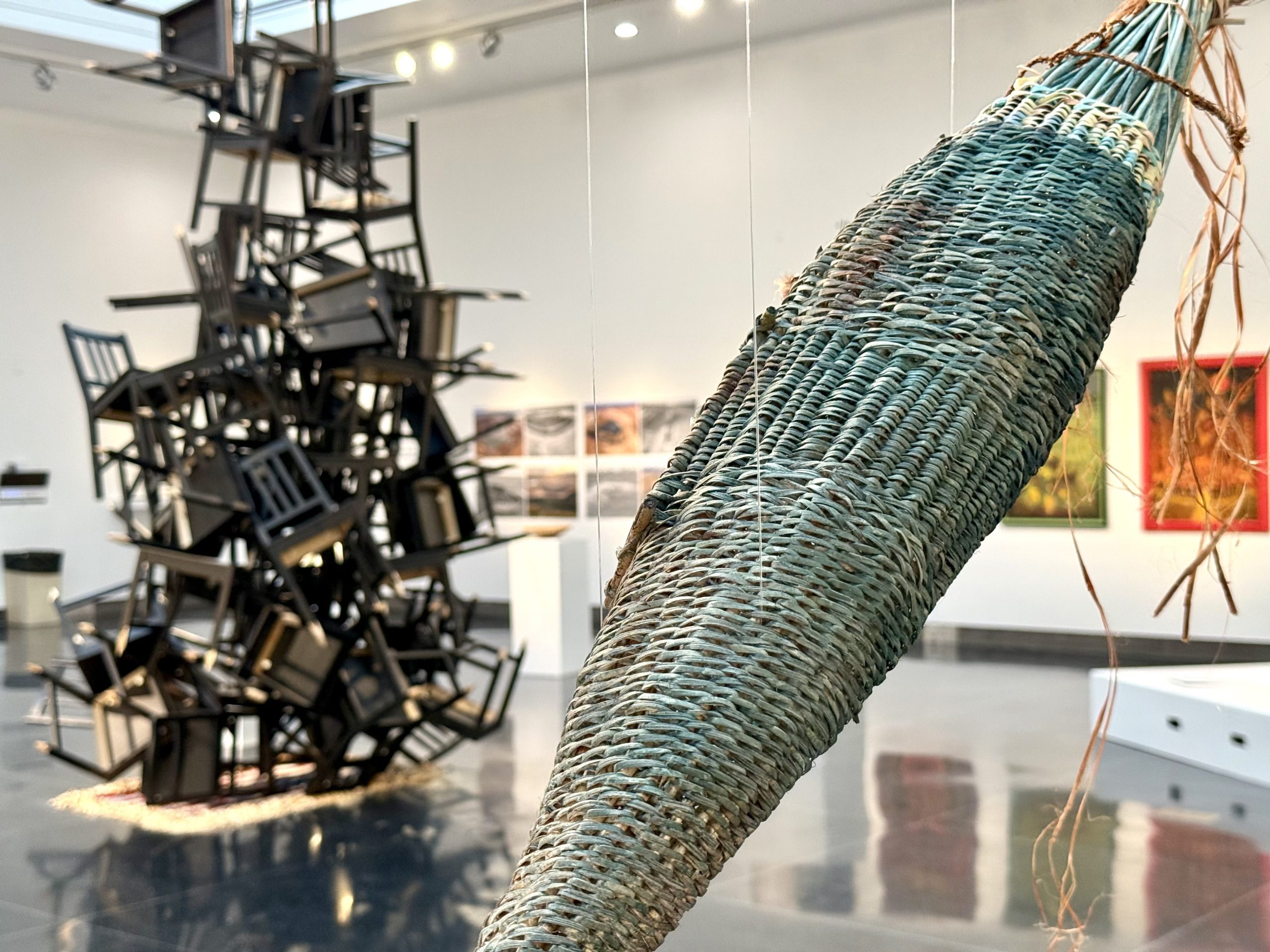
Detail of Gregg Deal’s “The Place Where Spirits Get Eaten” at the Shaw Gallery’s Of This Place.
Gregg Deal’s music is full of piss and vinegar, righteous anger delivered with a hot blade of wit and invective. “I’m not a very good Indian,” he announces in “Bad Indian,” one of the songs he performs as frontman for the punk band Dead Pioneers. “My cheekbones aren’t high enough/I don’t have enough beadwork/Or turquoise.” In another song he reduces a few centuries of American history to a one-line economic model: “America is a pyramid scheme, and you’re not at the top.” Deal, whose band released its third album this year, may now have as many fans for his music as for his visual art, but the latter came first. The Pyramid Lake Paiute artist, raised in Park City and now living in Colorado, has spent years picking apart the images America has made of Indigenous people, borrowing freely from punk, Pop Art, comics, Westerns and protest graphics to do it.
At Weber State University’s Shaw Gallery, you could scratch yourself on his work. Or be impaled on it. In the center of Of This Place: Great Basin Neighbors, black school chairs are stacked floor to skylight in a precarious tower, their legs sharpened to pencil points. Two cut braids rest on one of the chairs. Beneath the whole thing, amid a pile of wood shavings, lies an American flag. The references—to classrooms, cut hair and the boarding schools that attempted to strip Native children of their languages and cultures—are hard to miss.
Is this “bad Indian” art? There is little here of the tranquil craftsmanship that generations of tourists have been taught to expect from trading-post displays of rugs, pottery and baskets.

Installation view of Of This Place: Great Basin Neighbors at the Mary Elizabeth Dee Shaw Gallery on the Weber State University campus in Ogden, Utah.
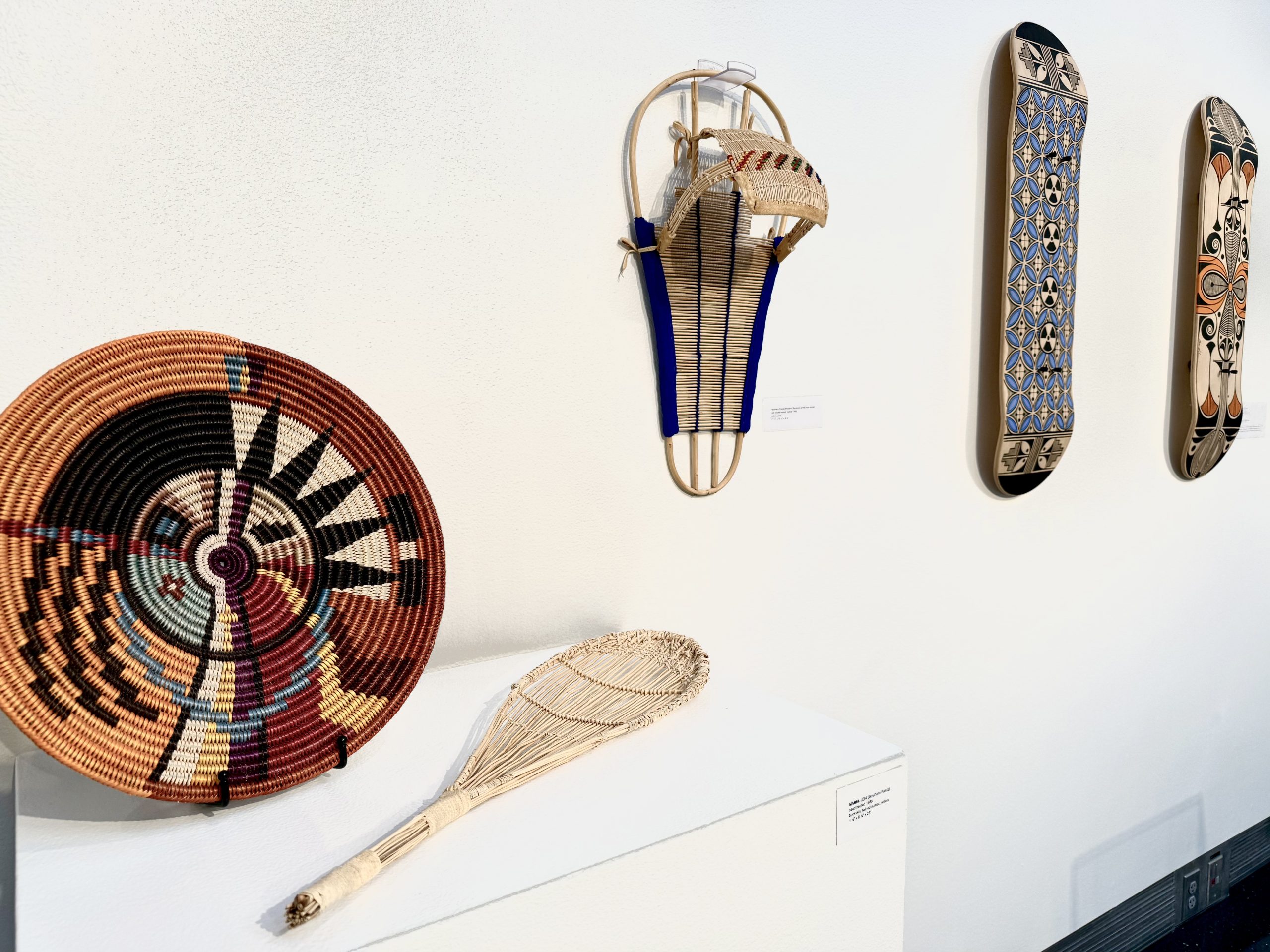
From left: Elsie Holiday (Diné), tray, before 2013, sumac; Mabel Lehi (Southern Paiute), seed beater, 1989, buckskin, twined sumac and willow; doll cradle basket by an unidentified Northern Paiute/Western Shoshone artist, before 1993, willow and yarn; and Rowan Harrison (Isleta Pueblo/Diné), Atomic Blue Deck and Warm Four Petal Deck, 2025, acrylic, pen and ink on wooden skateboard decks.
But there are plenty of baskets in Of This Place. Beautiful ones. Woven sumac trays and ollas, a willow seed beater and a doll cradle share the gallery with Deal’s punk-inflected work, photography, animation, skateboard decks, beadwork and installation. They are works by Newe (Shoshone), Numu (Paiute), Nuche (Ute) and Diné (Navajo) artists from different nations and generations who share, in different ways, the Great Basin. And basketry refuses to stay politely in the “traditional” part of the room. Jack Malotte (Shoshone/Washoe) turns three baskets into wireframe diagrams floating on a perspective grid. Karma Henry (Paiute/Italian/Portuguese) carries basket forms and stitch-like patterns into her landscapes. Fallon Paiute painter Melissa Melero-Moose stitches willow into “The Place Where We Gather,” bringing a material used by generations of basket makers onto the surface of a painting.
The Great Basin itself is hardly neutral ground. Diné photographer Will Wilson’s “Hubris on the Land” pairs aerial photographs of capped uranium mines with some of the West’s canonical land art: Spiral Jetty, Double Negative, Roden Crater and Sun Tunnels. From above, the geometric scars produced by extraction and those produced by art rhyme uncomfortably. Rowan Harrison (Isleta Pueblo/Diné) puts the same problem on a skateboard. Atomic Blue Deck is painted with the fine, symmetrical linework of Pueblo pottery, and down the center of its blue lattice runs a column of radiation trefoils.
Judith Lowry (Mountain Maidu/Pit River/Washoe) draws on her tribes’ cautionary legends in the four paintings of Quartet: Climate Prophecies. Painted in saturated reds and acid greens and set in ornate frames, each canvas places a roundhouse, or Ku’m, at the center of an elemental catastrophe, with small figures caught in its swirl.

Amanda Francom’s “Winter with a Wuda” in front of Judith Lowry’s Quartet: Climate Prophecies

Fawn Douglas, “Kwee’ You-Its!” (2019) in the foreground and “Nuwu Um-buh-gah, Learn Nuwu Deck #1” (2024)on the wall.
Fawn Douglas (Las Vegas Paiute) covers a wall with Nuwu Um-buh-gah, Learn Nuwu Deck #1, flashcards pairing Southern Paiute words with images of roadrunners, tortoises, elders, cradleboards and constellations. The label recounts a boarding-school survivor remembering pins being put in her tongue for speaking Paiute. Douglas hangs each card with a pushpin.
Deal’s own wall is the loudest in the room. A hot-pink collage built around a newspaper ad reading “Indian Land for Sale” hangs on one side. On the other, “Smash American Fascism” is lettered in chalky block capitals above a yellow lever-action rifle. Between them hangs a black cloak with a fur collar fringed in brass cartridges. On its back, John Wayne grips a rifle, his eyes red and his teeth fanged. On the floor below, inside a ring of ash on a striped wool blanket, lie a rifle and two revolvers wrapped in beaded fringe, an abalone shell of sage and two cans of Spam. Deal made the cloak for performance and wore it at the exhibition’s opening. In the gallery it hangs empty, a costume between sets.
But Deal’s volume is only one register in the room. Walker River Paiute artist Jacqueline Rickard sheathes a coiled willow basket in seed beads, working an eagle, hummingbird, dove and owl into its surface. In Basket Hat Woman, from 1974, Ben Aleck, also Pyramid Lake Paiute, builds a woman’s profile, and the woven cap she wears, from stippling and hatched lines. Deal’s “bad Indian” only stings if someone, somewhere, has already decided what a good Indian should be. Of This Place has little interest in doing so.
Of this Place: Great Basin Neighbors, Mary Elizabeth Dee Shaw Gallery, Weber State University, Ogden, through Nov. 20.
All images courtesy of the author.
The founder of Artists of Utah and editor of its online magazine, 15 Bytes, Shawn Rossiter has undergraduate degrees in English, French and Italian Literature and studied Comparative Literature in graduate school before pursuing a career in art.
Categories: Exhibition Reviews | Visual Arts