
When the Salt Lake Bees pulled up stakes and left for Daybreak after the 2024 season, they ended roughly a century of professional baseball around the corner of 1300 South and West Temple. The team’s owners found what they were looking for farther south—room for a new stadium anchoring their growing Downtown Daybreak development—while Salt Lake City was left with something considerably harder to move: a 14,000-seat ballpark in the middle of a neighborhood.
Losing an anchor like that can leave a gaping hole in a neighborhood, not to mention a lot of expensive infrastructure sitting idle. But while Salt Lake City works through long-term plans for the 13.5-acre site, it has begun putting the old ballpark to some imaginative new uses. Last month the Utah Arts Alliance brought its Urban Arts Festival to the stadium. Now Spy Hop is stepping up to the plate with an event of its own.
Smith’s Ballpark was thirty years old, but the departure wasn’t onl a matter of needing a new ballpark. The Larry H. Miller Company, which owns the Bees, had been weighing a move for years, citing concerns about crime, safety and parking around Smith’s Ballpark. More importantly, perhaps, the company had an opportunity farther south to put the team at the center of a development of its own. The new privately funded ballpark became an anchor for Downtown Daybreak, the Miller Company’s nearly 200-acre mixed-use development of housing, restaurants, shops and entertainment in South Jordan.
Salt Lake City tried to keep the team. Mayor Erin Mendenhall said her administration spent 20 months working to persuade the Miller Company to remain, but acknowledged when the move was announced that having the Bees anchor the long-planned Daybreak development had become the likeliest outcome.
Over the summer of 2025, the city’s Community Reinvestment Agency and Salt Lake City Arts Council commissioned ten new murals throughout the Ballpark neighborhood, pairing local artists with businesses willing to turn their walls into canvases. The resulting open-air collection includes work by Trent Call, Paul Heath, Traci O’Very Covey, Isaac Hastings, Joseph Toney and others, with several of the works drawing directly on the neighborhood’s baseball identity. The program was conceived as a way to strengthen the neighborhood’s identity, support its businesses and bring some additional life to its streets.

Meanwhile, the stadium itself has begun serving as an enormous experimental arts venue. Last month, the Utah Arts Alliance moved its Urban Arts Festival into Smith’s Ballpark, filling the former home of the Bees with visual art, music and performances. Now Spy Hop is stepping up to the plate with an event of its own.
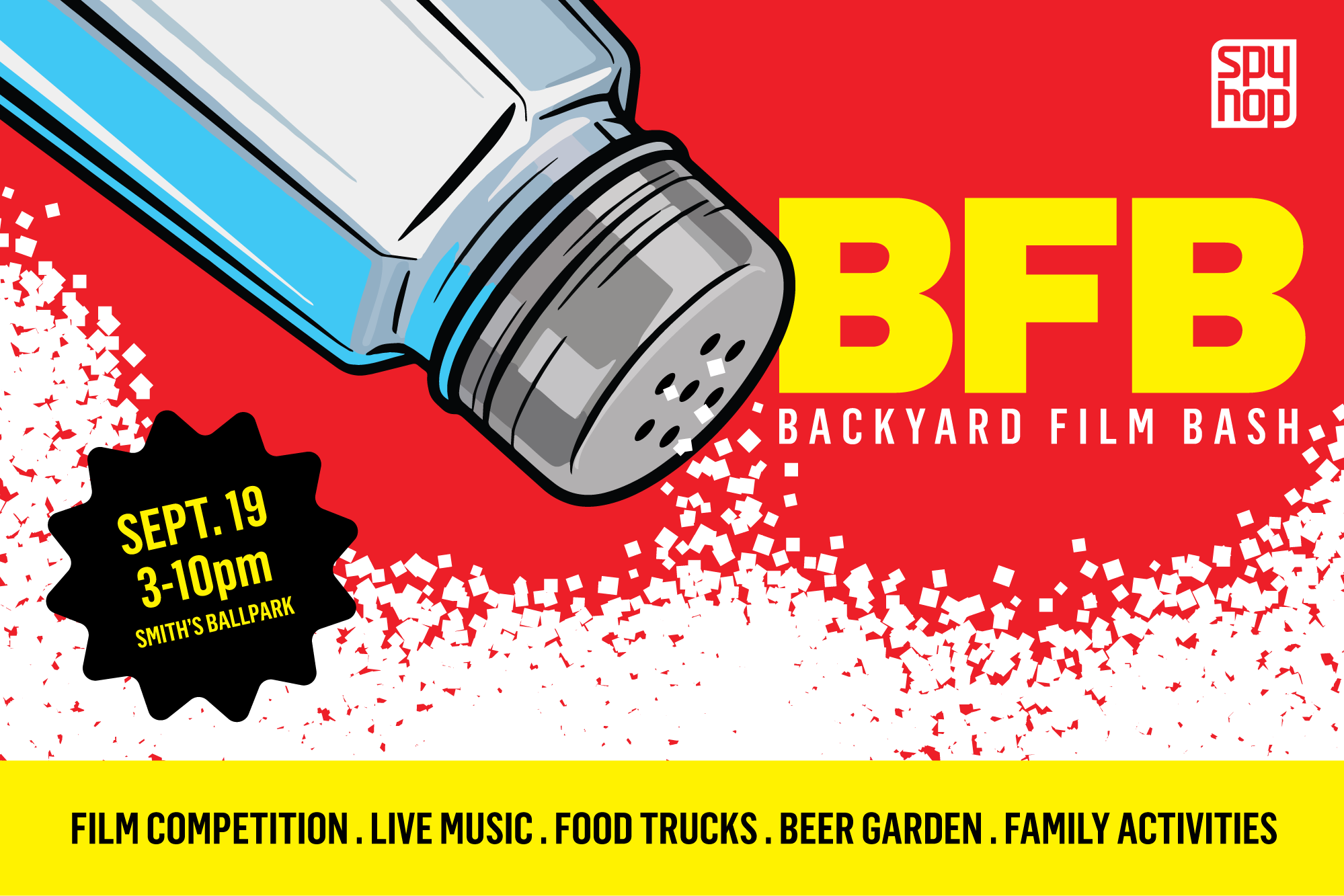
On Saturday, Sept. 19, the Salt Lake City youth media arts nonprofit will transform Smith’s Ballpark into what it bills as a giant backyard movie night. The inaugural Backyard Film Bash combines a national short-film competition with live music, food, interactive activities and performances by Spy Hop alumni, culminating in screenings and an awards ceremony under the stadium lights.
At the center of the event are 12 short films selected from a competition that challenged filmmakers to create an original work of no more than seven minutes and somehow incorporate one required ingredient: salt.
The results range widely. There’s Brinefest, Andy Whipple’s take on a Great Salt Lake pickling competition; KI: Potassium Iodide, Zealand Thomas Despain’s story of a man deciding whether surviving the apocalypse is worth the trouble; and Morty Goes Camping, by Lennox and Townes Fetzer, whose protagonist is an ordinary can of salt embarking on an outdoor adventure. Other finalists tackle horror, science fiction, friendship, family and the perils of taking the phrase “salt of the earth” too literally.
There’s more than bragging rights at stake. The winning filmmaker receives $10,000, two films will receive Special Jury prizes, and attendees will choose an Audience Award winner through live voting.
Judging the films live will be a Utah-centered panel: filmmaker and Napoleon Dynamite and Austenland writer Jerusha Hess; University of Utah Film & Media Arts chair Tim Palmer; Neon Trees frontman Tyler Glenn; and Emmy Award-winning documentary filmmaker Jenny Mackenzie. The four will watch the finalists with the audience, deliberate and select the Best Film and two Special Jury Prize winners.

SpyHop alumni Tinted Noise, at the Utah Arts Festival
The Bash is intended to be more backyard party than traditional film festival. Gates open at 3 p.m., with DJs and live performances by Spy Hop alumni throughout the afternoon, along with food vendors and family activities before the film screenings and awards later in the evening.
For Spy Hop, the event also puts some of its own creative community on a much larger stage. For more than 27 years, the Salt Lake City nonprofit has worked with young people ages 8–25, providing hands-on experience in film, music, audio and design. Alumni artists will perform on the ballpark’s main stage throughout the afternoon.
“Backyard Film Bash is Spy Hop’s way of creating a fun, new community gathering that celebrates media arts and the artists who use them to tell stories, spark ideas and connect people,” Executive Director Larissa Trout says. “We hope it becomes an annual celebration bringing together the community to discover great work, uplift artists and simply have fun together.”
Spy Hop’s Backyard Film Bash
Saturday, Sept. 19, 2026
Smith’s Ballpark, Salt Lake City
Gates open at 3 p.m.
Free tickets and event information: spyhop.org/events/backyard-film-bash

UTAH’S ART MAGAZINE SINCE 2001, 15 Bytes is published by Artists of Utah, a 501 (c) 3 non-profit organization headquartered in Salt Lake City, Utah.
Categories: Film | Performing Arts