
Alphonse Mucha: Master of Art Nouveau—Selections from the Dhawan Collection. Exhibition and museum tour organized by Landau Traveling Exhibitions, Los Angeles, CA. Installation View at the Utah Valley University Museum of Art at Lakemount.
It was short-lived, Art Nouveau. The ten years before and after the turn of the century, the movement burned like a hot, heavy romance, laced with sensuality and grace—elegance and sophistication, long hair and cigarettes. The style emerged from a rejection of industrial production while simultaneously harnessing its advancing technologies to make high art accessible to the masses. Inspired by the ethos of the British Arts and Crafts movement—bringing craftsmanship into even the everyday object—Art Nouveau began with theatre posters for the traveling heroine of the time, commissioned from a Slavic illustrator who would become the leading figure of the movement.
As a lad in a Slavic country—today the Czech Republic—Alphonse Mucha was a particularly talented young illustrator. He took that prowess to stone, becoming a legend in lithography. Printing posters for theatres, cigarette companies, biscuit boxes, and magazine covers, he used the femme nouvelle—the “new woman”—to make products appear beautiful and leisurely. The poster that put Mucha on the map advertised the internationally famous Sarah Bernhardt in the play Gismonda. And with her fame came his. Mucha and Bernhardt became close collaborators, Mucha designing the actress’s posters, costumes, and stage sets.
Smoking cigarettes was not respectable among women at the time. Yet Mucha’s posters for Job cigarettes made it appear so: women with their hair down, heads cocked in pleasure, eyes relaxed. The cigarette smoke entwines with swooping locks, breaking the border of the poster—lavish and sultry. In stark contrast to the femme fatale of art history’s predecessors, Mucha’s women are not presented as dangerous temptations to be resisted, but as freer figures—a liberated woman later embraced by 1960s psychedelic poster art, such as that of Wes Wilson, whose work is currently showing at SUMA in Cedar City. Mucha used divine femininity as an antidote to the hyper-masculine industrializing world.
-

- Alphonse Mucha, JOB, 1898, Color lithograph on paper mounted on linen Exhibition and museum tour organized by Landau Traveling Exhibitions, Los Angeles, CA.
-
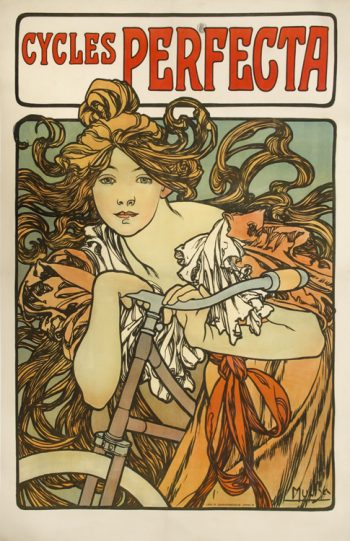
- Alphonse Mucha, Cycles Perfecta, 1902, Color lithograph on paper Exhibition and museum tour organized by Landau Traveling Exhibitions, Los Angeles, CA.
The kaleidoscope of botanical designs that sit behind Mucha’s women draw inspiration from Byzantine mosaics. Much of his style is also indebted to Japanese woodblock prints—seen in the wrapping plumes of smoke that curl into pinwheels, the sense of depth within flattened spatial fields, the ornate floral treatments, and the fine lines. He was obsessed with the flamboyance of peacock feathers and the intricacies of wrapping vines and blossoms.
The impersonality of mechanized production fueled his belief that even the quotidian object should possess beauty, that everyone should have access to high art in the living room. Mucha toggled industrialization—rejecting its lack of quality control—while also embracing the efficiencies of new technologies to produce high art en masse. Like the American Automobile Association’s later impetus to bring American artists to the people at a low price (see here), Mucha prioritized production for the masses while retaining craftsmanship in quality—rejecting the cheaply engineered goods the Industrial Revolution once heralded, but which have since become the bane of our climate-threatened culture. Mucha was a forefather in seeing through the thin veil of mass production while maintaining an ethos that prioritized access and well-designed works. Blending art and commerce, fine art and commercial art.
-

- Alphonse Mucha, Reverie, Variant 4, 1898, Color lithograph on paper mounted on linen Exhibition and museum tour organized by Landau Traveling Exhibitions, Los Angeles, CA.
-

- Alphonse Mucha, Zodiaque, 1896, Color lithograph on paper mounted on linen Exhibition and museum tour organized by Landau Traveling Exhibitions, Los Angeles, CA.
His posters ran in the hundreds and were pasted around Paris, some bearing the same Paris street authentication stamps seen on Jules Chéret’s posters of the era. A physical mark reminding viewers of the random hands that have touched them through time—the Parisian patrons walking down the street, the same man who puts up the posters this week only to paste over them the next. Always new. In the elements. I find beauty in the fleeting nature of this work. While I mourn the designs lost to time—the ones history did not tuck away under the couch to emerge as cultural cornerstones decades later, the ones that were simply another label or magazine cover on the coffee table.
Mucha illustrated hundreds of periodicals, many represented in this show. Whether Parisian journals, Catholic digests, or astrology magazines, so many of his works were lost to the trash bin that those preserved by history feel especially sentimental.
Recently donated by the original family of the mansion, the UVU Museum of Art at Lakemount resides in a baroque-inspired castle overlooking Utah Lake. The grounds feel like a park in France, as though a Mucha poster advertising a play later this week might be pasted just down the path. The chandelier’s crystals catch the sunset in the western-facing windows, while iron vines and blossoms wrap around the banister leading to the museum’s main galleries. The show features around seventy-five works by Mucha, part of the Dhawan Collection toured by Landau Traveling Exhibitions, an LA-based private collection that has circulated the show for ten years. This exhibition at UVU is its final showing before retirement, honoring the antiquity of the works. The museum at Lakemount feels like stepping into one of Mucha’s posters itself—a free and historic show not to be missed.

Alphonse Mucha: Master of Art Nouveau—Selections from the Dhawan Collection. Exhibition and museum tour organized by Landau Traveling Exhibitions, Los Angeles, CA. Installation View at the Utah Valley University Museum of Art at Lakemount.

Genevieve Vahl is a writer, farmer and artist from Milwaukee, Wisconsin. Her writing focuses on how art and community intersect, how to bring access to food and covering climate solutions around the Salt Lake Valley. She also writes poetry, binds artist books, makes paper and runs cyanotype prints from film.
Categories: Exhibition Reviews | Visual Arts