
Ursula Brodauf was born on January 24, 1926 in Grünhainichen, a small German town near the Czechoslovakian [Czech Republic] border that was known for its fine wood carvers. She was seven years old in 1933 when Adolf Hitler rose to power in Germany, engineering dire economic consequences for her family.
Brodauf’s father, whom she described to me in an interview eleven years ago as a “practical and quiet intelligent” iconoclast, stubbornly refused to conform to Third Reich conventions, even before the ‘30s when the Nazi culture began to proliferate. “My parents lost everything when I was a little girl,” she remembered. “But I never felt deprived.” Her mother “appreciated the fine arts. She only allowed classical music to be played in the house. I knew opera as a tiny child, but nothing else.”
At fourteen, Brodauf began an apprenticeship as a wood carver. “I liked carving but not the repetitive assignments. It was like a trade school and I wanted to do my own thing.” To her teacher, master wood carver Emil Helbig, she announced that she wanted to be a sculptor. Two years later, Brodauf received a scholarship to study sculpture, a benefit instigated by her teacher. This was unusual because the young pupil’s family was not in the Nazi Party and she did not rise through the Hitler Youth ranks like her peers.
Brodauf assumed her mother’s arts appreciation and her father’s nonconformist attitude. Motivated to become a sculptor, she left home after the war. She had earlier hoped to go to Dresden where her uncle was a professor of sculpture at the Academy of Art, but bombs had torched the city.
“There was nothing in East Germany—Hanover, Dresden, Munich—they were all pretty much devastated by the war. I knew that to advance my studies I had to go to West Berlin.”
Brodauf made three dangerous border crossings “under gunfire,” she said, to move her belongings and supplies. Her first load of possessions was stolen. “I got smarter each time,” she told me.
The Academy of Art in West Berlin was not prepared to receive students when Brodauf arrived in 1948. She had to wait another year, surviving on odd jobs and primitive living, much as her family did back in Grünhainichen. Accustomed to hard work, Brodauf began a demanding curriculum of studio work, drawing assignments, anatomy lessons with doctors, and art history. She also met with visiting instructors, such as Marc Chagall, Henry Moore, and Alexander Calder.
-

- Poko

-

- Public art piece by Ursula Brodauf
-

- Dolce
-

- Encounter

-
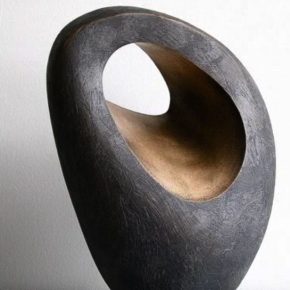
- Passage
-

- Black and White
-

- K‘ai‘ho
-

- Balance
-

- Ursula Brodauf’s studio at Pierpont
-

- Con Moto
About these times, author and translator Rosemarie Brittner-Mahyera wrote: “During the Third Reich, all art forms with the exception of realism had been banned as decadent. The West Berlin school was the first of its kind in Germany to foster Expressionism after the war, and that resurging artistic freedom provided the proper setting for [Brodauf’s] creative development. Her teachers included the sculptors Klakow, Seltz, Sinenis and Van Verkerk, some of them members of the famous Bauhaus School. After five years under their tutelage, she obtained her master’s degree in sculpture from the Master School of Arts (Utah Artists Project, J. Willard Marriott Library).”
Continuing, Brittner-Mahyera stated that Brodauf’s work “evokes a mood, contemplation, and stirring of the soul. She is a master sculptor who understands the nature of her medium – its strengths, weaknesses and possibilities. She creates but does not control, thereby allowing her sculptures to emerge into their own. The artist’s work is quietly bold; bare simplicity. Each sculptured art piece is stripped of unnecessary details, leaving a form that is pure, like a haiku poem. Her figures reflect sensitive awareness to the spirit of life; the abstract forms offer a quiet repose for the intellect.”
In 1950, Brodauf directed the design of the Colorphone Agfa Film Company’s stage sets, developing skills she thought would help her find employment in the United States while she furthered her sculpting career. Five years later, she was on her way to Los Angeles when she stopped to visit a friend in Salt Lake City. She decided to stay, settling in Emigration Canyon instead of Hollywood.
Two statements by a West Berlin teacher guided her work, she said: “Don’t piddle around. Do big things. Work has to be bigger than you”; and “You have to be possessed. I don’t want anyone in this class who isn’t possessed with their work.”
Brodauf was possessed by her work until the end of her life. She died on May 14, 2011. According to her obituary, “she invested her life to family, sculpture, and photography…” She was chosen, in 2002, as “One of the 100 Most Honored Artists of Utah” by the Springville Museum of Art. Some of her public sculptures include: “Breeze” at the Salt Lake Convention Center, “Intensity” at Fire Station No. 11, “Stations of the Cross” at St. Thomas More Catholic Church in Sandy, and “K’ai-ho” on the Browning Plaza at the University of Utah Hospital.”

Ursula Brodauf in her studio
“I feel I was put on this earth to sculpt,” she told me. “I do my work for me. I have to do it for me and those who acquire it, see it, get the benefit.”

Frank McEntire, former executive director of the Utah Arts Council, is a sculptor, independent curator, and arts administrator and was the art critic for The Salt Lake Tribune and Salt Lake City magazine.
Categories: In Memoriam | Visual Arts