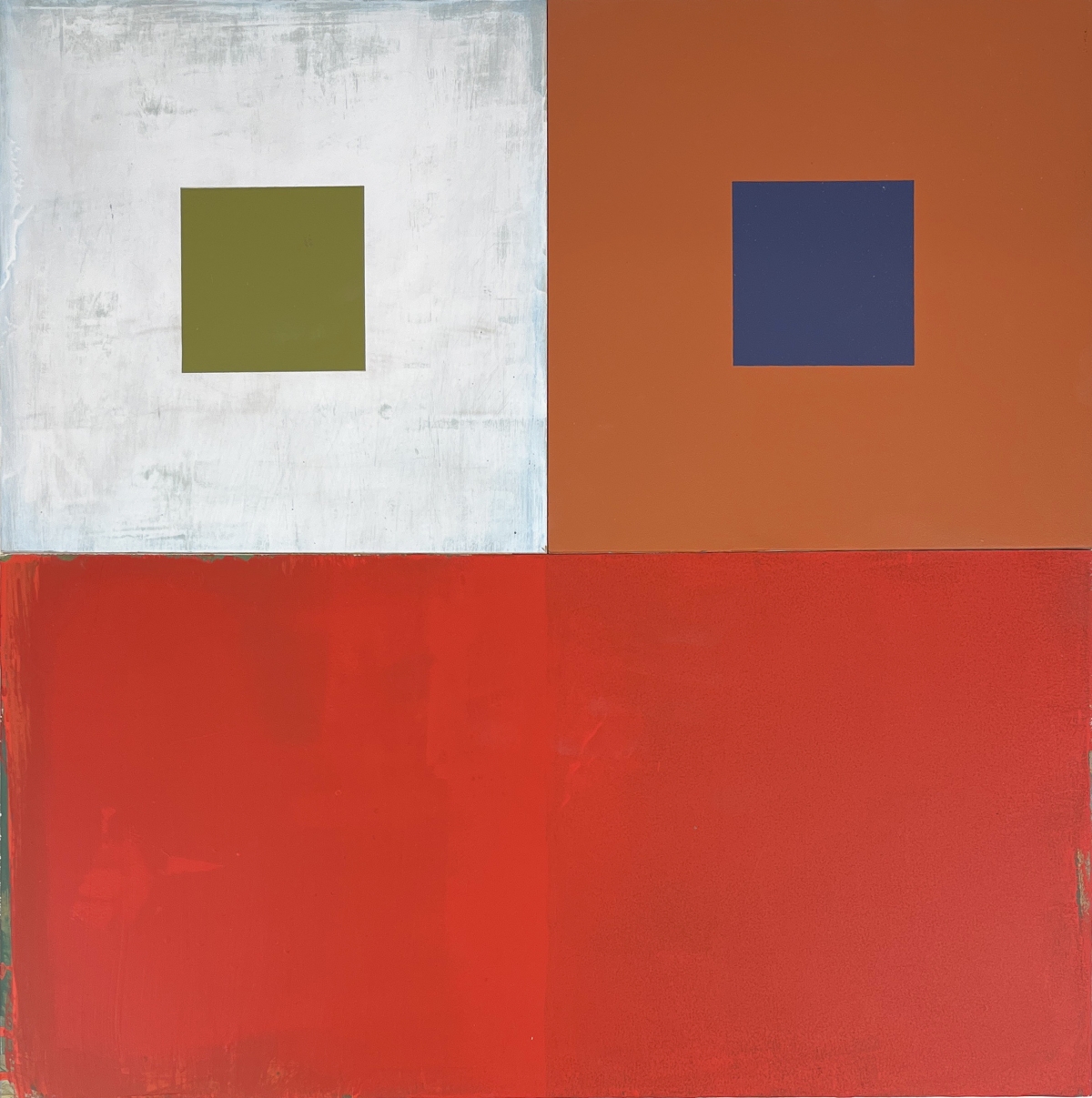
James Charles, “No Title,” house paint, 23 7/8 x 24 in.
One of the disappointments at the semiannual Poor Yorick Open Studios is the absence of James Charles. He occupies prime real estate at the crease in Poor Yorick’s B-wing, operating out of a large, enclosed space that you can catch glimpses of in our video profile of the artist from 2012. He’s there almost every day, quietly working, mixing paint, sanding edges, taping off lines. An introverted individual, he does not open his studio at the regular events. He’s not on social media. He has very little presence in our attention-demanding world. Which gives a little extra urgency to see his exhibition downstairs at Phillips’ Dibble Gallery, in Salt Lake City.
Working in a language of squares, rectangles, and clean divisions, Charles avoids spectacle in favor of precision, restraint, and slow visual accumulation. At first glance, these works seem coolly composed—simple blocks of color arranged in halves or quadrants—but the longer you stay with them, the more the surfaces appear lived-in: worked, adjusted, quietly unsettled. That tension—strict geometry against tactile, physical surface—runs through the show. In “Untitled #9,” a cool grey and olive band occupies the upper portion, hovering over a warm brown field below. Near the bottom edge, a thin blue bar interrupts the composition like a held breath. The palette across the exhibition is deliberate and weighty: deep blues, muted greys, ochres, rusts, reds. Even when the colors intensify, Charles resists drama in the usual sense. In “No Title,” a broad red field dominates the lower half, while the top is divided into white and orange panels that contain small green and blue squares. It’s bold, but not loud. There’s a sense of gravity to these colors, but the scale—mostly around two feet square—keeps the encounter intimate. You begin to take them in from across the room, but need to meet them at arm’s length.
The works inevitably nod toward Josef Albers, with their repeated use of the square as both structure and subject—one hue pressing forward, another receding, the whole painting shifting with small changes in tone. But where Albers pursued optical clarity and control, Charles allows the surface to remain imperfect and physical. His planes feel stained, rubbed, layered—less like pristine modernist modules and more like forms carried forward into a weathered present.
-
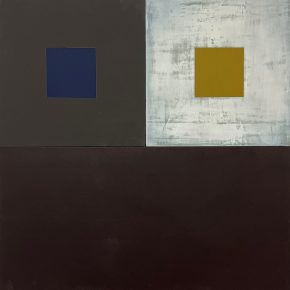
- “Untitled #2”
-
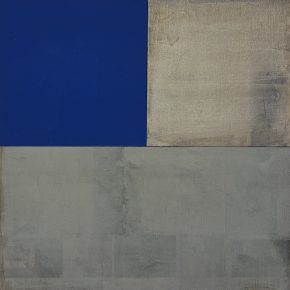
- “Untitled #13”
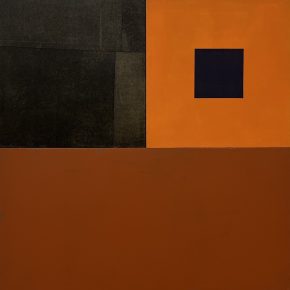
And there’s an important difference that’s easy to miss if you only encounter these works online: they aren’t single, unified surfaces. They are assembled from multiple panels—often three—joined together, and not always neatly. In some, slim gaps appear where two panels meet. In others, the bottom panel slightly exceeds the dimension of the top two, so the whole thing refuses to resolve into a perfect square. These aren’t flaws. They feel intentional: small interruptions that keep reminding you the painting is a made thing, a constructed object, a composition literally put together.
This is something Charles has been pursuing for years. In earlier work he wasn’t content simply to collage a square onto a painted surface, or mask an area and paint it in directly. He likes to cut a void into his panels and then fill it with another panel from behind—as if the square isn’t just a shape but a space that can be opened up and repaired. Look closely, and you can still catch evidence of that logic here—edges and seams give the sense that the painting has a front and a back, and that both matter. Overall, Charles’ language has tightened. The palette has deepened. The divisions have grown calmer. Previously, Charles introduced small figurative cues, little handles that suggested interpretation, or at least pointed toward it. There’s none of that here. These paintings don’t give you much to “decode.” Instead, their quiet insistence asks for that precious commodity—attention.

James Charles, “Untitled #9,” mixed media, 24 x 24 in.
James Charles, Phillips Gallery, Salt Lake City, through Feb. 13.

The founder of Artists of Utah and editor of its online magazine, 15 Bytes, Shawn Rossiter has undergraduate degrees in English, French and Italian Literature and studied Comparative Literature in graduate school before pursuing a career in art.
Categories: Exhibition Reviews | Visual Arts