

Foyer at Modern West’s new location on South Temple in Salt Lake City.
Modern West Fine Arts has had three successive locations in Salt Lake City, which is an unusual number for a gallery. For those who fondly remember the days when critics told us what was good and what was bad about things, here are some relevant opinions. The first Modern West, at 2nd & 2nd, had a great location, with good visibility and wonderful windows that allowed browsing the art without having to leave your car, or step off the sidewalk. Those windows, though, made going inside a little like being part of the display along with the art. Some of the spaces were like hallways between those windows and the partitions on which the art hung: they were too narrow ever to back up and bump into a sculpture. Other than that, the interior core was well laid out and a nice place to meet groups of enthusiasts, or even to speak to those groups.
The second, recently vacated location was literally hard to find without GPS. Once the traffic pattern in and out of the immediate vicinity was learned, it became a simple routine, though not one that made it easy to gang errands together. The space inside bordered on enormous, with industrial windows that threw glare on the art. “Industrial” was a signature of art that carried over from the 20th century, not only in galleries but in studios and lofts. Things seemed very far apart, but the lounge was elevated enough to make it a place one could sit and watch the hoi polloi as they wandered across the distance.
The third time really feels like the charm. The location is once again readily accessible, on the long straightway of South Temple, where urban clutter gives way to something sleeker. The new space is almost a cube, itself an architectural sculpture with rooms inside instead of “galleries.” These succeed each other in ways that draw one on and create relatively modest spaces, with the exception of the large and welcoming foyer that feels like a friend’s living room. The stairs are open, eliminating that feeling one is being sent up to one’s room, while allowing the ensemble and its contents to be seen in various intriguing and revealing perspectives. The spaces vary in size and, with the judgment of the staff working so well for them, an artist needn’t be Picasso to fill one of them. For Modern West, an establishment that likes to keep a sizable stable of contemporary art not only on hand, but on view, and move it around frequently in order to keep it fresh, this looks to be the place to stay for now, and for us to stop whenever the Salt Lake core is on the itinerary.

A wall of works by Fidalis Buehler.
The current exhibition, Spring Salon, offers a chance to see how well this marvel works, not only by making new work accessible, but in making art by already familiar artists look fresh and new—which much of it is. Artists who can work large but also like to make intimate pieces have the room to breathe without getting lost in space. Fidalis Buehler’s complex and winning figures hold up brilliantly here. Kiki Gaffney, another gallery stalwart whose combinations of meticulously drawn driftwood and flame-like gold leaf convincingly show that in nature, death really is a component of life, has woven together the vegetal world into a “Continual Conversation” in four parts. And Woody Shepherd, whose counterfactually colorful paintings reveal the structure of the forest, has brought forth further truth in black-and-white block prints.
Salt lakes dot our planet, misunderstood and tragically unwelcome, each in a low and very flat place, all endangered or dying. Laura Hope Mason, one of several new artists at Modern West, focuses on the local, great one as if to prove that there are, indeed, straight lines in nature. In works like “Green Fields” she has recently begun to fill in her abstract representation of water and desert with more realistic foregrounds, all to the delight of Modern West’s director, Shalee Cooper. Meanwhile, Cooper’s black-and-white, visual and geometric palindromes appear in locations where they synchronize with the building.

Laura Hope Mason, “Green Fields”

Kevin Perry of Salt Lake City and Helper, Utah is a new addition to Modern West’s stable of artists.
Also new is Kevin Perry, whose nine small paintings use techniques including collage and cutaway to create a new realism and idiosyncratic perspective on Western attire. Also showing are some of his large photographs of found architecture, in which he takes a documentary point of view without canceling the feeling that he is showing us something more than just facts.
Modern West’s third new artist is Ludivine Gérard, a Belgian living in Colorado whose abstracts follow each other from the easel in series, according to a complex, personal system. Abstraction, having reached various minimal and restrained ends, seems ready to come back with Gérard and some others with no more apologies, but with bold and energetic purpose.
In addition to those discussed here, a surprising number of painters and even a few sculptors have been made to fit right in this new home for Modern West. Anyone who feels, as I do, that the community has lost too many of its resources recently might be reassured to find this reinforcement.
-

- Kiki Gaffney, “Continual Conversations”
-

- Ludivine Gerard, “Untitled”
-
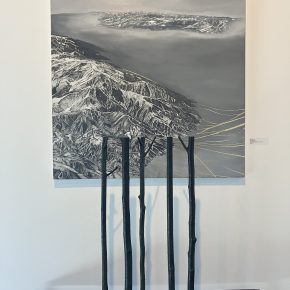
- Kiki Gaffney’s “The Valley” behind Day Christensen’s “Windbreak V Study 2”
Spring Salon, Modern West Fine Art, Salt Lake City, through June 5.

Geoff Wichert objects to the term critic. He would rather be thought of as a advocate on behalf of those he writes about.
Categories: Exhibition Reviews | Visual Arts
2 replies »
Leave a Reply
UNDERWRITERS





Thanks, Geoff. Really interested in Kevin Perry’s work.
Thank you, Geoff, for such a complimentary review of our space, and our new and existing artists. Your detailed perspective on each of our locations was spot on and hopefully our latest is also our last! Our new artists add another depth to our roster, while our tried and true artists hang beautifully in our new space. We appreciate your expert eye and detailed review!