
 Edit someone’s words long enough and their voice begins to seep into your own. For 10 years, I worked with Ehren Clark, one of the most passionate voices in Utah’s art community, and his many verbal mannerisms — his cadences, syntax and lexicon — became so familiar, so intimate even, that they seemed, at times, to take over my own, becoming like a second personal dialect, one through which I could experience the world the way he did. Ehren’s death on Monday, June 26, at the age of 43, is a painful loss to our community, and I can almost hear his voice in my head, suggesting a eulogy, in the same manner he wrote his articles: passionate, soaring, superlative, reaching for the sublime and the absolute, exhausted and out of breath at the end of each sentence.

Ehren was born in Provo, and grew up in England and Houston, in an LDS family of four boys and two girls. He was tall at an early age and, growing up, put his lanky body to use on the swim team, and as a neighborhood swim coach. The oldest in the family, he was also the “gifted” one, excelling in academics, interested in art and music, full of promise.
Ehren began writing for 15 Bytes in the spring of 2007. We were a relatively young publication, still exploring the terrain and what we could make of it. He was living in Provo at the time, writing the occasional piece on the local art scene for the Deseret News. We met through a mutual friend at the BYU Museum of Art, and Ehren quickly turned his energy to our publication. An open forum, willing to speak up to our audiences rather than down, and eager to pursue the ideas that inform art and its creation, 15 Bytes was well-suited for his own interests. He began writing on a monthly basis, carving out a space of his own, diving with equal abandon into historical exhibits at large museums and small, personal shows by local artists, becoming one of 15 Bytes’ principal voices in the years it came to define itself.
Soon after he began writing for us, Ehren moved to Salt Lake City, “where the action was,” as he would say. He set up shop first in a cozy duplex near Liberty Park before settling in his longtime home at The Ruby Apartments downtown — within a block or two of a half dozen art venues, all of which he covered in his articles. He could be seen jaunting about town in all kinds of weather, on his way to Deseret Industries or a gallery exhibition, riding his little gray scooter, or, in the last years, on foot, a modern day flaneur absorbing the city he made his own, and which he refused to leave.
He was an unapologetic individualist, living a curated life, from the bohemian chic fashion sense he could forge with a select pair of corduroys and a well-chosen thrift store shirt — accented in colder months by a scarf or beret — to the numerous objets d’art and used books that filled his apartment. He was an incurable collector. He passionately bought up the entire Criterion Collection of films, then sold it off when he found the obsession too overwhelming, only to begin forming the collection once again.
He was always passionate, hungry for a new assignment. In addition to the 150-plus articles he wrote for 15 Bytes, Ehren was a regular contributor to City Weekly, wrote pieces for the short-lived print journal Fibonacci, and engaged in several independent writing projects. He even managed to slip in a stint as a professor at Westminster College.
Since he wrote about it in various public venues, it won’t betray any confidences to say that Ehren struggled with mental-health issues for years. He had his first major psychotic episode in 1994 and was hospitalized more than once as he struggled with schizoaffective disorder for two decades. Despite these difficulties, he finished his undergraduate studies at the University of Utah and was able to earn a master’s degree in art history at the University of Reading, in England. It was there he soaked up the likes of Immanuel Kant and Edmund Burke, frequent references in his writing.
He wasn’t always easy to be around. His enthusiasm, which was one of his most magnetic qualities, could become manic frenzy, spilling over into chaos and belligerence. Depression frequently followed, and one suspects not just for chemical reasons — here was a passionate, intelligent man with an open heart, frustrated by the gap between the promise of his abilities and the realities of his illness. With time, friends and colleagues learned to recognize the shifts in mood, but those who knew him less well were often left bewildered.
Which was a shame, because his struggles with mental illness frequently hid his endearing qualities. He was a kind individual, filled with an enthusiasm for life and persistent optimism even in the face of ravaging interior struggles. He fell out with friends, sometimes more than once, but seemed little willing to hold a grudge, eager always for reconciliation. When he wasn’t mired in the deepest troughs of paranoia or depression, he managed his illness with humor and a good deal of grace.
He was driven by a desire to give, to be something to the community, to the world, to bridge that gap between the early promise of his youth and the struggles of his adult years. He did that in small, personal ways, as a friend and as a brother and an uncle, but also in more public ways, in his assumed role as champion of Utah’s artists. He spent countless hours visiting shows and stopping in to talk with artists in their studios, and everything he came across was pregnant with possible meaning.
Read his articles from the past ten years and many recurring ideas emerge — existentialism, subjectivity, the sublime. But one sticks out overall: connectivity. In art, Ehren saw the possibility for connection, between the abstract and the concrete, between the world as it is and the ideas we develop to organize it; but more importantly, between the artist and her viewer, and between the critic and his audience.
Ehren was a gay man who ultimately chose to live within his faith tradition, compounding the inherent loneliness of his mental struggles with that of being single. He was supported, however, by a loving family who managed to help him live an independent life despite his struggles; by a wide array of friends, from the well-established gallery owner to the clerk at the local 7-Eleven; and by the members of his local LDS congregation, which became his home and gave him an opportunity to care for others.
At one time, Ehren seemed almost everywhere in the Utah art scene — on social media, in the pages of 15 Bytes, City Weekly and Fibonacci, towering over the crowds at Gallery Stroll. For the last few years, however, he was seen much less frequently. The frenzy with which he immersed himself in the community at one point became unsustainable as he dealt with his mental health, and he was constrained to establish a more measured approach to the community he loved. Yet he seemed continually drawn, whenever his health would permit, to the role he saw for himself as “Utah’s art critic,” as he once styled himself.
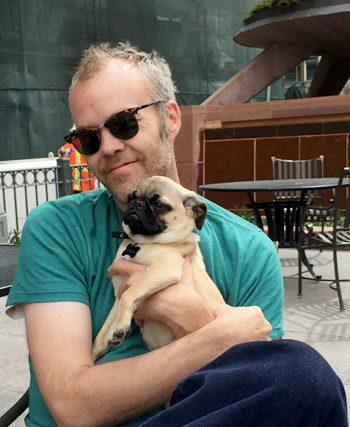 It may be small comfort to know that in his last months Ehren was excited and engaged, rather than listless or despondent. He attended Gallery Stroll for the first time in a long while in June, and was at work on two articles for our July edition when, after a recent shift in his medication, he died from an accidental overdose. He was also drawing up plans for a home exhibition. It was to be a third Friday event, in which he would invite members of the community into the personal space of his apartment, to peruse his carefully organized but overflowing collection of books, objects and art. It was to be called “Mind the Gap.”

You’ll find our archive of Ehren Clark’s articles here.
35 replies »
DID YOU ENJOY THIS ARTICLE?
Help make more like it possible.
VENMO us a donation at artistsofutah

Or use PayPal to MAKE A DONATION.
15 Bytes is published by Artists of Utah, a 501 (c) 3 tax-exempt nonprofit.

The founder of Artists of Utah and editor of its online magazine, 15 Bytes, Shawn Rossiter has undergraduate degrees in English, French and Italian Literature and studied Comparative Literature in graduate school before pursuing a career in art.
Categories: In Memoriam








Dear Shawn,
I have tears in my eyes and a lump in my throat reading your words about Ehren.
They are perfect words for your friend and colleague. Also you clear away some of the questions we all have had about Ehren who many loved. Your friendship to him, was I am sure, invaluable to him. Thank you Shawn for writing about his life, struggles included. Sincerely Carolyn Coalson
I never met Ehren. After he wrote a beautiful review of my exhibit at Art Access in October 2015 I searched him out online with the intention of writing him, thanking him. I couldn’t find him on Facebook at the time and meant to contact 15 Bytes to get his info. Life got busy and it fell by the wayside with a thought that I’d meet him at some point and could tell him then how much his review meant to me, how he captured in words what I had expressed in paint, how he understood the great emotion behind these particular paintings. My heart is broken to know that I cannot thank him… Beautiful tribute Shawn. I wish I had known him…