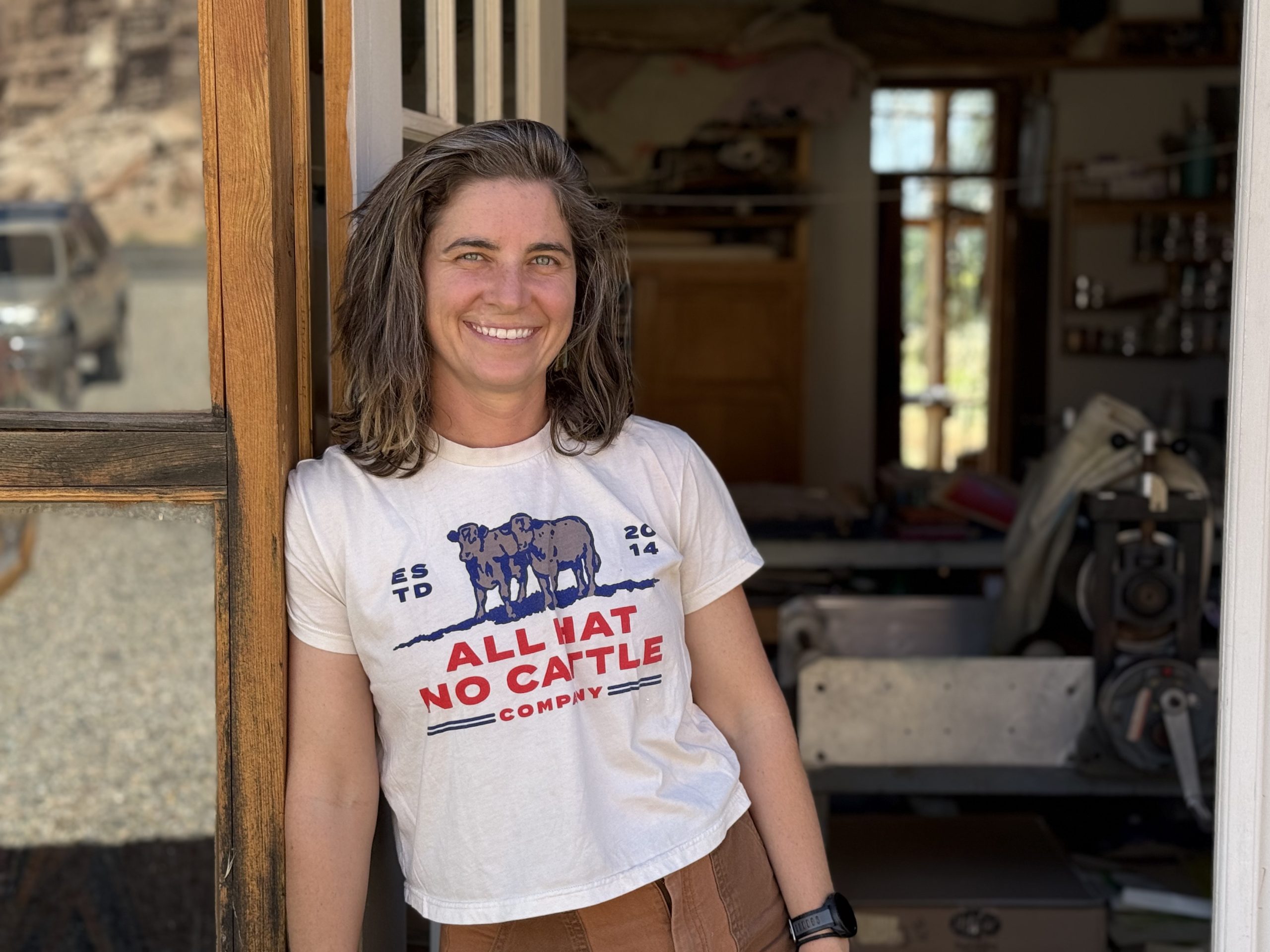
Growing up in Flagstaff, Arizona, Kate Aitchison had a father who could tell her what everything was. A naturalist and photographer, he knew the plants of the Southwest—which were native, which were invasive, what belonged where. His daughter wasn’t particularly interested. “Now I wish that I could record it every time he talks about stuff.” It would come in handy as she gathers plants from the landscape around her home in Bluff, Utah, and turns them into paper.
Aitchison is primarily a printmaker and papermaker. In her Bluff studio, handmade sheets, beautiful in their own right, become the grounds for layered monotypes of rivers, cliffs, vegetation and sky—the landscape that has kept drawing her back to the Southwest.
Aitchison left Flagstaff for Colorado College in Colorado Springs, where she studied art and discovered printmaking. After graduation she spent a winter in Taos with painter Elise Frank, then returned to Flagstaff before deciding to apply to graduate school. Somewhat to her own surprise, she got into the Rhode Island School of Design. “It took me out of this place,” she says, “and so I had this kinda different perspective on the Southwest, ’cause I wasn’t there.” At RISD she found herself among artists whose interests could be radically different from her own. “People were doing all kinds of different things that were very unrelated to what I was doing,” she says. It helped her “see my work in relation to what else was going on instead of being saturated in landscape stuff.”
After earning her MFA, Aitchison stayed in Providence and taught at RISD. Her future husband, Brian, was working at AS220, a community arts organization with a massive printing press donated by RISD, its printable bed measuring five by ten feet. Aitchison put it to use. “I was making these gigantic monotypes of dams for my thesis,” she says. Human intervention in the landscape was an explicit subject of her work: dams and other built structures imposed on natural systems. Over time, the intervention has become less literal. The dam largely disappeared from the picture. The paper underneath it became more important.
Despite building a successful life in Providence, Aitchison kept coming West. She spent summers working on the rivers, including in the Grand Canyon. Eventually Brian began river work as well. Their lives developed an east-west rhythm: teaching and art in Providence, rivers and desert in the West.
That included Bluff and the San Juan. Her father had brought her through the southeastern Utah town several times when she was young. She knew it and its river well. When, in 2019, they saw a house for sale, they jumped. “It was a really good price, and it just worked out,” she says.
The following year provided an unexpected trial run for life in Bluff. Aitchison and Brian were visiting when COVID shut down schools. Her teaching moved online. His nursing school did the same. There was suddenly no reason to return immediately to Providence. “We just stayed here because we didn’t have to go back,” she says. “You would just go outside every day and not really have to worry,” she recalls. “It was like, ‘Oh, this is actually really nice.’”
After the shutdowns they returned to Providence. But in 2023, they decided to make Bluff their permanent home. “We just really liked the landscape,” she says. “That was the major draw.”
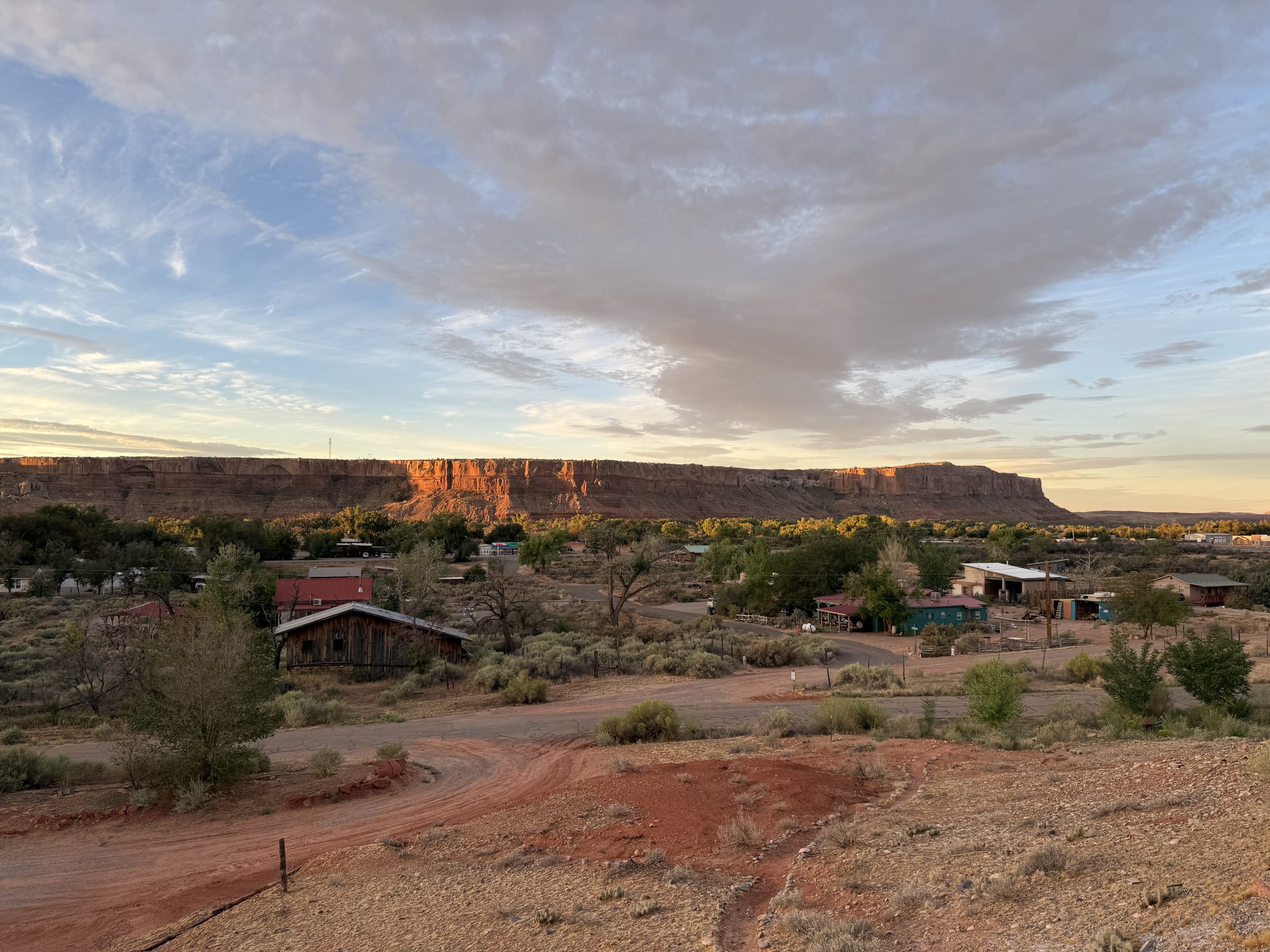
It would be easy to turn their decision into the familiar story of the artist escaping the city for the inspirational solitude of the desert, Georgia O’Keeffe style. Aitchison doesn’t. “Sometimes I love it and sometimes I wish it was bigger,” she admits.
Bluff is beautiful. But it is also small and isolated, its economy largely dependent on seasonal tourism, public-sector employment and retiree income. Moving there meant figuring out how to sustain both an artistic practice and an ordinary life.
The answer, at least so far, has involved doing a little bit of everything. Brian works as a nurse and is also a screen printer. Aitchison teaches workshops and classes and continues to pursue exhibitions and residencies outside Bluff. She has taught at Anderson Ranch in Snowmass and works with Mancos Common Press in nearby southwestern Colorado. She has collaborated with scientists and is part of an artist-in-residence duo at The Nature Conservancy’s Dugout Ranch.
She also helps run the Cow Canyon Coffee Shop. She and Brian convinced his sister, Hannah, to move west with them. Hannah had worked as a barista for years in Brooklyn, but “neither of us knew anything about opening a business,” she says. “I think if we had thought about it too much, we probably wouldn’t have done it.”
They lease the building from Liza Doran, who runs the Cow Canyon Trading Post next door. The coffee shop is part cafe, part bookstore, part gallery, and it fills a conspicuous hole in a town with few places to gather. It also began to occupy more and more of Aitchison’s time. “The coffee shop just took over our lives for a couple years,” she says. During the first year, she and Hannah did nearly everything together as they tried to figure out how the business worked. Eventually Aitchison reached a point where she had to pull away. “I was like, ‘Okay, no, this is not what I’m trying to do.’”

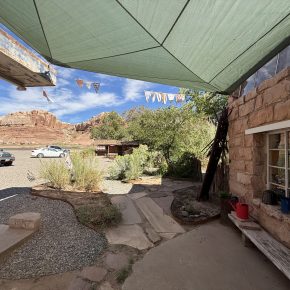


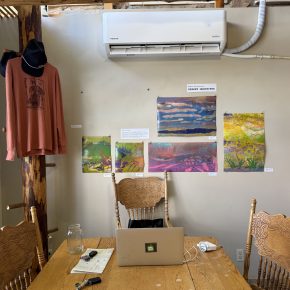
Hannah now serves as general manager, giving Aitchison more time to return to her studio, next door in a sandstone structure that once served as a mechanic’s shop. But you’ll still find Aitchison pulling espressos, or sitting at the cafe’s front table on her laptop, several of her prints hanging on the wall above her. Separating the coffee shop from her creative life isn’t entirely straightforward. “The coffee shop is not an art project,” she says, “but it also felt very much like an art project.”
It became a community space, and Aitchison has used it as an exhibition venue, curating contemporary work in conversation with the trading post next door. Twice Aitchison has brought Colorado College students to Bluff for an intensive course centered on building wooden boats. Working with her friends at Fret Water Boatworks in Flagstaff, she begins with plywood hulls prepared for the students. Before the plywood becomes a boat, however, it becomes a printing surface. “The students designed for one week, and then they carved and printed for one week, and then we built for one week,” Aitchison says. “It’s an insane amount of work, but it’s really, really fun.” Then they launched the boats on the San Juan and spent three days on the river. Now the boats are scattered around the yard of the Cow Canyon complex.
She has also become increasingly involved in Bluff’s larger cultural life. She is running the Bluff Arts Festival for the second year and has been developing connections throughout the Four Corners region and, increasingly, with the rest of Utah. “It wasn’t like, ‘I’m gonna go make Bluff an art mecca,’ or something,” she says. But living in an isolated place has meant helping build some of the infrastructure she might once have taken for granted. “Mostly I feel like I’ve been trying to build stuff here and also just make connections regionally,” she says. “It’s happening slowly but surely.”


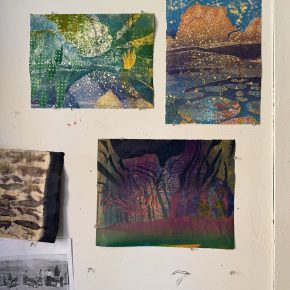
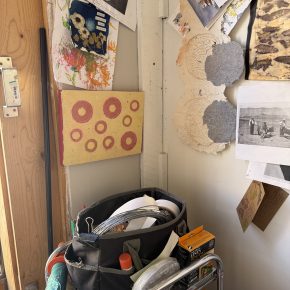

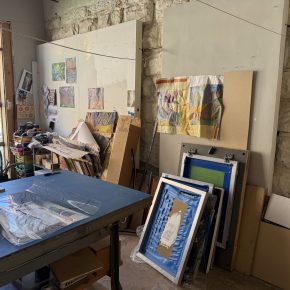
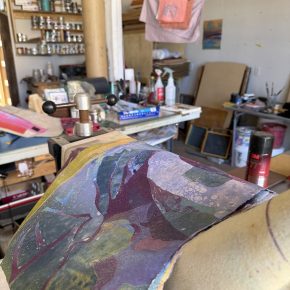

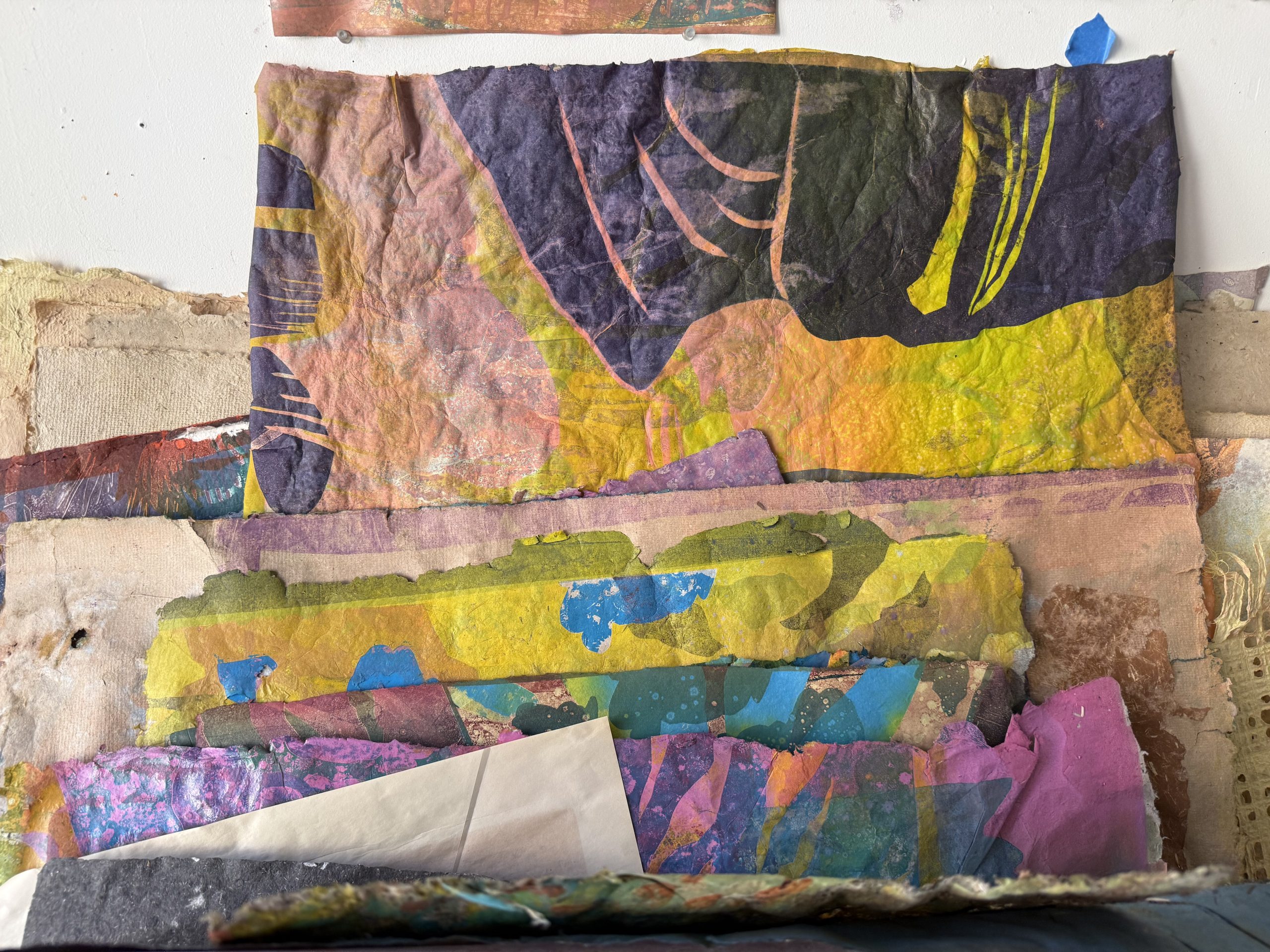
Through it all, Aitchison carves out time in the studio, where papermaking shares space with printmaking. Invasive plants, old T-shirts and jeans, scraps of linen and other scavenged materials are pulped and recombined into sheets that can be mottled and irregular, sometimes translucent, sometimes built up with areas of colored pulp poured almost like paint.
“I’m a really fast worker and a messy worker,” she says. Though printmaking is at the core of her work she says she has never been particularly attracted to the technical aspects that can consume printmakers. “I don’t really love getting into the nitty-gritty of the exactitude of printmaking like some people do,” she says. What she loves is the medium’s democratic history—prints as comparatively inexpensive, reproducible objects, an “accessible art form” and “a form that’s for the people.” There is a slight contradiction in that enthusiasm: Aitchison primarily makes monotypes, unique prints rather than editions. But the process suits her temperament. Printmaking puts something between her hand and the finished image. Unlike drawing or painting, she can’t entirely control what happens when the paper meets the plate. “Taking away the directness of a painting or a drawing I think is good for me,” she says. “It actually does make me slow down.”
Creating her monopirnts, she generally knows what she’s trying to make, but she just doesn’t know precisely what the press will give back. “To me that’s really exciting.”

Kate Aitchison, “4 Pass Loop,” 2025, monotype on handmade paper (paper made by the artist from recycled textiles and invasive plant species), 38 x 50 in. Courtesy of the artist.
The landscapes that emerge from this process aren’t conventional views of southeastern Utah. Aitchison uses photographs extensively as source material, but a photograph is only a reminder. It rarely captures what she remembers experiencing. She might encounter a rainbow on a run near Bluff and take hundreds of photographs, but none of them will right. “I know it’s there,” she says, “and I just have to remember what it was actually like and try to recreate that instead of this photo.”
Her prints are infused with these memories. A stencil developed from one place might turn up in an image of another. Elements from earlier prints reappear. Multiple viewpoints coexist in a single landscape. The works don’t necessarily describe a particular place at a particular instant. They are closer to what remains after having been somewhere: a bend of river, a plant along a trail, the shape of a distant bluff, a remembered sky, all collapsed into the same image. “I think I’m really interested in making landscapes that people are drawn to in the way that I feel drawn to landscapes just by being in them,” she says.
That means making something different from the southeastern Utah a one-time traveler might encounter driving through at noon, when the desert is washed flat by the sun and the heat can make the whole place seem hostile. “The way that I make landscapes is, like, if you were here at the ideal time and the ideal weather and the ideal moment,” she says, “this might be how you feel about it.”
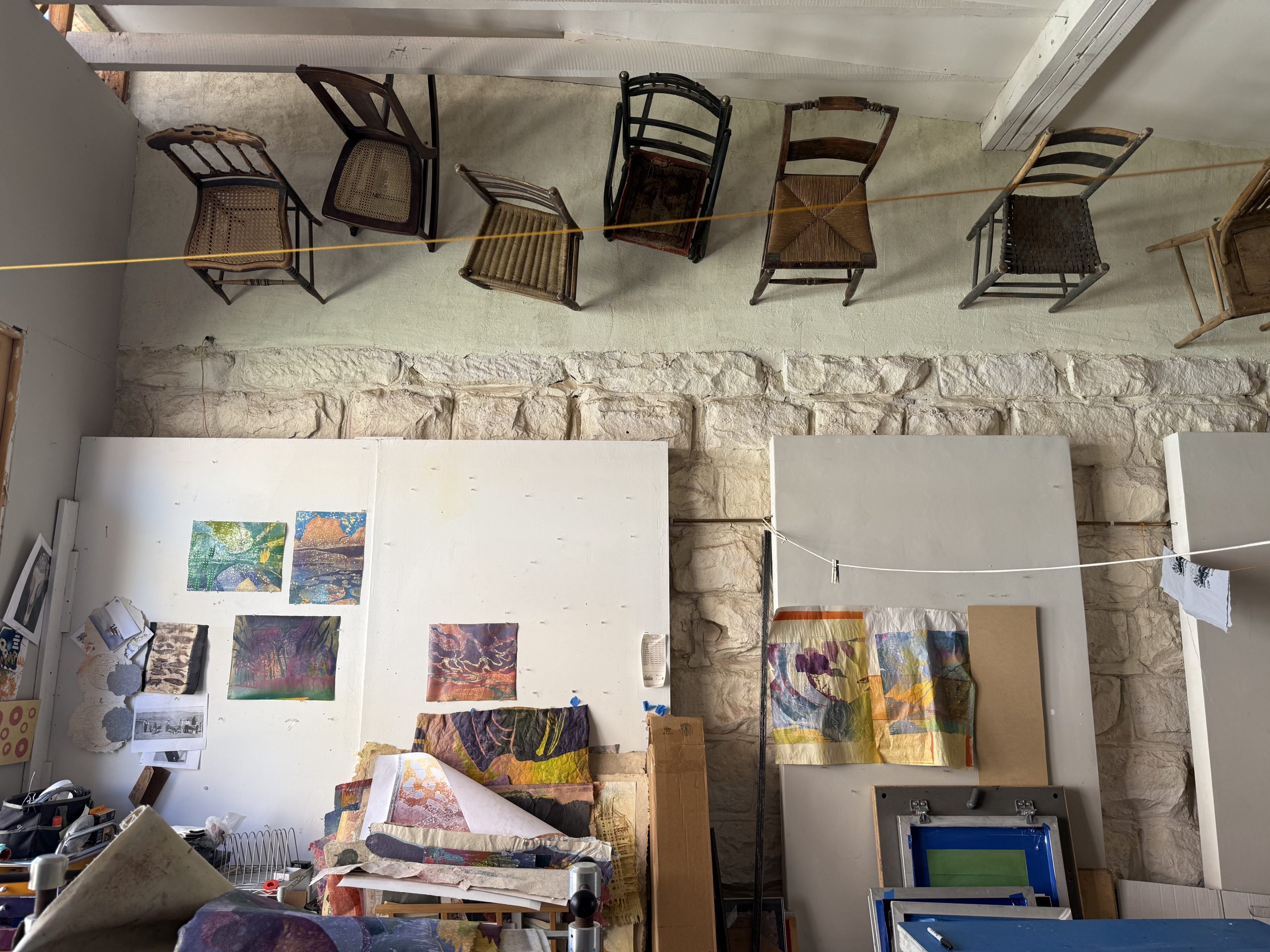
It shouldn’t be hard to find Aitchison at the Bluff Arts Festival, Oct. 15-18. You can find her work at kateaitchison.com.
All images courtesy of the author.
Related posts:
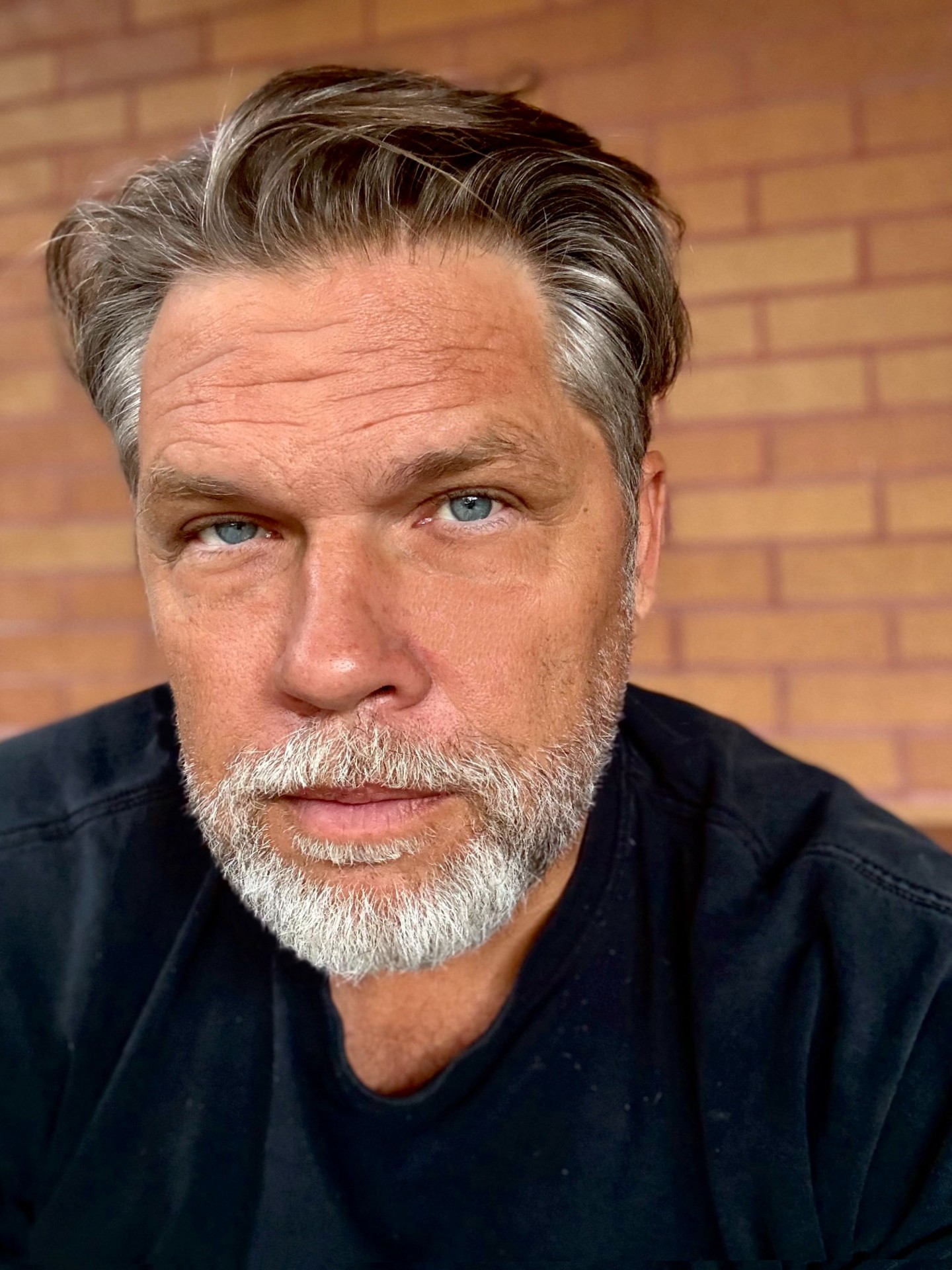
The founder of Artists of Utah and editor of its online magazine, 15 Bytes, Shawn Rossiter has undergraduate degrees in English, French and Italian Literature and studied Comparative Literature in graduate school before pursuing a career in art.
Categories: Artist Profiles | Featured | Visual Arts