
 There’s a wisecrack by Ad Reinhardt (or some say Barnett Newman) that a sculpture is something you bump into when you back up to get a better look at a painting. That notwithstanding, having the two media share a gallery can be an effective use of space. One goes on the walls, the other between them. That said, it’s a challenge for the installation photographer, who will struggle to avoid the ultimate mixed metaphor of making one artist’s soulful contribution a mere backdrop for another’s.

Then again, when two artists who are partners, professionally, or personally, or both, choose to show together, sympathy between their styles can make a statement about far more than their aesthetic principles. Artists are often portrayed as suffering and ill-rewarded victims of their muses, but John Wood and Cuong Ta, currently showing at Phillips Gallery, where Wood has been a steady favorite ever since he graduated from the U of U in 1971, are better seen as examples of what Utah offers its artists: they appear to be happy, hard-working, and content in the important choices that determine their lives.
Modern art criticism tends to confuse abstraction, wherein something essential is drawn out from a sight encountered in nature, and concrete art, which is an original construction from marks and gestures. In fact, artists like Wood and Cuong tend to begin a work in one and work their way into the other. Wood is known for favoring two sources, the landscape and the figure, that are sometimes still discernible as a sketch buried in the layers of color arrayed on top of it, and at others present in the overall organization of a work. Like a composer or jazz artist, he may start with a simple theme, elaborate it extensively, and then apparently return to sum up the beginning at the end.
Cuong Ta often begins a sculpture with a concept, like his variations here on functional objects. His “boxes” seem to have been built of wet clay, then cut up in various ways, while the “bottles” have had disks, pierced off-center by holes that suggest handles, attached in such profusion that they depart function for something else entirely. Both artists may predicate a work—or a series in Cuong’s case—in language. Wood’s “Poems on the Wall” is his primary example here, in which just enough of the letters survive to identify the poem, while some viewers may regret not being able to pick out enough to gather a sense of what it originally said. In Cuong’s case, as we will see, the label is pretty much all that remains of the original function.

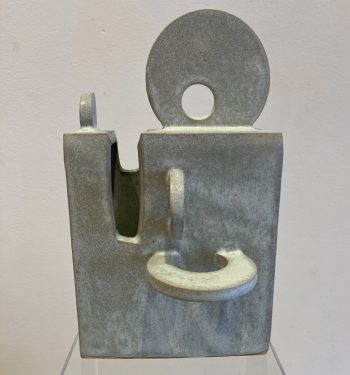
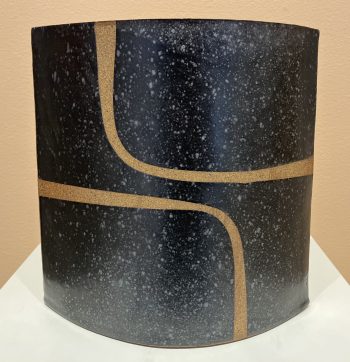
There’s an old distinction, that where artists make pictures of things, sculptors make things. Both these artists revel in the materiality of what they do: the ink sticks, markers, paint, and paper Wood spontaneously and energetically applies; the clay, with its granular texture and mineral colors, that Cuong molds, then articulates with colored glazes. Cuong, however, seems further seduced by the physical potential of his medium, in which he makes countless cups or mugs, striving always to make no two alike. In regards to this fundamental ceramic activity, he comes right out and says that in them, functionality gives way to form. Furthermore, the ease of duplication, such as the discs he cuts out with what are essentially cookie-cutters, allows him not only to build with them in their basic, repeated form, but to cut them up to use as recurring parts—fragments that thematically invoke their original forms.
The notion of conversation is relevant to both artists, but in necessarily different ways. Although some of Cuong’s pieces, notably here the bottles, are completely covered by their glaze, as though it made up their entire substance, most of the rest have been first masked, then glazed, so that after firing the masked parts display the original clay surface. Like “Bird,” the colors on these pieces possess a palpable thickness. Each piece so made conveys the sense of a single intention and the craft used to carry it out. Where these are done in series, like “Small Red I-IV” or the “Wall Installation,” they can be shown together to create a feeling of objects in conversation. Then, with others, specifically the variously decorated, convex disks that are like circles cut from balls, the conversation that begins may swell and eventually resemble a party.

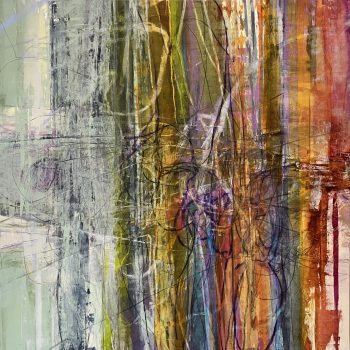
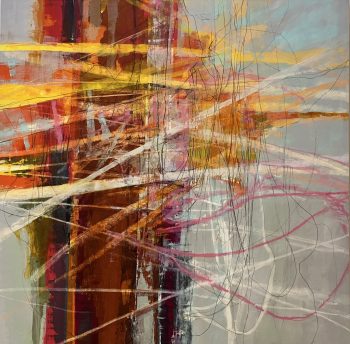
In Wood’s case, it’s his technique rather than the results that is described as a conversation, here between the artist and his work. Hints he’s offered over the years come close to a conceit familiar with novelists, who may claim that their characters come to life and tell them what they must write. For some artists, this experience might actually be part of the creative process. A bit of visible evidence for it can be seen on Wood’s Instagram page, where photos of him are interspersed among the catalog of his works and scenes from his life. In almost every one of these, he is smiling, genial, and enjoying himself. The single exception, a photo taken over his shoulder as he drew on a painting, seems to show him just as he realized he was being photographed. If so, his response perfectly captures someone whose important and intense conversation has just been interrupted.
There is a third conversation in this context. In an interview, Cuong expressed his delight at having his husband and fellow artist in the studio “right next door” to his, though he did mention—and no one should be surprised to hear—that in the beginning they had to establish some boundaries to protect their respective labors. Speaking of boundaries, Emeryville, where their studios are located, is bounded by Berkeley and Oakland, north and south, and on the west by San Francisco Bay. It’s a small town with the practical advantages of an edge city, but embedded in the heart of one of the densest and most substantial cultural zones in America. It’s a pre-European historical site, including an artificial mountain of clam and oyster shells deposited by the Ohlone Native Americans, yet it’s also connected to the future through the presence of forward-looking businesses like Pixar Films and several refugee corporations from nearby Silicon Valley. For years, there were driftwood sculptures on the shore of the bay that could be seen from the Bay Bridge. Meanwhile, John Wood still maintains his lifelong connection to Utah, and has introduced Cuong Ta and Utah, through Phillips Gallery, to each other.

John Wood and Cuong Ta, Phillips Gallery, Salt Lake City, through May 8.

Geoff Wichert objects to the term critic. He would rather be thought of as a advocate on behalf of those he writes about.
Categories: Exhibition Reviews | Visual Arts





This show was coming in as my show with Paul Vincent Bernard was coming down. I have always loved John Wood’s work however I was obsessed the second I saw Cuong Ta’s work! We were out of town for the opening but purchased three pieces of his work of his work upon our return. I cannot wait to pick them up at the end of their show!
Josanne, I can take no credit; your good taste is well known. But I’m glad you had the chance to collect some of Cuong’s work, which I envy you. Mostly, though, I want to thank you for taking the time to comment here. Your feedback is one of the things I live for in this work.