

John Erickson in his studio. Photos by Zoe Rodriguez.
“It’s almost like a bug in amber,” says John Erickson, describing his new series of multi-layered, multi-media paintings that will be featured at Phillips Gallery this month. That simile is a good place to start this article because it’s typical of Erickson, who uses simile and metaphor frequently to help his University of Utah Students make sense of the creative process. “Johnisms,” they call them.
Think of a bug in amber and you’ll also begin to visualize the shiny smooth surface of the resin-coated painting trapping the many layers of marker drawing, latex paint, collage, and oil paint that seem to occupy infinite space and incorporate mutliple centuries, from Renaissance realism to post-modern abstraction. Such is the complexity, contradiction, and excitement of Erickson’s new “big head” paintings.
Yes, the subject and starting place for Erickson’s creative process is the human head. Exploded larger-than-life to a 3’ x 4’ panel or 16” x 20”, at the very least, the people may be friends, colleagues, students, or himself; anyone willing to sit for a series of photographs. You might even call them portraits for he achieves a recognizable likeness in spite of the abstraction that characterizes his work.
Abstraction has not always been Erickson’s chosen style. In 1972, he moved “east” (from Magna), to study at the University of Utah with realist painter and teacher Alvin Gittins. Then, in 1975, he received a fellowship to study at Yale University for the summer. There, he met such notable painters as Wolf Kahn and Alex Katz. But it was Louis Finkelstein who reframed his approach to painting. Finkelstein, who referred to his own work as “abstract impressionism,” sent Erickson into a deep Connecticut forest and told him to paint it. Erickson recalls that in that space, surrounded so closely by green trees, abstraction seemed the only possible approach.
After graduating from the U with a B.F.A., Erickson took a couple of years off, turned an abandoned Magna barbershop into a studio, and just painted. He taught occasionally at Bountiful Davis Art Center and eventually decided a M.F.A. degree would help validate and open new doors for teaching. He returned to University of Utah for graduate school and has taught there ever since.

Teaching figure drawing at the U gives Erickson an opportunity to exercise his drawing skills as well as to challenge himself and his students to follow new impulses. The particular process that has yielded this exhibition has been two years evolving. Last summer when he took one of his new paintings to Helper, UT, where he juried the Helper Art Salon, a collector approached saying, “I can’t live without one.” His first sale in the series encouraged and energized him to work more intensively toward this exhibition of more than 15 brand new works.
Like a time traveler, Erickson moves back and forth between a Renaissance devotion to realism, drawing with accuracy the shapes, planes, and lines of the head, and the post-modern intuitive, deconstructive impulse. It’s a thrilling ride though he admits he sometimes doesn’t know where he’s going.
His process starts with a random application of color in a New-York-school-canvas-on-the-floor kind of way. Next comes the Renaissance academic drawing, which challenges the randomness of the underpainting. He may use red and black markers to draw the structure of the head, defining shapes and planes with contour lines. Even in this skeletal framework the likeness begins to emerge.
Then, with an assertiveness that horrifies his students, he says, “I vandalize my own painting.” With large brushes in about 10 Ziploc pots filled with latex paint in various warm and cool “bad beige” tones, he roughly blocks in the forms and features of the head, usually obliterating the drawing he so carefully constructed.


Now the real fun begins. With colored pieces of paper and torn magazine pages, he begins to deconstruct, or abstract, the image. “My collage system is not very orderly,” says Erickson. “ I don’t have them categorized into pots or scales. I just have a bunch of magazines lying around. And then I almost go through a kind of crisis…I need a particular color value and odds are I’m not going to find it. So I have to get an approximate thing that sort of does the job, and there’s this accumulation of sort of…kind of…never quite gets there. But as [the pieces] accumulate, it does get there, but it gets there slightly wrong all the time, so there’s that unity of wrongness, chaos.”
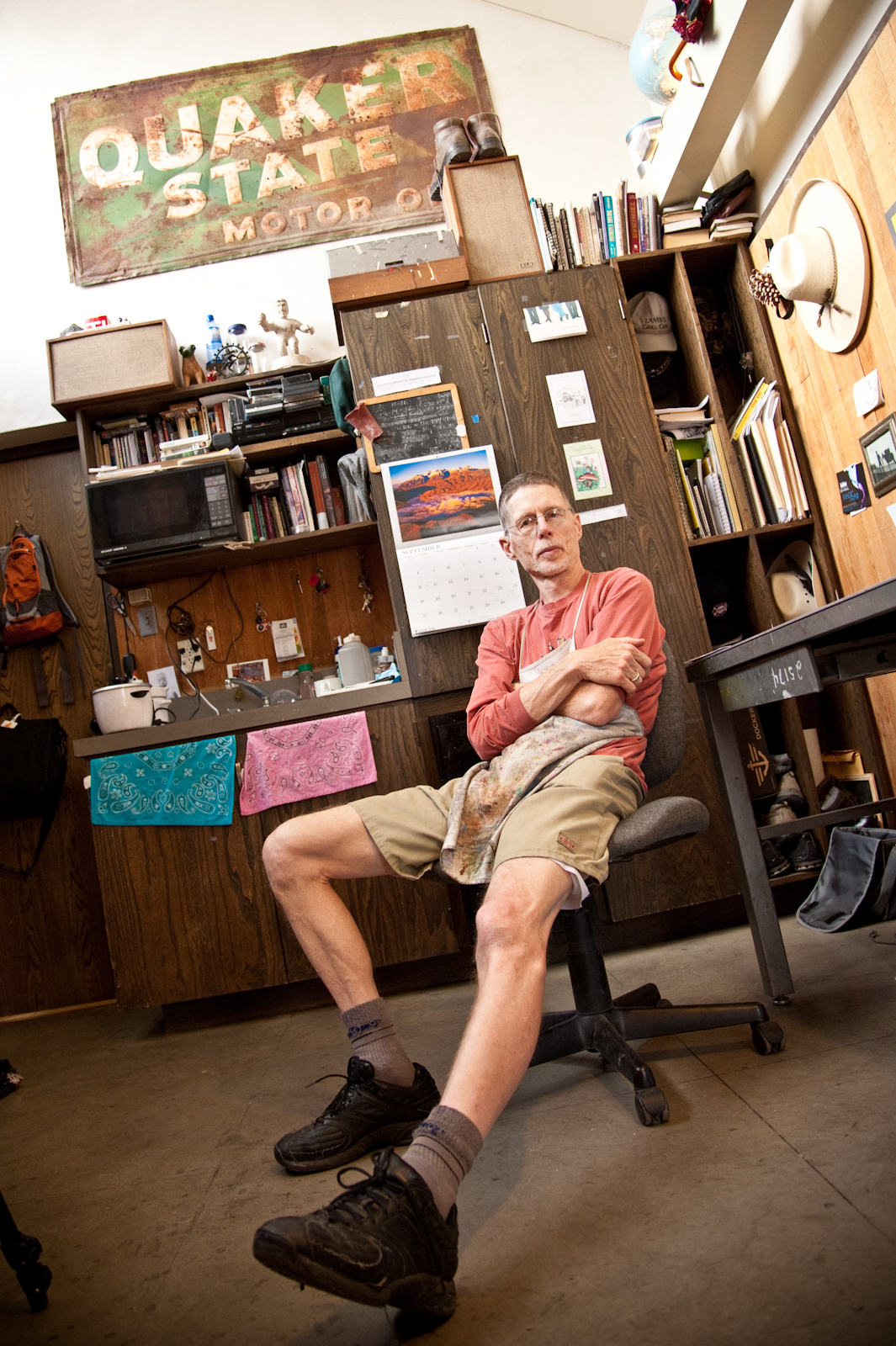 To the viewer, Erickson looks like he knows what he’s doing, but he insists, “My process is enigmatic to me. A lot of times I don’t know what I’m doing. Yet I’m trained to paint. There’s a process where I’m not functioning out of my training, and then there’s a period of process where I’m very conscious and I’m quite academic. I can tolerate, in a sense, different religions on different days. That’s what the viewer is going to have to deal with. It could repulse some viewers; they’ll struggle with it; and other viewers will think this is delightful. I love the contradictions. I love the moments of coherence.”
Out of chaos, Erickson once again finds order. As he says, “I do the Dutch thing,” meaning a more realistic classical painting with oil paint, not on the entire painting, but in those places where the face or object is closest to the viewer. With the shift from chaos to realism, “It becomes the delectable moment,” says Erickson. “Like when you’re eating pancakes; the butter, the maple syrup, and the right amount of carbohydrate are sitting there on your tongue and you’re having that delectable moment. In my case, on the tip of the nose you’ll have the soft edge, the rolling of the cartilage on the tip of the nose from the light side to the dark side. Maybe there’s a temperature change there, too. And in oil paint I can come on top of the abstracted collage and give that delectable moment, that sensation, which then seduces the viewer into the tipping point. For me it’s a moment of tension.”
In his oil painting phase, Erickson mixes a palette of oil and then scumbles, dragging fairly dry paint across the collaged surface. Then he takes a smaller, flat sable brush and begins to soften edges to create highly illusionistic moments. “I don’t want to get over-resolved because it would hide those layers of process,” he says.


So when is the painting done? “When the tension is exquisite. Sometimes I don’t always know. What I’ve learned in this series is that sometimes the painting will tell me not to paint on it. Or I’m learning how to not do it on certain days. I want to protect some of those raw impulses that make the painting visually exciting.”
After looking at a painting for days or weeks, when he decides he’s achieved that exquisite tension, he adheres the painting to a cradle and coats the top and sides with a two-part polymer resin called Envirotex. He mixes about a half gallon, enough to cover a 3-foot by 4-foot painting. Then, he has about an hour to cover the painting and get the air bubbles out before the substance begins to harden.
It seems odd that a surface so hard and shiny and two-dimensional could enhance the illusion of deep space in the completed paintings. Yet, Erickson’s mix of materials, colors, and techniques are enriched and refined by this final layer. It’s a bit like those paperweights we made as kids; the thick glass dome magnifying the colors and forms underneath.

The resin layer would seem to be the end of the process, yet Erickson wonders “what if” you added more collage and another layer of resin? As so often happens with him, the materials may lead the way to new discoveries and a different process.
The Phillips show is about six weeks away as we talk in Erickson’s studio on the top floor of the art building at the U. In addition to more than 15 completed paintings, there are four or five works in progress on easels around the room. Two are portraits commissioned by a woman who is also an artist. In Erickson’s world of deconstructing and abstracting, there’s a real possibility that the client wouldn’t like the end result. Erickson must balance his desire to satisfy the client with his own chaotic process. “I’ll do several paintings of the same person so that I can feel dangerous and take a lot of risks. Hopefully, there will be one that the client will like and I’ll have a process that will satisfy me.”
In addition to the abstracted but recognizable human head, Erickson’s paintings often include objects that play with the viewer’s perception of space. An apple hanging in the foreground; a light switch that seems to be on a plane perpendicular to the picture plane; an electrical plug; and a cat walking straight toward the viewer. He calls these devices “tropes,” which, in medieval choral music, referred to the insertion of an ornamental or rupturing element. “It can rupture, pollute, or contradict the overall intention,” Erickson explains. “For instance my light switch I use to contradict the expectation of the painting and it keeps the viewer and me a little unsettled. It keeps the painting a little unbalanced.”
The Phillips Gallery exhibition continues a 35-year relationship with Erickson and his work. Over those years Erickson’s collections of works have evolved in surprising ways. At one time he created large figurative paintings in a monochromatic, gray-black palette. In another period, he was known as the “painter of night,” with a series of works painted at night on various Salt Lake City area street corners. His big head collection of paintings is all new and just a brief pause in the continuing evolution of Erickson’s visual language and style. We can’t help but wonder, and look forward to, where he’ll be in another year or two.

DID YOU ENJOY THIS ARTICLE?
Help make more like it possible.
VENMO us a donation at artistsofutah

Or use PayPal to MAKE A DONATION.
15 Bytes is published by Artists of Utah, a 501 (c) 3 tax-exempt nonprofit.

Sue Martin holds an M.A. in Theatre and has worked in public relations. As an artist, she works in watercolor, oil, and acrylic to capture Utah landscapes or the beauty of everyday objects in still life.
Categories: Artist Profiles | Visual Arts







Sue,
You did a first rate job in presenting this difficult and rather enigmatic artist. I was able to learn something of his life but more “about” him through his painting methodology which is confounding yet made lucidly clear in the piece. Erickson the man seems to comes alive through Erickson the painter and this is the strength of this article which I enjoyed thoroughly as a richly “sensual” experience.
Thank you Sue,
Beautifully handled.
Ehren
I have never seen an artist more in tune with his craft than I have seen in John Erickson’s latest work. the paintings are him, he is the painting(s). The only other artist who comes to mind with this sinchronicity of life mirroring art is Van Gogh; unfortunately i didnt know him personally like I am blessed to know John. John was my teacher at the ‘U’and I’ve never quite gotten over it… in a very humbling sort of way.