
Ashraf and Arash Shoveiri in their home in Sandy, Utah.
A father’s wishes for his son can be a dangerous thing. Arash Shoveiri’s father was an art lover. “He always told me: you have to grow in your art and be successful. This is my wish for you.” But he also stressed that as an artist, you must be responsible to the society you are living in, that each step must be taken carefully, with intention. Shoveiri took the wish, and the admonition, seriously. By 16, he was enrolled in Tehran’s fine arts conservatory; by his early twenties he had a BA in art and architecture from Tehran University. He made paintings—nudes, shown privately, since the conditions in Iran required it. He taught design at Tehran Artists’ House. He worked in animation, creating characters for a children’s series that aired on Iranian television, and won first prize at the Tehran Animation Festival for a short film he conceived and designed.He became an art instructor in Tehran, teaching at Tehran University where he’d trained. Then Shoveiri drew a caricature. It got him into enough trouble with the authorities that he left Iran at 35 and never went back.
He is now in Sandy, Utah, making large paintings in which ancient monumental figures are surrounded by landscapes of desert and distraction, plugged into invisible systems, oblivious to the catastrophes unfolding behind them. They don’t sell the way prettier paintings might. His father’s wish, it turns out, followed him across the world.
Shoveiri left Iran in 2011 and sought refuge in Denmark. He arrived with a bachelor’s degree in art, a teaching career at his alma mater, and a handful of canvases—the rest of his work remained in Iran, where it still is. A mutual friend introduced him to Ashraf, still in Iran at the time, and their relationship unfolded across distance before becoming a marriage. She joined him in Copenhagen. For several years the two lived there, building a life together but finding limited opportunity for his work as an artist. Denmark is a small country, he says, with limited room for what he wanted to do. He was looking for more.
-
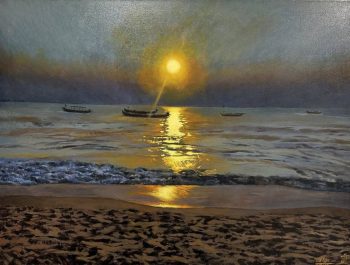
- Arash Shoveiri, “Sunset,” 32×24 in.
-
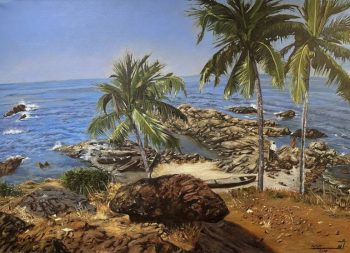
- Arash Shoveiri, “Goa,” 32×24 in.
Chance intervened. Ashraf won a U.S. green card in the diversity lottery — one of several in her family to do so — and the couple immigrated, landing first in California before settling in Utah, where her siblings had already established themselves. The Wasatch Front felt, to both of them, unexpectedly familiar: a high valley ringed by mountains, not unlike Tehran. “I feel that here is really my city,” Shoveiri says. “My country.”
Both he and Ashraf now work in the medical industry—he at Edwards Life Sciences in Draper, she at BD Medical—jobs that have allowed them to buy a house in Sandy, which they’ve been steadily renovating, doing much of the work themselves. Attached to the main house is a separate apartment, refloored and rebuilt by hand, that functions as an informal gallery and, eventually, they hope, a teaching space open to the community. He paints in an upstairs bedroom, which he calls his cave, listening to music on a CD player.
America, for Shoveiri, existed long before he arrived. He grew up watching American movies—mid-century through the 1990s, with a particular affection for David Lynch, whose surreal and destabilizing imagery finds a clear echo in his own canvases—and he came here with a clear-eyed sense of what the country could offer, alongside a clear-eyed sense of what it had lost. “I believe that after the 90s, art—specifically cinema—dropped here,” he says. It is the observation of someone who loved a culture from a distance and then arrived to find the streets full of smoke shops and restaurants where the vinyl stores and libraries used to be. He is not naive about America; he chose it anyway. Ashraf is more direct: the United States, she says, is her first country. Not by birth, but by choice.

An attached apartment below the Shoveiri’s Sandy home currently functions as a gallery for Arash’s work. From left: “Absurd Euphoria,” “The Cycle of Destruction of the Planet,” and “Totem in Desert” (all 48×60 in.)

From left: “Totem in Desert” and “Life” (both, 48×60 in.)
That choice is shadowed by distance, and by the particular darkness of the Iranian regime. When he left at 35, he had no apartment of his own, no accumulation of property—the system, he says, reserves that for itself and its inner circle. “I never call it a government,” Shoveiri says. “It’s a kind of Mafia system.” His brother, thirteen years younger, still lives with their parents, unable to afford a house, unable to find stable work. “Now it’s worse than before I left,” Shoveiri says. There have been periods of violence and unrest, during which he has become untethered to his family. After the U.S. and Israel attacked Iran at the end of February, reaching family becomes nearly impossible. Recently, Ashraf’s elder sister obtained a satellite phone card—very expensive, Shoveiri emphasizes—traveled to their parents’ home, and called. It was the first time he had spoken to his mother in fifty days. Even if the regime changed tomorrow, he is not sure he would go back. “Nothing is established there,” he says. “It’s still chaos.” He has a house here, a life he has built. He wants to put his energy here. These tensions—between here and there, freedom and constraint, visibility and blindness—find their way directly into his paintings.
There is a moment, sitting in his Sandy home, when Shoveiri searches for the words—in a language he is still learning—to describe the figures in those paintings, ancient and monumental, looking out at the modern world. “Nothing gets green in their minds,” he says finally. It is a striking phrase, and one that lingers, its slight strangeness part of its power. In his work, the crisis is not only environmental or political but interior: a loss of growth, imagination, attention.

Arash Shoveiri, “Social Media Desert”
His current body of work began, somewhat unexpectedly, with Mesoamerican motifs, pursued at first for their formal beauty He describes them as unique and extraordinary, from a civilization that had developed its own complex integration of art, science, and cosmology. Over time he has begun incorporating figures from other ancient civilizations: Persia, Sumeria. The specific cultural origins of these figures matter less to him than what they collectively represent—a past he sees as more intellectually and artistically alive than our own present. “In the past, people were more clever,” he says, only half provocatively. “If you take a look back — in Italy, in Iran, in Egypt — people knew more different styles of art and science. Now, the internet, cell phones, social media don’t let people have their own thinking.” The screens, he argues, have made us incapable of that kind of sustained, generative attention.
In his paintings, these ancient figures are transported into the present not as relics but as witnesses—and what they witness is bleak. They appear isolated in barren landscapes, absorbed in glowing devices or wearing visor-like headsets whose thick yellow cords disappear beyond the frame, suggesting an unseen system that both connects and controls. In one painting, which Shoveiri calls “Social Media Desert,” an ancient figure sits plugged into an invisible force, surrounded not by the jungle landscapes from which such civilizations emerged, but by arid wasteland. The mind, overfed and undernourished, becomes desert. The complaint is not against technology so much as excess—saturation, the erosion of attention, the foreclosure of inner life. “I agree with using social media,” says Shoveiri, who recognizes that when it works, it connects him to home. “But not too much—to the point that people are asleep in life.”

Salt Lake Community College has installed Shoveiri’s “Gateway to Civilization” on the second floor of their Student Life Center at their Redwood Campus.
Other canvases carry more specific political freight. In one, smiling figures remain absorbed in their devices while scenes of police brutality unfold behind them—a direct allusion to the crackdowns on protesters in Tehran following the death of Mahsa Amini, to the young people killed in the streets while others went about their lives. Writing about “Absurd Euphoria,” Shoveiri’s entry in Salt Lake Community College’s recent President’s Exhibition, Geoff Wichert described the central figure as “a stone idol from a land of warfare and human sacrifice, who dwells in a harsh desert he does not see, thanks to the advanced technology that downloads pleasant fantasies and distracting lies directly to him from a source hovering for its own safety somewhere unseen, while its anodyne poison feeds him through a fiber optic umbilical cord.” Wichert called it “the most trenchant vision” in a show of nearly one hundred works, and noted that the shock Shoveiri experienced fleeing across the world was essential to its creation—that only someone who had seen, from the outside, how much ingenuity a purportedly modern population invests in distraction rather than in confronting its actual problems could have painted it.
The college subsequently commissioned a new work from Shoveiri, this one incorporating Persian imagery and a spaceship looming over the scene—post-apocalyptic in register, science fiction deployed as diagnosis rather than escape. It helped pay for a minivan, which Shoveiri needs to transport his large canvases.
Shoveiri has found footing in group exhibitions—the President’s Show, a surrealist exhibition, a show at Urban Arts Gallery in 2021, his first in Utah—and he is hoping for a solo exhibition at the Salt Lake City library system in October. But opportunities have not come without disappointment. The Spring Salon rejected his work (though you’ll find it at Provo’s ALMA Gallery this month). He would like to show more widely, to find collectors beyond Utah, to make enough from his work that he can paint and teach full time. Whether Utah can support that is an open question. For now he gets up early to work long shifts at Edwards Life Sciences and reserves what time he can for the studio. “I have no choice,” he says, with neither bitterness nor resignation. “First, I need money. At least I have opportunity here.”
In the cave, a new canvas is underway: robots, artificial intelligence, the coming displacement of human labor. Downstairs, finished works lean against the walls of the renovated apartment, waiting for the gallery that space will become. The house itself is part of the story—rebuilt by hand, adapted, lived in, a place where survival and expression are, for Shoveiri, the same project. His father told him that art means something, that an artist owes his society the truth of what he sees, that each step must be taken carefully. He has been paying that debt ever since, across three countries, in whatever space he can find.

You can find more of the artist’s work at arasharts.com.
The founder of Artists of Utah and editor of its online magazine, 15 Bytes, Shawn Rossiter has undergraduate degrees in English, French and Italian Literature and studied Comparative Literature in graduate school before pursuing a career in art.
Categories: Artist Profiles | Visual Arts



Thanks for sharing. I wasn’t aware of him or his work.
Poor Iran, and so many other countries that cause suffering for their citizens—not to mention outside nations, like ours it seems more frequently, that cause
chaos, disruption, and misery to others, the environment, and living creatures.
As Shoveriri’s dad said, we “must be responsible to the society [we] are living in, that each step must be taken carefully, with intention.“ True for artists and all of us. And, as an artist, I agree with your summary: “Art means something, that an artist owes his society the truth of what he sees, that each step must be taken carefully.”
http//artistsofutah.org/mcentire
Incredible work. Loved his piece at the President’s Show ’25 (SLCC) which won Best of Show, very deservedly.
This is marvelous work! What a wonderful painter…so much life and feeling. We are so lucky he landed here in Utah.