
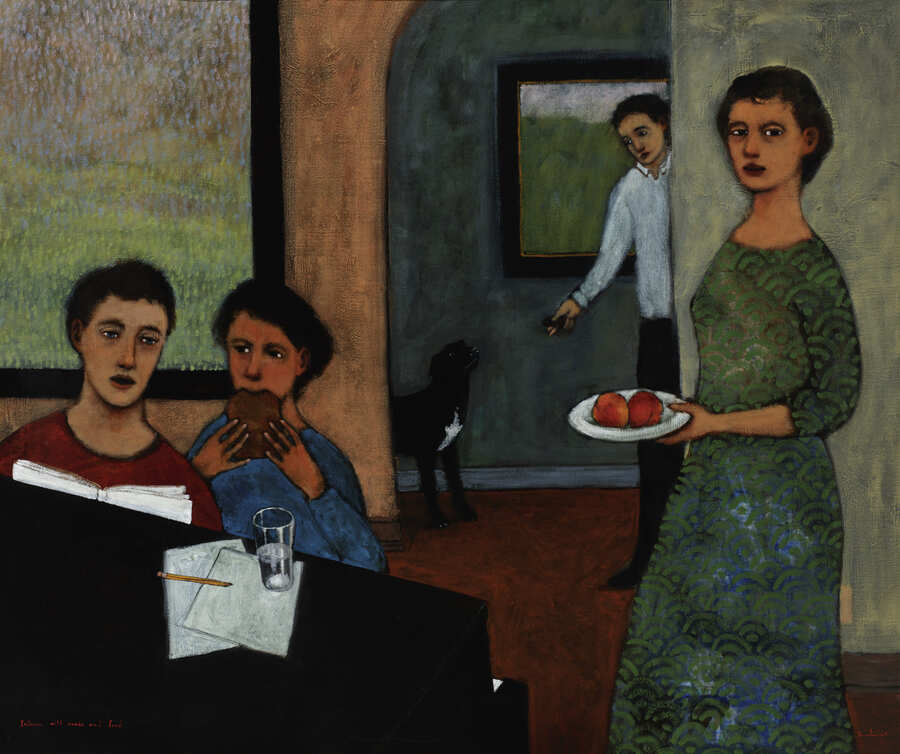
Brian Kershisnik, “Interior with Music,” on view at David Ericson Fine Art in Salt Lake City.
Any good interior has a piano. Or so Brian Kershisnik seems to think. We recently noticed just how often one turns up in his paintings: uprights tucked against walls, keyboards anchoring domestic scenes, instruments waiting to be played (see the work at David Ericson through Oct. 10). Maybe there’s something particularly Utah about the image. We haven’t found anyone who counts pianos in Utah living rooms, but there is evidence that Utahns are unusually inclined to make music. In National Endowment for the Arts survey data collected just before the pandemic, 17 percent of Utah adults reported playing a musical instrument, compared with 9.6 percent nationally. Utahns also reported singing at more than twice the national rate.
Some of that culture begins very young. When Ellen Hayashi was a child, she went to hear the Utah Symphony perform Mahler’s Seventh Symphony. What stayed with her was the final movement. “They got to the last movement, and the sound they produced was absolutely incredible,” she remembers. “I remember thinking at that moment that this was what I wanted to do. I wanted to be an orchestral musician.”
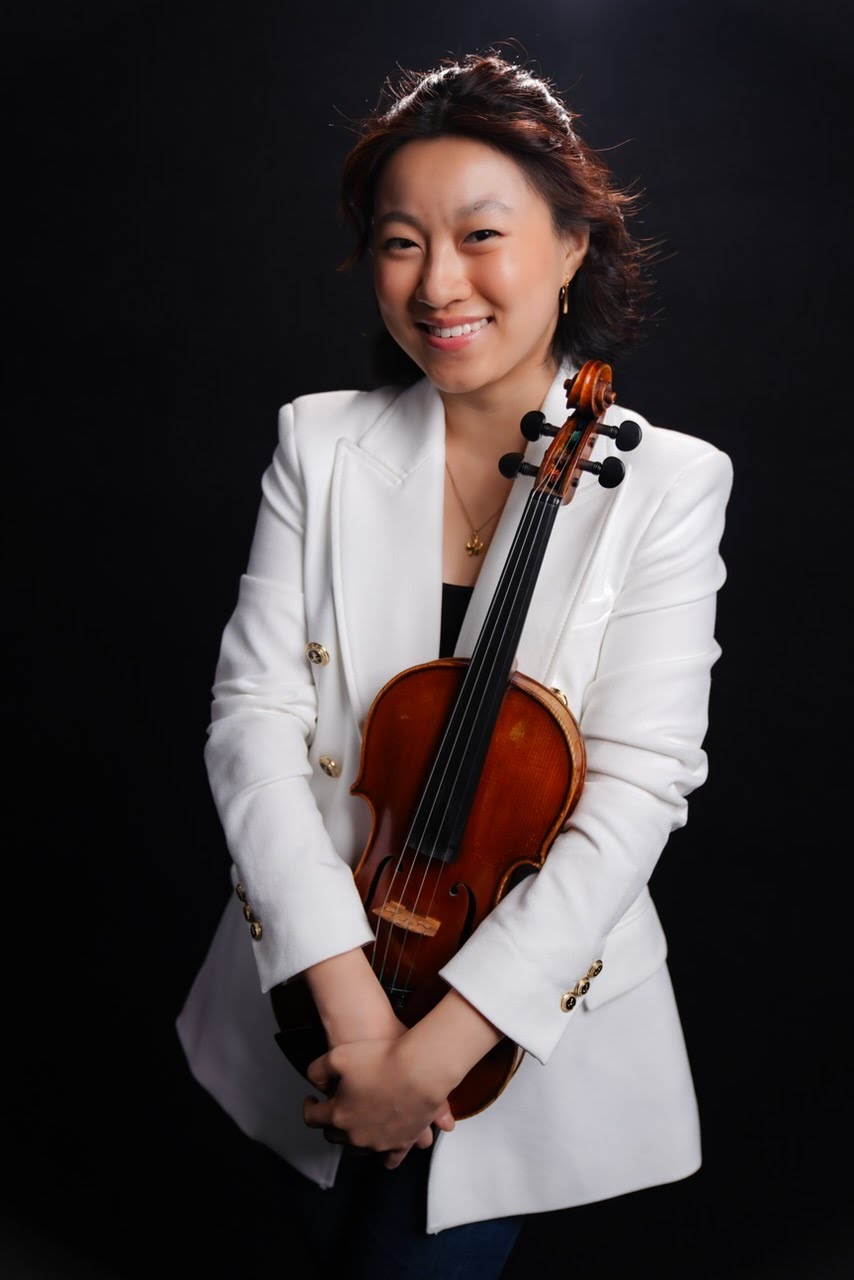
Violinist Ellen Hayashi, who grew up in Utah and went on to join the Utah Symphony.
This spring, Hayashi got the chance to take a seat on the other side of the footlights. She and fellow violinist Karen Ferry won section positions with the Utah Symphony after a competitive audition process. Both came through the pre-conservatory program at what is now the Diana & Joel Peterson School of Music in Salt Lake City. Their appointments are a notable achievement for a music school that is less than two decades old. But they also offer a glimpse into something much older: the network Utah has built to turn children carrying violin cases and sitting at piano benches into serious musicians.
Suzuki music education took root in Utah in the 1970s, and the Suzuki Association of Utah now reports nearly 200 teachers serving approximately 2,000 students around the state. Its annual Intermountain Suzuki String Institute in Draper regularly brings together more than 500 students.
For young musicians who want to move beyond private lessons, Utah has spent decades building places for them to play. The Utah Youth Symphony dates to 1957. The Utah Valley Youth Symphony followed in 1960. And for 66 years, the Utah Symphony itself has invited some of the state’s most accomplished young musicians onto its stage through Salute to Youth. After competitive auditions, young musicians perform concertos and other works as soloists with the professional orchestra.
Salt Lake City native Bonnie Terry, for example, began violin through the Suzuki method at age six. At 10, she won the opportunity to perform with the Utah Symphony through Salute to Youth, playing under then-music director Joseph Silverstein. She later studied at Interlochen, Eastman and the Cleveland Institute of Music, became associate concertmaster of the San Antonio Symphony and eventually returned home. Today she plays first violin in the Utah Symphony and teaches at the University of Utah.
Barbara Scowcroft followed another version of the same path. While studying violin at the University of Utah, she appeared as a Salute to Youth soloist with the Utah Symphony in 1978. She graduated from the U in 1982 and joined the orchestra. She also became part of the music system that helped make that possible. As longtime music director of the Utah Youth Symphony, she has conducted generations of young musicians—more than 1,500 of them during her tenure, according to the organization.
Eugene Watanabe studied violin with Joseph Silverstein, the celebrated violinist who served as the Utah Symphony’s music director from 1983 to 1998. Watanabe later studied at the Curtis Institute of Music and his path eventually crossed that of Russian-born pianist Vera Oussetskaia. The two married and, in 2009, founded Salt Lake City’s Gifted Music School. Vera had grown up with the comprehensive conservatory tradition of Russia, where intensive musical education could begin in childhood, and she saw a gap in the American system: the lack of intensive, long-term training available to children regardless of their families’ financial circumstances.
They founded the Gifted Music School—renamed this year as the Diana & Joel Peterson School of Music—in 2009. The model is broader than simply teaching a child to play an instrument. Peterson’s advanced programs combine private instruction with ensemble playing and pre-professional training, while its GRIT Scholarship Program provides free instruments, ensemble training, Suzuki group classes and private instruction to students in Title I schools and immigrant communities in the Salt Lake Valley.
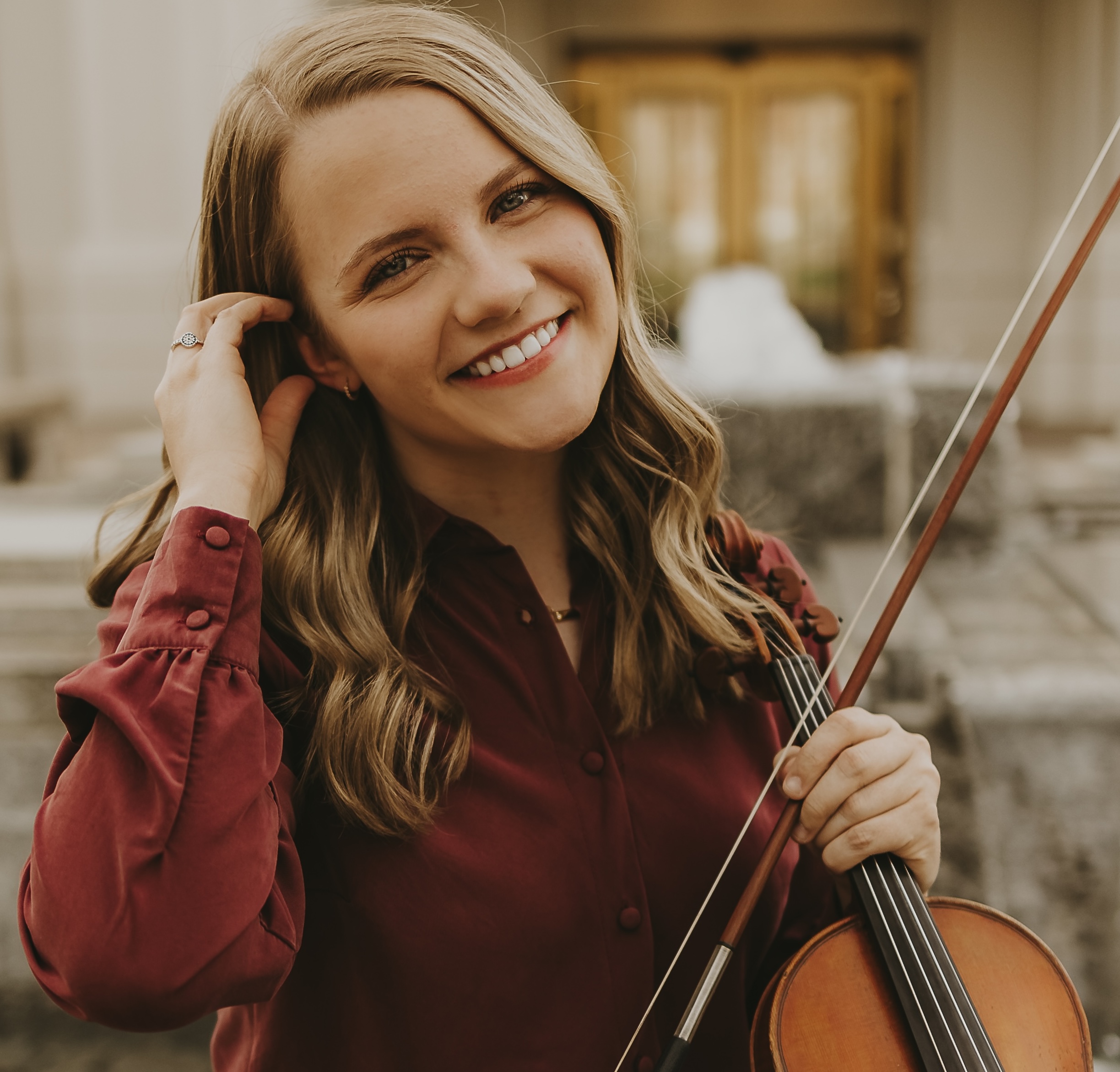
Karen Ferry, a Utah-trained violist whose musical education included the Gifted Music School and the University of Utah.
Karen Ferry was among its founding students. She says the teachers she encountered there expanded her sense of what a life in music might look like by putting her in contact with people who were already making one.
The Utah Symphony audition stretched across three consecutive days. “After those three grueling audition days, getting the call that I had won a section violin position was just crazy,” Ferry says. “I couldn’t even believe it.”
Hayashi describes her education somewhat differently. What she learned, she says, wasn’t simply how to play the violin better. Making music with other people meant learning how to listen, when to lead and when to support someone else. It demanded discipline and curiosity, but also collaboration and empathy. And more than likely, it all began in the home, around a piano. When the Utah Symphony produces an enormous sound this season, she’ll be part of it.

UTAH’S ART MAGAZINE SINCE 2001, 15 Bytes is published by Artists of Utah, a 501 (c) 3 non-profit organization headquartered in Salt Lake City, Utah.
Categories: Music