
Aziza Abdieva in her studio in Cedar City with her work, “The Eternal Becoming.”
“I saw my darkness, I saw my light, I saw everything in between, and now I’m a new human being,” says Aziza Abdieva. “I’m a Phoenix rising.” Fear is a darkness that is hard to climb out of, but Abdieva has made her artistic career by welcoming it.
Born and raised in Kyrgyzstan, Abdieva left the country to study at Bilkent University in Ankara, Turkey, where she earned a bachelor’s degree in Communication and Design in 2018. Her senior project, an exhibition created with Pelin Özesen titled Faux Skins // I Can Be You and You Can Be Me, led to an invitation to study at Texas Tech University.
There, Abdieva began moving beyond photography. Working with her husband, psychologist Joshua Brown, she created “Stress Flesh,” an interdisciplinary project that used art to explore his research into stress. Abdieva made strange, flesh-like forms from silicone, as well as “Umbilical Cord,” a 60-foot installation incorporating silicone, imitation pearls and casts of her own hands. Both works would eventually make their way to Utah, appearing in the 2025 Utah Statewide Annual.
But by the time Abdieva earned her MFA in 2022, she was exhausted. She felt she had made strong, heartfelt work during her MFA, but had put so much of herself into it that she had allowed the work to consume her. When she and Brown moved to Wisconsin, for his postdoctoral research at the University of Wisconsin–Madison, she stepped back from her studio practice. For two years, she worked as a creative producer for FOX. She enjoyed the work, but eventually realized she wanted to make art again. When the couple relocated to Cedar City, Utah, Abdieva decided to use the new start to commit herself to art again.

Installation view of Utah Arts & Museum’s 2025 Statewide Annual, with works by Abdieva in the foreground: “Stress Flesh” (left) and “Umbilical Cord” (right).
But before she had a studio, before she had anywhere to exhibit, Abdieva was still struggling. She describes this period as the “dark night of my soul.” She says she wanted to come back to art, but creating felt pointless. She wondered if her desire was selfish when there was so much destruction and pain in the world. But she came to believe that the antidote for destruction is creation: the point of making art is the making itself and the transformation the artist goes through while making it. For Abdieva, every creative act heals. She decided to start creating and trust that opportunities would come.
To avoid another burnout, she took inspiration from elite athletes who are very intentional about their bodies. They eat well and take care of their mental state so that they can perform to the best of their ability. She committed herself to “good sleep, good diet, consistent scheduling.” Knowing that whatever she feels shows in her art, she took measures against producing stale, exhausted work by utilizing a routine.
Abdieva’s morning starts with journaling. Three pages. She lets her thoughts out so nothing lingers, poisoning her work. After some intentional movement through yoga, she fuels her body with a healthy breakfast. Then, to fuel her confidence, she picks nice clothes and takes time to do her beauty and hair routine. She always looks polished in her studio. She sees this two-hour process of “fine-tuning [her]self to a specific frequency of creation” as an investment in the longevity of both her body and her art practice. By using this routine, she says she is now able to withstand 8-10 hours of continuous studio time without getting burnt out. In fact, she is energized by it. “I just go and let this creative energy flow through me. And sometimes I’m like, ‘Whoa, has it been 10 hours?’”

Abdieva in her studio at work on “The Fertile Dark.”
Once Abdieva is in her studio, she likes to invite the artistic flow with movement through dance. “Inviting flow into my body invites the flow into my thoughts, into my creativity, into the studio.” Nature provides another way for Abdieva to enter that creative state. In fact, she says, her source material is always nature. Often she goes to certain places where she can “feel the energy of nature.” “I look and observe and let the energy of nature tell me its messages, tell me its meaning, and I bring that meaning into my artwork.” When making art inspired by this, she feels like she is “co-creating with nature.”
As part of her practice, Abdieva has decided to share her whole artistic process. Like a phoenix, artists change as they make art, and for Abdieva that change is the most important part of the practice. Yet audiences generally see only the finished product, not the journey that produced it—the beautiful bird rather than the ashes and fire from which it emerged. Abdieva wants people to see and feel the thoughts and emotions she experiences during each piece’s creation and eventual birth. So, she hosts daily live streams on YouTube.
“People come into my studio online and see my art,” she says. “We connect and have these beautiful conversations, deep conversations. I am able to see my art through their eyes because they share how they feel about my art. It’s building this beautiful community. It is really so interesting and special, showing my authenticity, in real time, and attracting my heart-aligned community.”
This idea of transformation—of treating fear not simply as something to overcome but as material to work with—forms the basis of Abdieva’s new exhibition at the St. George Museum of Art, Fear Alchemy. Explaining the idea behind the title, she says, “[Alchemy] is an ancient science of transforming one object into another. The reason why alchemists started their quests was mainly to transmute lead-based material into gold.” For Abdieva, that pursuit becomes a metaphor for transforming something seemingly negative into something valuable.
“I feel like the point for me is treating fear not as something negative,” she says. “It’s not something we should be afraid of. But taking fear as a material. A material for transmutation. I can take my fear and transmute it into love. I can take my fear and transmute it into curiosity. There are so many things you can transmute it into. So take that darkness and transmute it into something of light.”
-

- “The Purifying Heart”
-
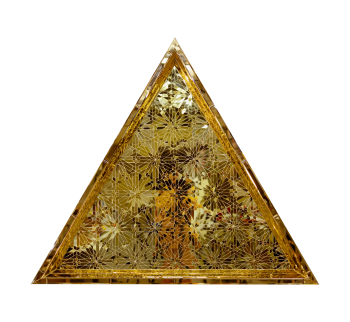
- “The Golden Palace”
Abdieva structures the exhibition around what alchemists called the Great Work, using the cycles of nature as a metaphor for personal transformation. “[It] includes seasons, …[just like] in nature. Just the way the sun goes down and everything turns to night, so does the darkness in your soul, then the sun emerges from the horizon and everything whitens. Light purifies the darkness.”
The first of the four main artworks, “The Fertile Dark,” is a large square composed of charred bark, which she ethically harvested after a fire in Utah. In the cycle of the forest, life is burnt and dies, but in doing so it creates a fertile ground for growth. “The darkness that happens to us are the ashes for us to regrow as new human beings,” she says. “And so every darkness that we experience is fertile, a reason for us to evolve.”
Next is “The Purifying Heart.” Inspired by the salt flats of northern Utah and marked with protective Kyrgyz patterns, it is a triangle made of resin mixed with salt. She chose salt because it is a purifying agent. Abdieva explains that at some point on your journey you must say goodbye to darkness and the habits you got from it that no longer serve you. Release them from a place of love rather than fear. Separate your identity from those habits or beliefs, and let them go gratefully. “When you say goodbye to things from the space of heart, you say goodbye for real. Because you know it’s best for you.”
Third is “The Golden Palace.” Here she uses another triangular frame filled with slices of golden mirrors arranged in a pattern inspired by Islamic patterns. The fragmented mirrors split the viewer’s reflection into multiple images, an effect Abdieva uses to suggest the multidimensional nature of identity. For her, the work is a reminder that no one is reducible to either their struggles or their strengths.
Last is “The Eternal Becoming.” Against a fire-red background is a snake which eats its own tail—Ouroboros, the alchemical symbol for life and rebirth. The image represents the symbolic death that occurs when fear is overcome: the old, fearful self is consumed, fueling the creation of a new, braver one.
If you are sitting in your ashes and hoping for inspiration, Abdieva’s exhibition is one to see.

Aziza installing her exhibition, Fear Alchemy, at the St. George Museum of Art.
Fear Alchemy, St. George Museum of Art, St. George, through December 23.
You can find her livestreams on YouTube at @aziza.abdieva and Instagram at the same handle.
All images courtesy of the artist.
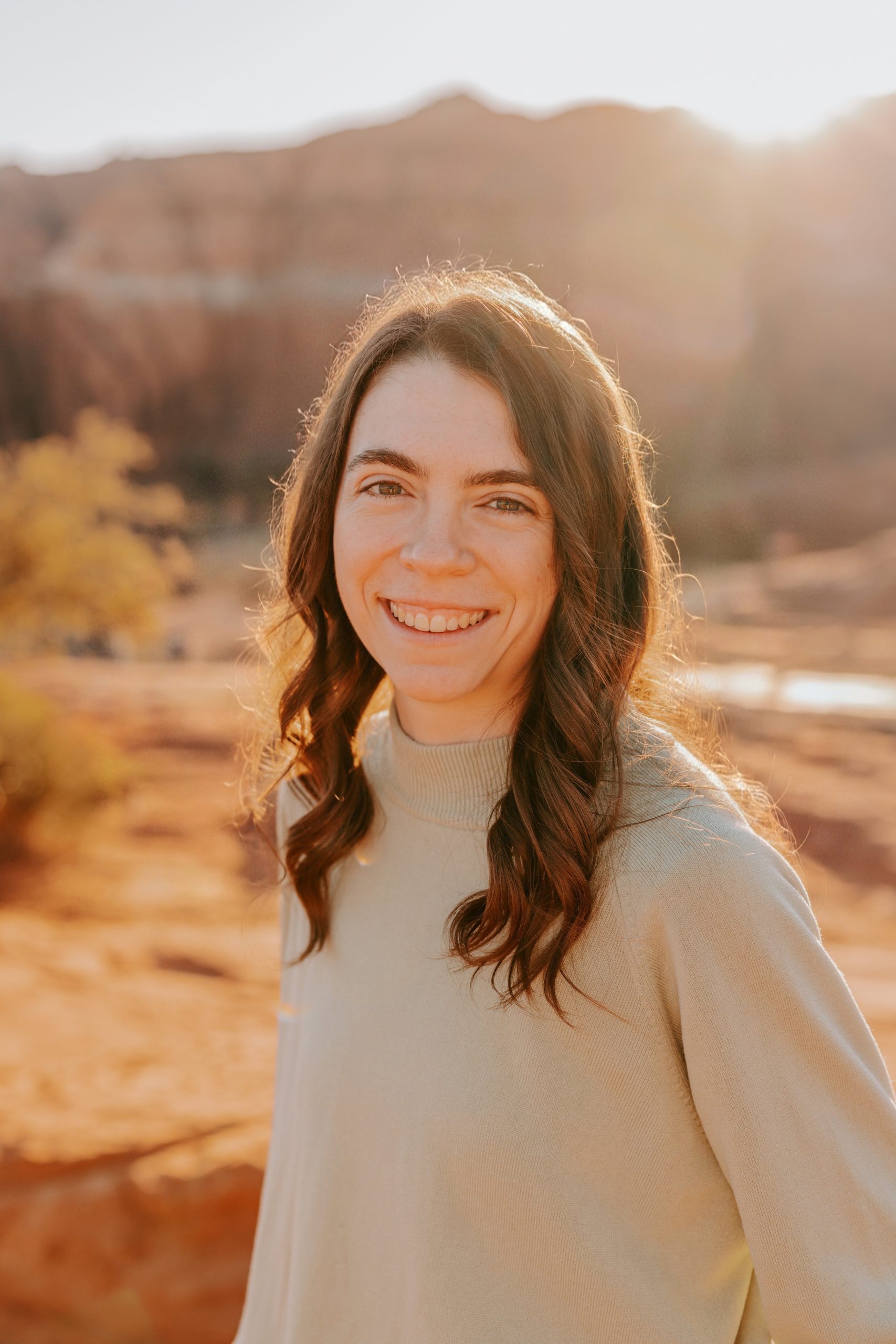
Courtney Seamons Yeatman is a Southern Utah artist who graduated from Brigham Young University with a BFA in Art. Her work explores hidden struggles through high contrast, textured oil paintings.
Categories: Artist Profiles | Visual Arts