
Park City’s public art program started with an accounting error.
David Chaplin was going through the books of the Park City Arts Foundation when he came across a felicitous accounting error. Chaplin, an avid skier, professional artist and instructor at the high school and college level, had moved to park city in 1963, participated in the city’s first art exhibitions and helped found the Park City Arts Foundation, which launched the Park City Arts Festival in 1970. The festival began as an informal affair—a group of invited Utah artists who y set up shop along the sidewalks of Main Street because they weren’t allowed to block the road. By 1975, when the Chamber of Commerce took over, the festival had grown to 240 artists and resort parking lots were filled with what organizers estimated as 50,000 visitors. With the chamber of commerce running things, the foundation lost its purpose and slowly faded away. Almost a decade later, Chaplin discovered they still had a bank account. And it had money in it: $2,000.
That’s when the foundation decided to commission the town’s first public art piece. They worked with City Councilwoman Tina Lewis, who was then working to transform the former Miner’s Hospital into the city library. (Built in 1904 with miner-funded contributions and originally located near Thayne’s Canyon, the hospital closed in the 1950s, became a hostel and bar for a time and then when it faced demolition in the 1970s, locals paid to have it moved to its current location in the city park. It served as the town’s library until 1993, when the former high school took over that role. It now serves as a community center). Once they chose an appropriate spot, Chaplin contacted James McBeth, a professor of art at Weber State whom Chaplin had known since their college days at the University of Utah. “I thought there couldn’t be a better sculptor whose work we could afford,” Chaplin told The Park Record at the time (1984, Nov. 1, p. 22).
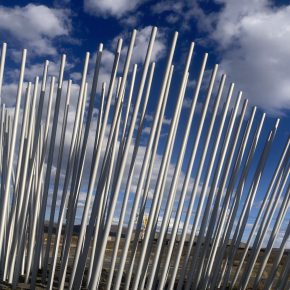
McBeth’s sculpture is carved from three large sheets of quarter-inch burnished stainless steel, rising from the ground in a loose cluster of tall, tapering forms. At first glance, the shapes read like stylized trees or aspens—an abstract stand echoing the surrounding landscape. But cut into the metal are other familiar motifs: sinuous, wavy lines that suggest ski runs, and angular silhouettes reminiscent of buildings, a subtle acknowledgment of human presence in a place defined by nature. Near the top of one panel, McBeth embedded a highly polished metal disc, reflective enough to catch the sky, snow, and the viewer’s own image, a literal mirror meant to “reflect the people themselves,” as he explained at the time.


Over the four decades since McBeth’s sculpture was installed, Park City—and the surrounding communities of Summit County—have steadily woven public art into the fabric of daily life. Permanent works now appear along Main Street and at trailheads, in plazas, parks, and roundabouts, joined by rotating installations commissioned through city programs as well as pieces initiated by private developers and cultural organizations. Local ski resorts have added their own sculptural landmarks on and off the mountain, while artists and residents alike have contributed occasional impromptu works that blur the line between sanctioned art and spontaneous expression. Taken together, the result is a landscape where art is encountered not as a destination but as a series of discoveries—revealed while walking to dinner, riding a lift, or following a trail through the trees.
Visit the Park City and Summit County portion of our Utah Art Map! below to discover these art gems around Park City.




With our In Plain Site byline we feature publicly viewable art, both official and street art, throughout the state of Utah.
Categories: Architecture & Design | In Plain Site | Visual Arts