

Rock of Ages #26, Abandoned Section, E.L. Smith Quarry, Barre, Vermont, 1991 by Edward Burtynsky
Upon entering Edward Burtynsky: The Industrial Sublime, visitors are immediately compelled to look through a regional sense of place and a striking visual representation. In “Mines #22, Kennecott Copper Mine, Bingham Valley, Utah, USA, 1983” layer upon layer of rock and ground pull us into Burtynsky’s large-format photograph as our eye rests upon the emerald green water at the base of the mine. Maybe the unnaturally-colored water is the initial visual draw; from there your eye moves up and out, rotating from that nexus past curvilinear layers to the outer edges of land, then sky, then picture frame.
“Mines #22” reveals to Utahns a portion of our landscape we may have never seen: one of the largest copper mines on the planet, shaped by people and excavated by technology to form a hole large enough to “stack two Sears Towers (now known as the Willis Building) on top of each other and still not reach the top of the mine.”* Considering “Mines #22” conjures a feeling of astonishment at the sheer size and magnitude of this created landscape; an element of horror creeps in as we realize the scale of this industrial site has not been positioned by Burtynsky relative to a broader sense of place, but is all encompassing. In this work, and the thirty additional photographs on exhibition, we encounter the themes that have gained Burtynsky international acclaim: he is able to create beautifully-shot, exquisitely-posed compositions which draw us in to landscapes that humans have overpopulated, damaged, scarred, and in some cases, left for ruin. And, although many of his photographs lack a human presence, when included, the artful juxtaposition of people within the land presents us with intensified issues of scale. The much vaster industrial landscape is often poised to consume humans, growing much larger in size and urgency than his human subjects seem able to comprehend. Welcome to the themes of the industrial sublime.
Burtynsky’s images are contemporary portrayals of a subject that has its origins intimately tied to the beginning of the Industrial Revolution in 18th century Great Britain. Several decades before machine manufacturing replaced toil by humans and animals, the British statesman and philosopher Edmund Burke presented definitions of the sublime and the beautiful in his 1757 treatise on aesthetics. While Burke codified emotions elicited by the sublime in a number of scenarios, he wrote his treatise before anyone began to link the words industrial and sublime together. Yet almost from the onset of the Industrial Revolution, images of the industrial sublime were created: drawings, lithographs, and paintings such as Philip James de Loutherbourg’s 1801 harrowing “Coalbrookdale by Night” – a nightmare of smoke and flame choking the night sky behind the Bedlam Furnaces of the Coalbrookdale Company – quickly documented the rise of industrialization in England. Technological developments spread quickly, both in the creation of new industries and in the geographic spread of industrialization. Swift and massive change ensued, impacting almost every level of human existence tied to industrialized communities.
-
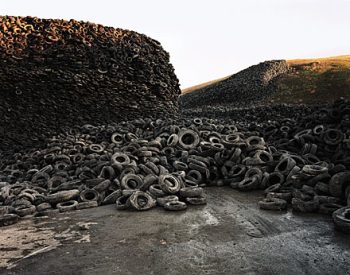
- Oxford Tire Pile #5, Westley, California, USA, 1999 by Edward Burtynsky
-
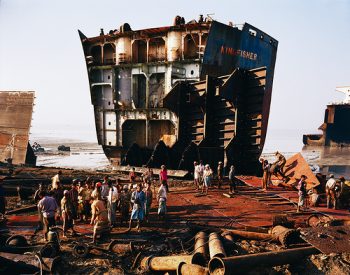
- Shipbreaking #4, Chittagong, Bangladesh, 2000 by Edward Burtynsky
-
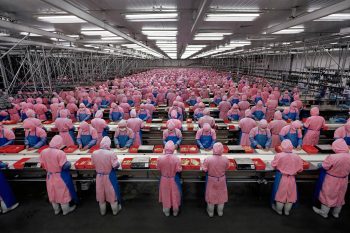
- Manufacturing #17, Deda Chicken Processing Plant, Dehui City, Jilin Province, China, 2005 by Edward Burtynsky
-
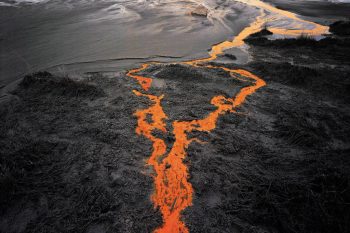
- Nickel Tailings #31, Sudbury, Ontario, Canada, 1996
We are still documenting and grappling with the Industrial Revolution today. Concurrent to Burtynsky’s exhibition in Ogden is the Canadian exhibition Songs of the Future: Canadian Industrial Photographs, 1858 to Today at Toronto’s Art Gallery of Ontario. In contrast to Burtynsky’s contemporary global view, the AGO’s exhibition of over 100 works “highlights the ways in which the photographers’ perspectives on industry have shifted along with those of society at large, as celebratory images of human domination over nature give way to more critical views of industrial impact.”
Burtynsky’s concern with multitudinous manufacturing and the industrial sublime is well documented: his Canadian heritage and passion for his country’s vast and relatively pristine lands led him first to photograph untouched landscapes. A trip to Pennsylvania caused him to rethink his focus, however, and concentrate on photographing landscapes altered by people. Several of Burtynsky’s early photographs from North America are included in the exhibition, such as “Rock of Ages #26, Abandoned Section, E.L. Smith Quarry, Barre, Vermont, 1991” – a surreal façade of vertical and horizontal lines that betray little sense of real space – to “Oxford Tire Pile #5, Westley, California, USA, 1999″, a surreal juxtaposition of hills constructed by disused automobile tires in shadow, offset by the beautiful shimmer of afternoon sun on a California hillside.
From North America, Burtynsky traveled to Bangladesh to document the dismantling of some of the largest ships on our planet. While the exhibition includes several photographs from this thematic ensemble, I was continually drawn back to contemplate” Shipbreaking #4, Chittagong, Bangladesh, 2000.” The photograph’s foreground is populated with workers, many of who stare fixedly at the viewer, setting this one photograph apart from all others in the exhibition. This work links industry and humanity in a personal, almost poignant manner as the connection made to us through gaze binds us to the worker’s plight, yet separates us at the same time through the secret relief that their plight is not ours.
Burtynsky’s work from his visits to China in 2005 and 2006 present us with human movement on a monumental scale. There, he documented the creation of the Three Gorges Dam through the deconstruction of thirteen cities in that region, the rebuilding of displaced cities, and domestic factories that employ tens of thousands of employees. The rigid formalism of the photograph “Manufacturing #17, Deda Chicken Processing Plant, Dehui City, Jilin Province, China, 2005” (reminiscent of Stanley Kubrick’s tight film shots) echoes the rigidity of the factory workers’ plight. Cities such as Shanghai have whole neighborhoods constructed almost overnight through mazes of buildings and skyscrapers, as we find in “Urban Renewal #5, City Overview From Top of Military Hospital, Shanghai, China, 2004.” Burtynsky’s focus on density and the overwhelming number of both people and objects in China – the subject matter of so many of his great photographs – was in turn the subject of the award-winning 2007 documentary by Jennifer Baichwal, Manufactured Landscapes. The film (available on Netflix, at local libraries) unfolds over the course of 90 minutes, bringing to life Burtynsky’s artistic thought and process.
Comparisons of photographs in the exhibition can be made across continents, content, and time. “Nickel Tailings #31, Sudbury, Ontario, Canada, 1996” presents us with unnaturally colored, undulating patterns of water and refuse, creating a futuristic, barren landscape. When the Italian Renaissance master, Leonardo often compared the rivers of the earth to the veins in our bodies, writing poetically: “Veins arise from the bed of the seas and intersect the world and ascend to the mountains and travel back again to the rivers and return to the sea.”* It was far beyond his scope of knowledge to imagine a landscape such as this. When in China, Burtynsky created “Bao Steel #8, Shanghai, China, 2005” – a masterful study in linear perspective composition in the style employed by Italian Renaissance painters in an attempt to create three dimensional space while directing the viewer’s gaze to the focal point of their work. In this case, the focal point is a colossal pyramid of steel, sharply delineated by sheer mass and by the haze of polluted air which forms the background.

Urban Renewal #5, City Overview From Top of Military Hospital, Shanghai, China, 2004 by Edward Burtynsky
It is difficult to look at some of these photographs, but it is imperative we see them. Exiting the exhibition recalls “Mines #22” the first work on display. Burtynsky’s realistic representation of Kennecott’s mine is in stark contrast Robert Smithson’s drawing “Bingham Copper Mining Pit – Utah / Reclamation Project (1973, The Metropolitan Museum of Art), his rendition of a massive earthwork placed at the bottom of the mining pit, consisting of a spiraling wheel design. Smithson’s drawing was created on the heels of his proposal submitted to Kennecott Copper Corporation in 1972 to turn the Bingham Copper Mine into an earthwork. The Corporation turned down Smithson’s proposal, yet through many land reclamation projects and proposals, Smithson’s vision remained unwavering: “The artist, ecologist, and industrialist must develop in relation to each other, rather than continue to work and produce in isolation…The artist must accept and enter into all of the real problems that confront the ecologist and industrialist.”
Burtynsky and Smithson both approached industries in the hopes of enacting change through the lens of the artist. While their artistic creations differ from each other, they both acknowledged dialectical situations presented through their work. Burtynsky wrote of his photographs:
These images are meant as metaphors to the dilemma of our modern existence; they search for a dialogue between attraction and repulsion, seduction and fear. We are drawn by desire – a chance at good living, yet we are consciously or unconsciously aware that the world is suffering for our success. Our dependence on nature to provide the materials for our consumption and our concern for the health of our planet sets us into an uneasy contradiction. For me, these images function as reflecting pools of our times.
In 2005, Burtynsky won the prestigious TED Prize for his body of work. During his acceptance speech, he posited the impact three wishes could make, if granted. While his work can be interpreted as critical of industry or humanity’s plight, his three wishes were affirmative, practical solutions to contemporary concerns. He wished for (one) increased positive communication and conversations about sustainability, especially through sites such as worldchanging.com (two) adults engaging children in the practices of recycling and sustainability, and (three) the ability to reach new audiences through large-scale films, such as IMAX. While this last wish drew laughter from the crowd, Burtynsky’s large-format photographs of immense landscapes would be staggering in an IMAX theatre.
Artists are able to grant us access to landscapes we may never be able to visit, let alone comprehend. Through vision and visionary ideals, their creations can alert us to what is on the horizon, as Smithson did with his land reclamation projects, which are now gaining traction, or lead us to contemporary solutions as we create a more sustainable existence. Here is hoping that Burtynsky’s wishes come true, so that the industrial sublime is eventually relegated to the pages of history, instead of existing as it does today: an urgent issue for us to see.

Bao Steel #8, Shanghai, China, 2005 by Edward Burtynsky
Edward Burtynsky will visit Weber State University to speak on Friday, September 16th at 6:00 pm in the Lindquist Lecture Hall in the Kimball Visual Arts Center. Exhibition catalog on sale through “Art Elements” for $10.00.
Related posts:

has taught art history at Westminster College since 2006, and has also taught at the University of Utah and Weber State University. Her extensive exploration of Spiral Jetty was published by The University of Utah Press and the Tanner Trust Fund in a book titled “The Spiral Jetty Encyclo: Exploring Robert Smithson’s Earthwork Through Time and Place” in 2017; it won the 15 Bytes Art Book Award in 2018.
Categories: Exhibition Reviews | Visual Arts






This is such an insightful review of Burtynsky’s work! The comparison between his industrial landscapes and Edmund Burke’s concept of the sublime really frames that unsettling tension between beauty and environmental impact. As professional painting contractors, we think about surface transformations, materials, and scale every day, so seeing large-scale industrial alterations documented with such artistic precision is truly fascinating. Thanks for sharing this perspective!