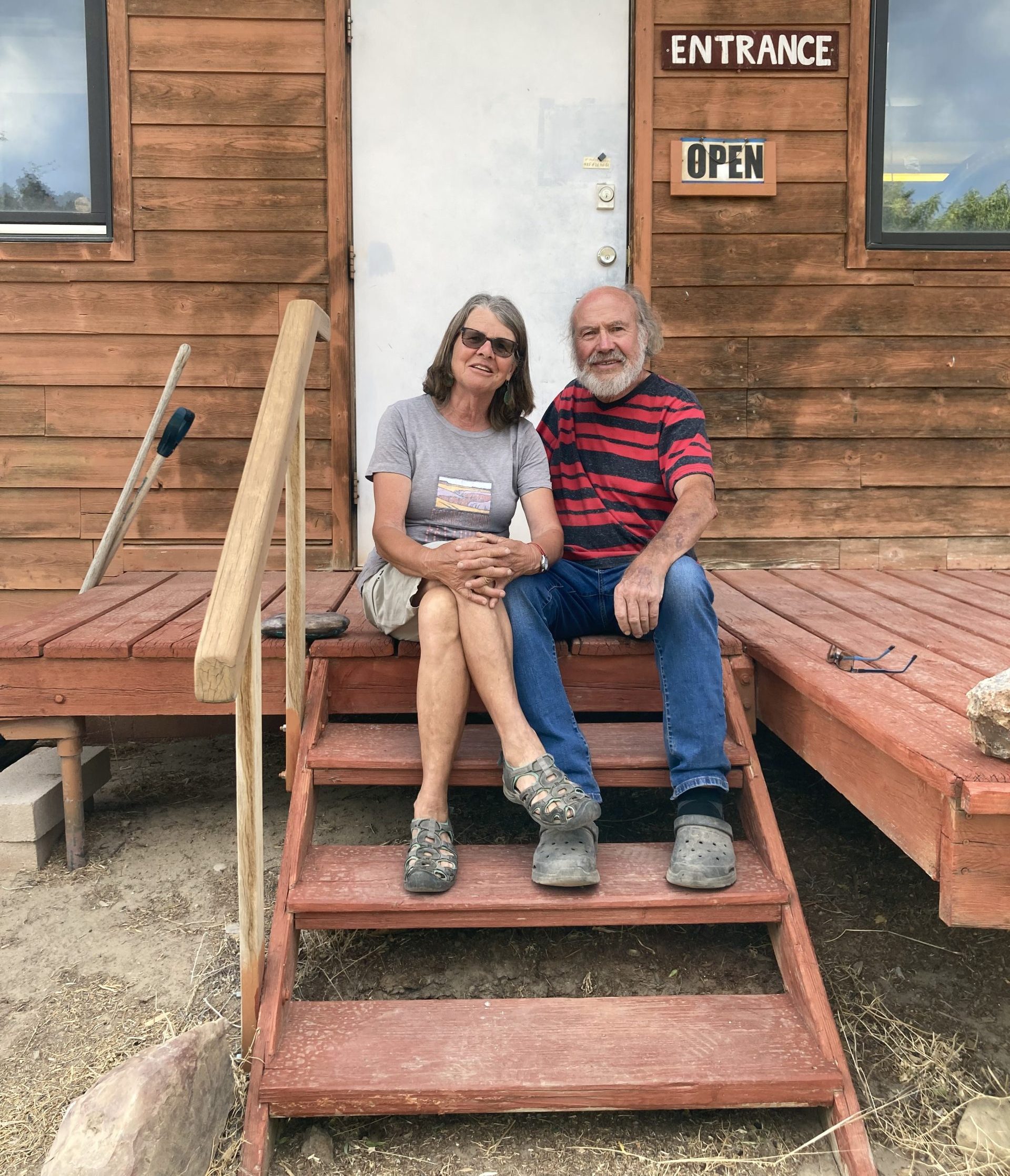
They bought the property on a whim. David and Brigitte Delthony were mid-career artists out of Berlin traveling through the Southwest when they stumbled across a property for sale outside the small town of Escalante, Utah. It was a former sawmill. The owner needed cash for another project, the price was right, and the Delthonys decided to buy it, though they weren’t entirely sure what they would do with it. It was, David recalls, the sort of decision “you make when you’re kids.”
Two years later, they packed their lives—and much of David’s woodworking studio—into two 40-foot shipping containers and moved in. That was thirty years ago.
Neither had any particular connection to southern Utah. David, born and raised on Long Island, attended Haverford College in Pennsylvania, where his interests increasingly turned toward art, ceramics, sculpture and woodworking. He spent two years in the Peace Corps in Turkey, where he also worked with village potters. After returning to New York, he began designing and building furniture before moving to West Berlin, drawn by the Bauhaus tradition and Germany’s strong craft culture. There he earned a degree in interior design from the Academy of Fine Arts in 1975 and trained as a master cabinetmaker.
Brigitte was German, born and raised in Heidelberg. She studied in Paris, Freiburg and Munich before attending the Academy of Fine Art in Berlin, where she earned her degree as an art teacher and later trained and became accredited as an art therapist. For more than 15 years, she worked as an educator and art therapist while pursuing her own work in painting and ceramics.
David, meanwhile, set up shop on an old factory floor near the Berlin Wall, in a neighborhood where businesses had departed during the Cold War and artists had moved in to take advantage of inexpensive space. He began abandoning conventional rectilinear furniture and developing the biomorphic forms that became his “Sculptured Furniture.” He also began assembling the industrial infrastructure necessary to make it, acquiring much of his heavy machinery and hand tools from junkyards and business closings around the city.
By the time the Delthonys encountered the old sawmill outside Escalante, David was exhibiting at international furniture fairs in Cologne and Milan, where his one-person operation stood out among manufacturers of kitchens, sofas and other mass-produced furnishings. He describes himself as something of a “unicorn” there, the lone studio artist among large manufacturers.
At one of his first fairs, an influential figure David calls “the guru of the German furniture industry” spotted his work and began featuring it in his talks. One morning, while David was still setting up his booth, the man arrived at the head of a group of some 30 reporters. “I got into a lot of newspapers and magazines and everywhere,” David recalls. “And ever since then, I was doing quite well.”
Following German reunification, however, businesses were returning to Berlin and rents were climbing. The inexpensive factory-floor loft became increasingly unaffordable. Meanwhile, half a world away, the couple already owned a piece of land. “We had the property here,” David remembers. “Okay, let’s think about it.”
During her school vacation in 1995, Brigitte returned to Escalante to consider the question seriously: “Is it a place where we could live?” For David, the answer came fairly easily. For Brigitte, “it took a little.”
In the spring of 1996, they made the move. Escalante was still a small, isolated ranching community, a town where cattle and the surrounding public lands remained important parts of both the economy and local identity. Younger residents were already leaving in search of work, the Delthonys recall, and tourism had not yet assumed the role it would come to play along Highway 12. For two artists arriving from Berlin, there was little in the town that resembled the cultural and professional world they had left behind.
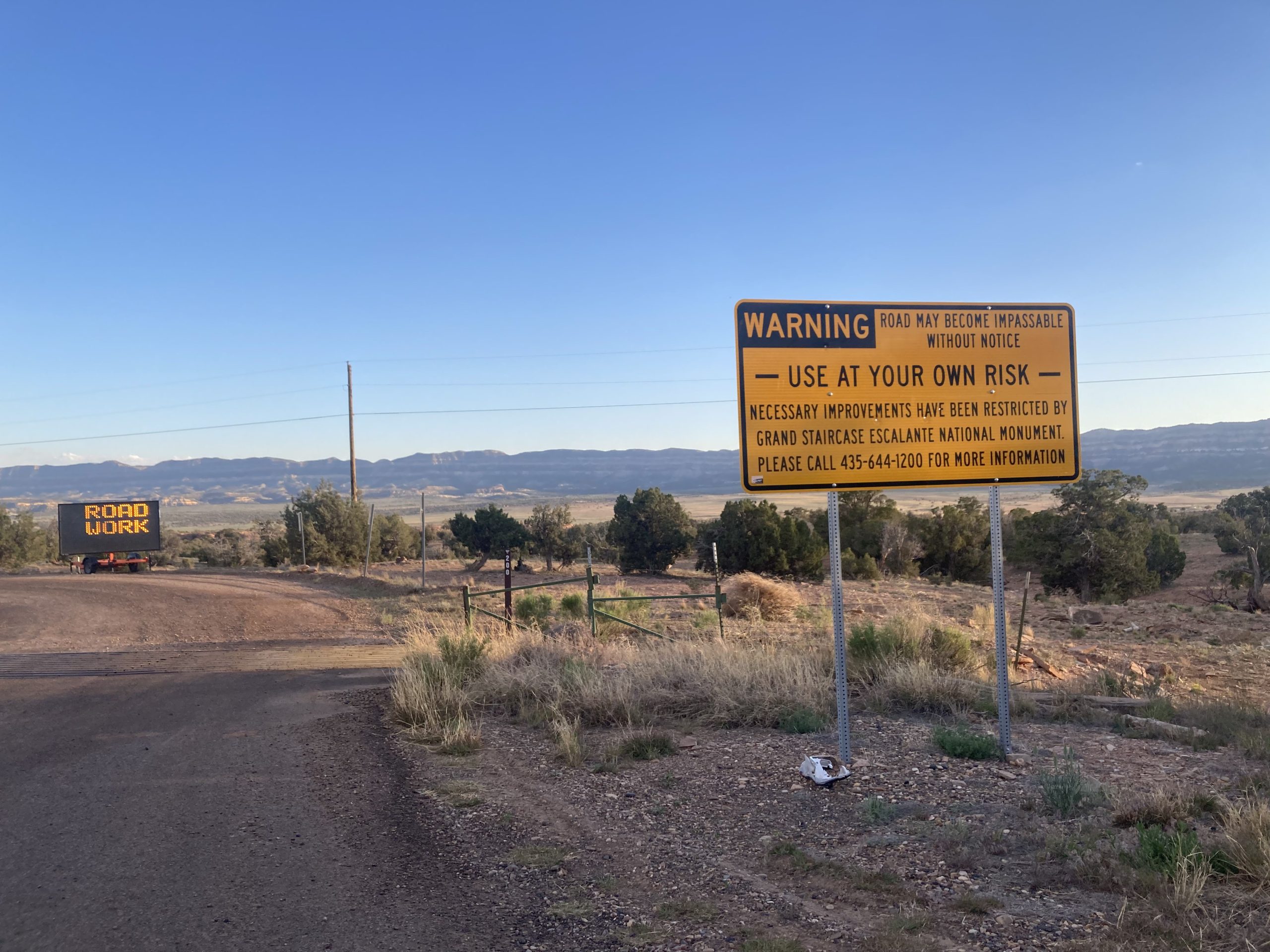
They arrived only months before President Bill Clinton declared Grand Staircase-Escalante National Monument that September, setting off an intense political fight in the surrounding communities. The Delthonys remember an effigy of Clinton hanging outside the grocery store. In a town that was largely rural, Mormon and conservative, they were none of the above.
Looking back thirty years later, David says, “It was a good decision.” For Brigitte, the transition was more difficult. “It was certainly a little more of a challenge,” she says. “Through my profession, I was very connected to a lot of people in the professional field, and there was really basically nobody I could talk to here.” She particularly missed art therapy. “I would have so liked to continue in this field. It’s such an interesting field for me, but there was just no possibility.”
She taught briefly at the local high school, then began giving private art classes for children and, later, workshops for adults. Those classes provided something more than work. Asked whether they helped her become part of the community, Brigitte doesn’t hesitate. “Yeah, that was certainly good,” she says. “I really enjoyed that a lot.”
The couple initially lived in a trailer on the property (still there, now rented), eventually building a home and planting a large garden. And the old sawmill turned out to have advantages they hadn’t considered when they impulsively bought it. There was well and irrigation water and, crucially for David, three-phase electricity capable of powering his machinery. The property also sat directly on Highway 12, the spectacular road between Bryce Canyon and Capitol Reef that would eventually receive designation as an All-American Road. “We didn’t even think about those things,” David says.
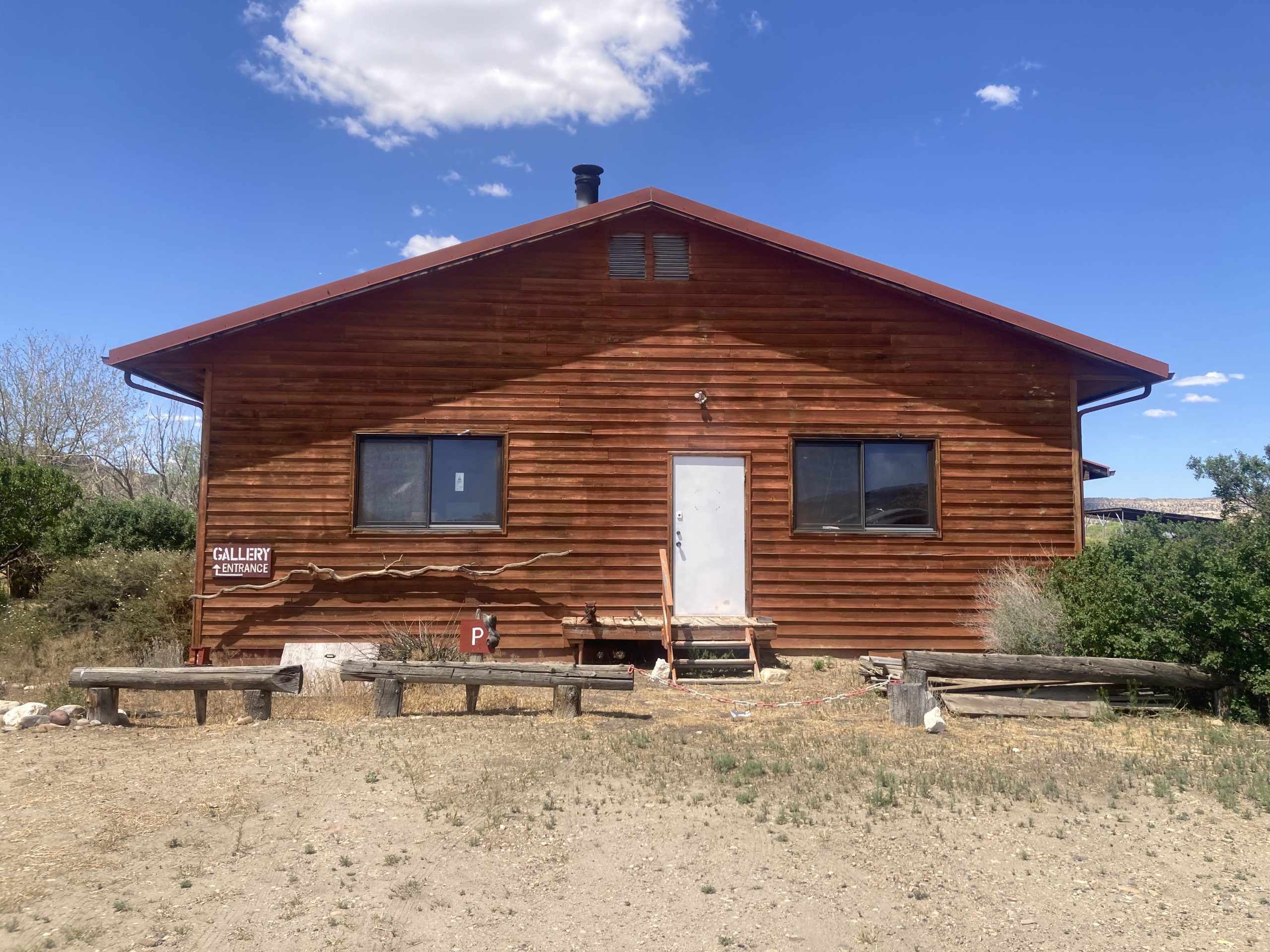
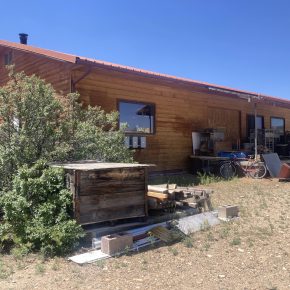
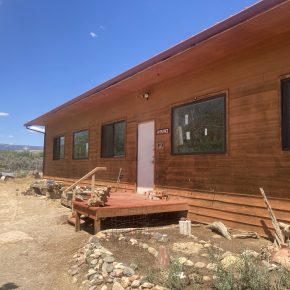
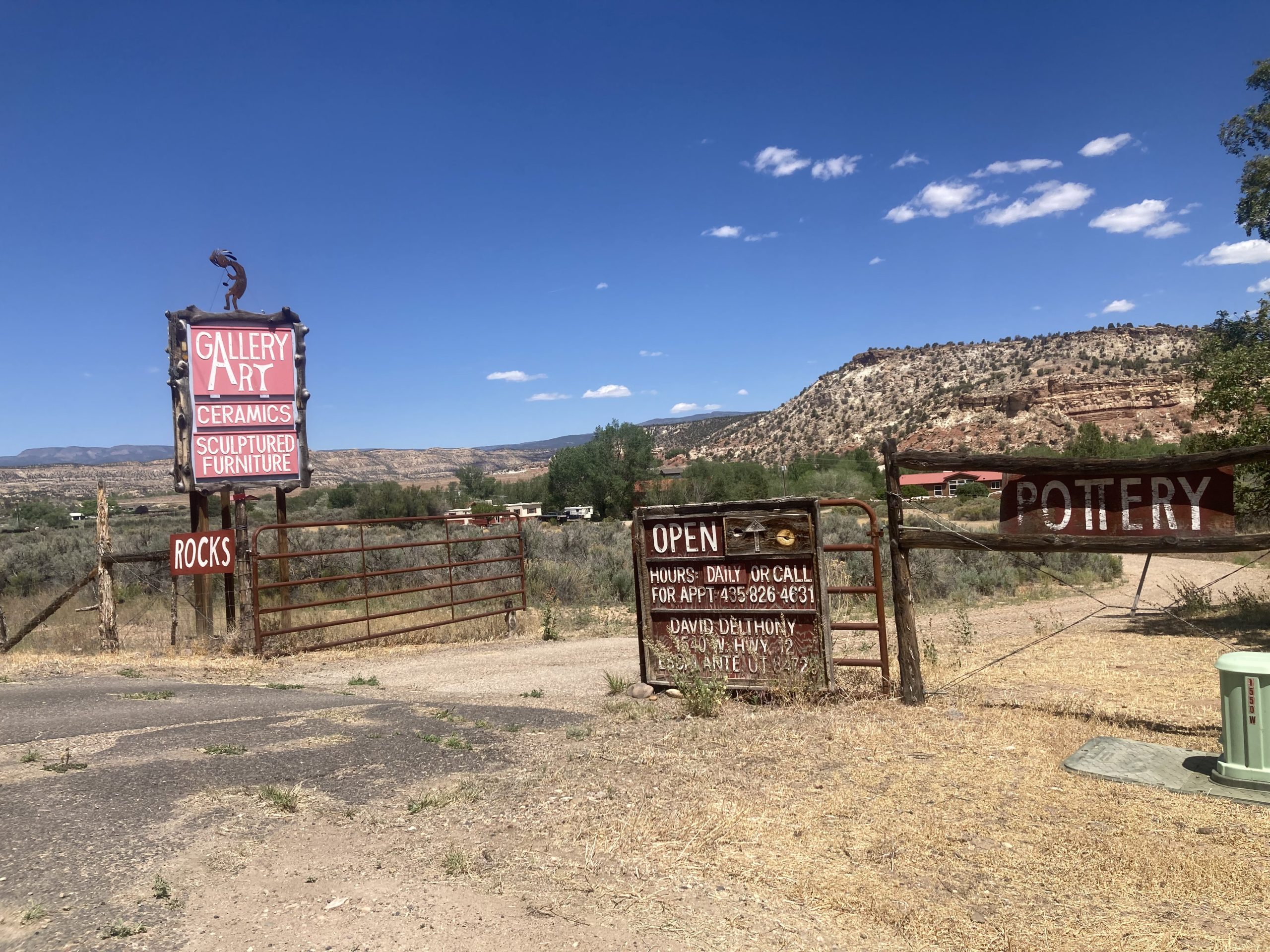
Thirty years later, handmade signs along the highway announce what has grown up on the property: GALLERY ART, CERAMICS, SCULPTURED FURNITURE, POTTERY, ROCKS. Another says simply OPEN. Visitors pull off the highway and cross the property to a long, wood-sided building that contains the couple’s working lives.
David’s studio on the eastern half is less a conventional artist’s studio than an industrial workshop, filled with saws, woodworking machinery, lumber, tools and the large extraction ducts necessary to keep it all operating. Much of what fills the room is the same equipment he assembled during his Berlin years.
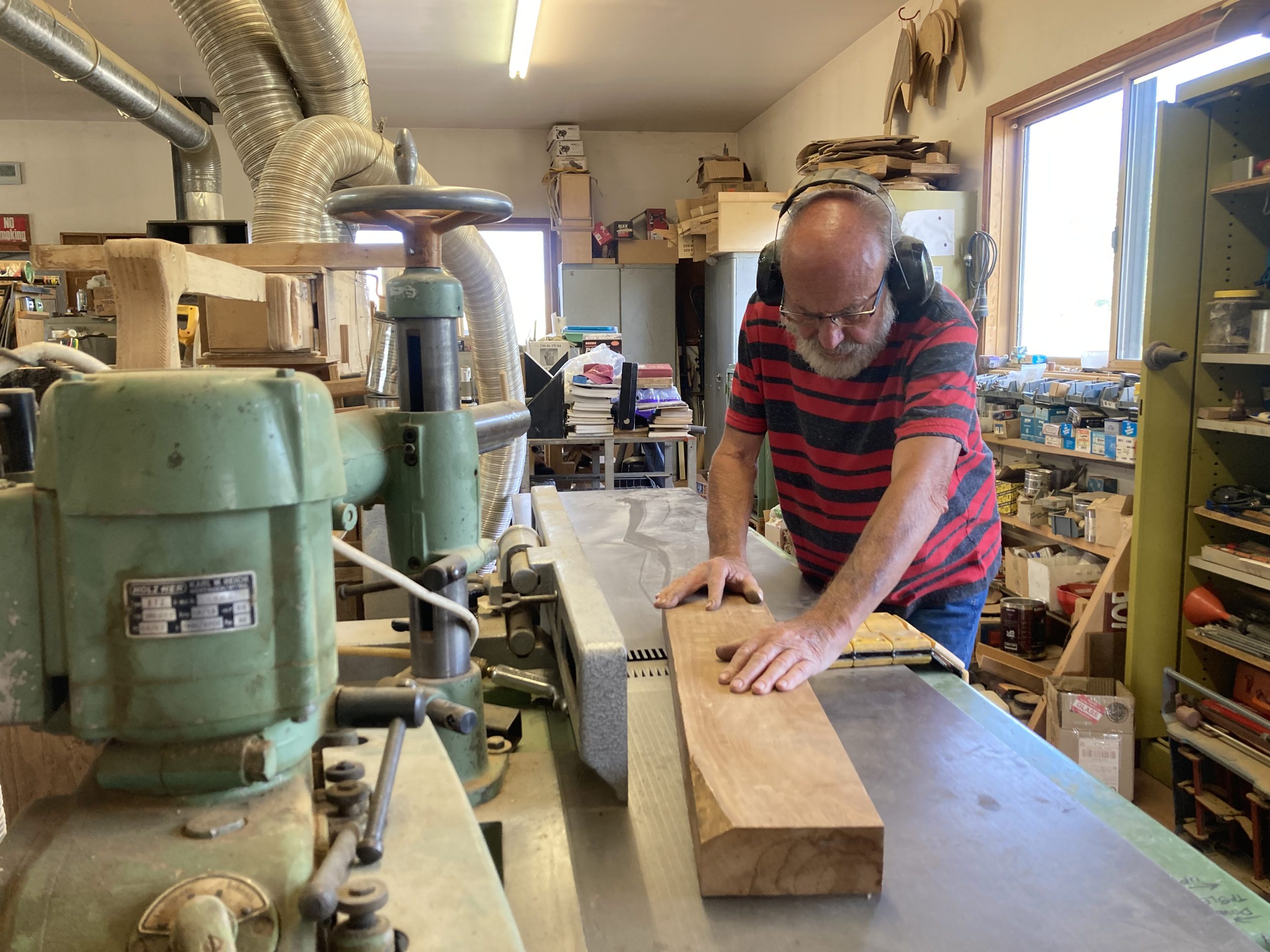
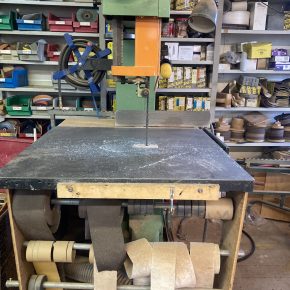
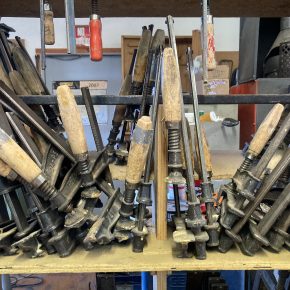
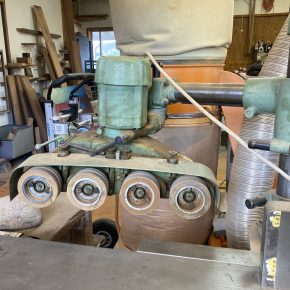
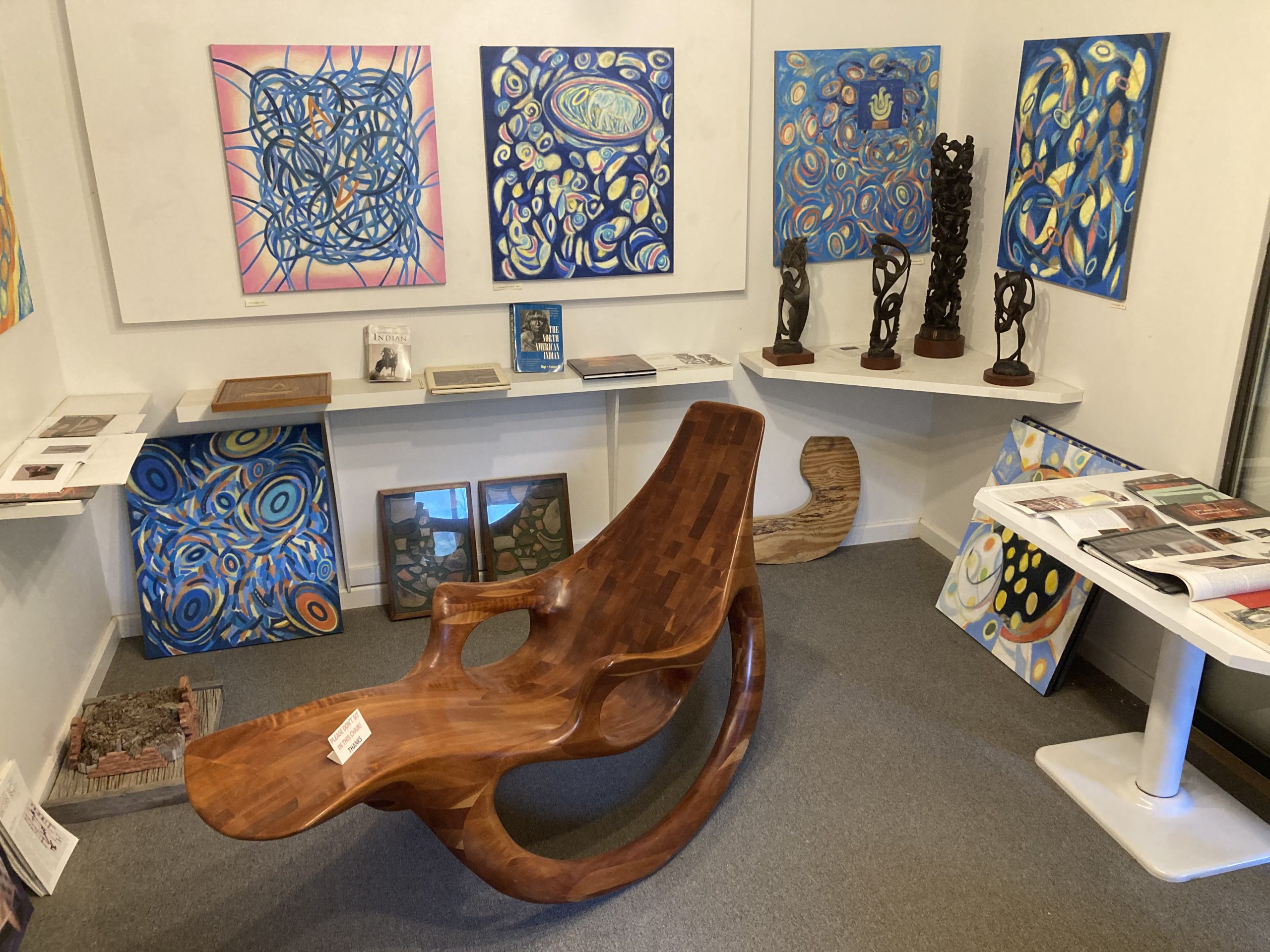
David’s flowing, organic furniture depends upon an exacting process of cutting, gluing and laminating wood, work for which, he says, “I need very good machines so I have perfect glue joints.” The process is slow. His smallest pieces can take more than a month to complete. A larger work, such as one of his laminated cherry rocking chairs, takes roughly three months. Even when he was younger and spending considerably more time in the shop, ten pieces would have constituted a very productive year. “I don’t need many customers,” he says. Seven or eight commissions in a year are enough to keep him occupied.
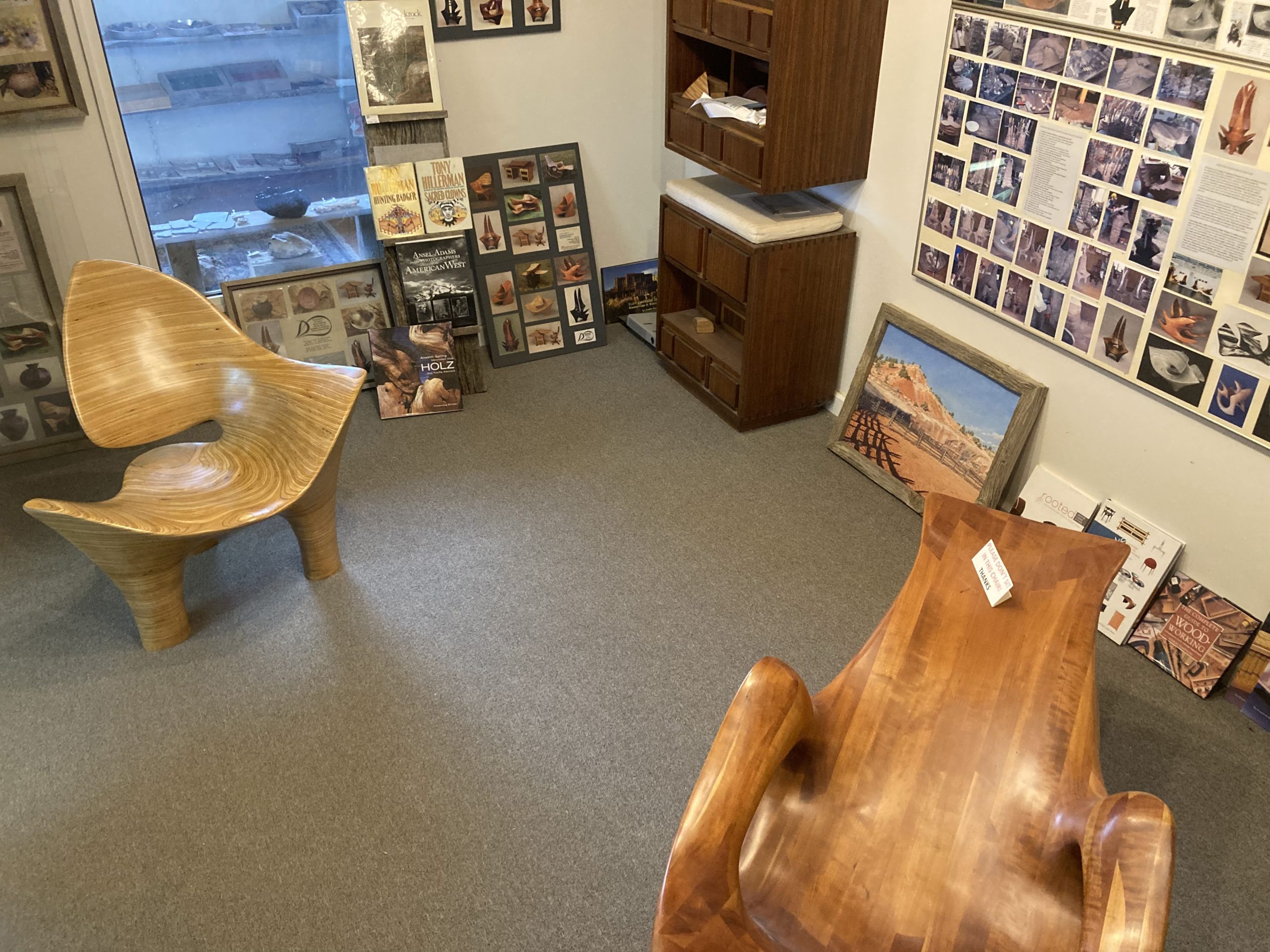
In the middle of the building, against white walls and gray carpet, a few finished pieces have the room to display their strange biomorphic elegance: chairs and rockers whose sweeping wooden forms seem closer to sculpture than conventional furniture. Books, photographs and clippings document a career that began long before Escalante.
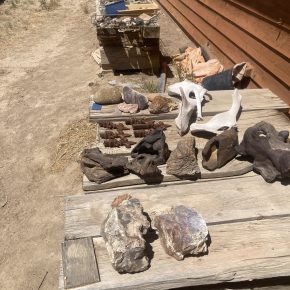
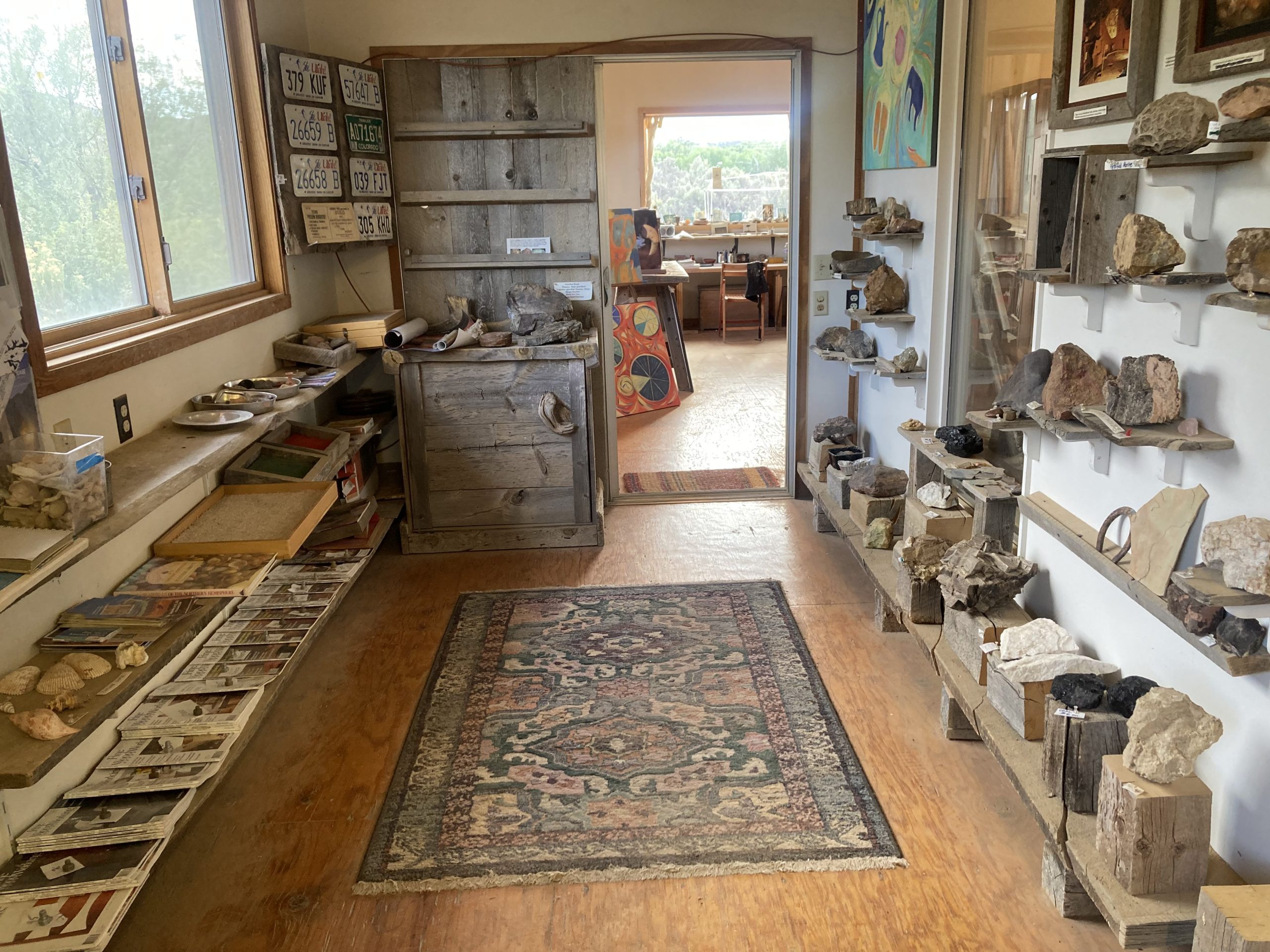
Beyond the showroom, at the entrance to Brigitte’s studio, rocks and mineral specimens line rough wooden shelves, part collection, part display. Through the doorway beyond them is Brigitte’s studio, bright with the light coming through large west windows and, these days, crowded with paintings.
For much of her life in Escalante, Brigitte worked in clay. Her interest in prehistoric cultures preceded the move and was part of what drew her to this part of the United States. But clay came to mean something else after she arrived. “I think the clay helped to ground me to the earth,” Brigitte says, “ to find my place here.”
Her ceramics are hand-built rather than thrown on a wheel. Instead of glazing them, she burnishes their surfaces with a stone. They receive an initial firing in an electric kiln the couple brought from Germany, followed by a second, primitive firing outside. There the pieces smolder for two or three days in what she describes as a partly reducing atmosphere: where oxygen reaches the surface, the color of the slip remains visible; where it doesn’t, the vessel darkens. Their burnished surfaces and irregular patterns of smoke and fire give the work an elemental quality, connecting process and material to the ancient ceramic traditions that first interested her. The work eventually found an audience well beyond Escalante. In Salt Lake City, Modern West exhibited her ceramics alongside contemporary painting and sculpture.
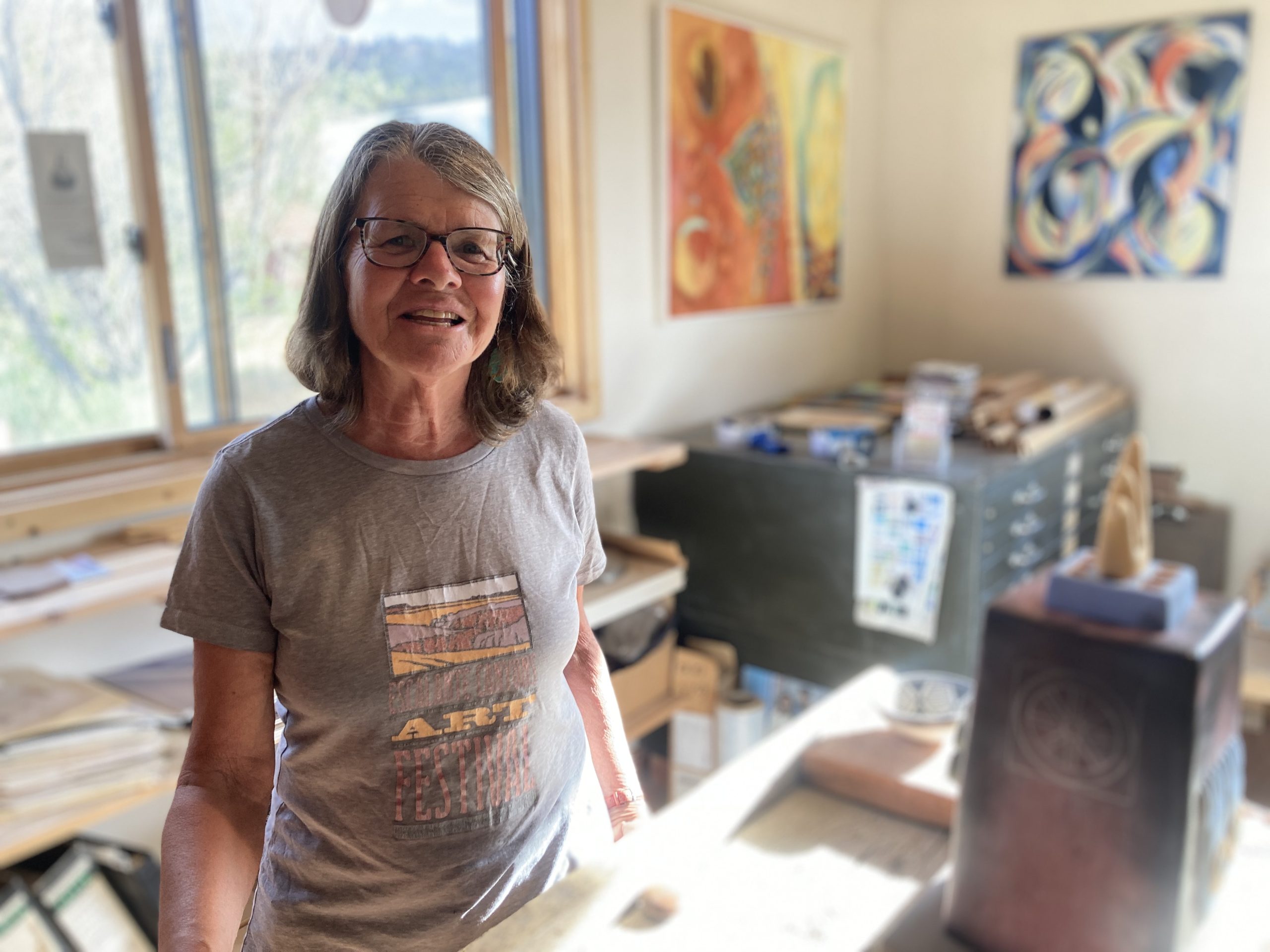
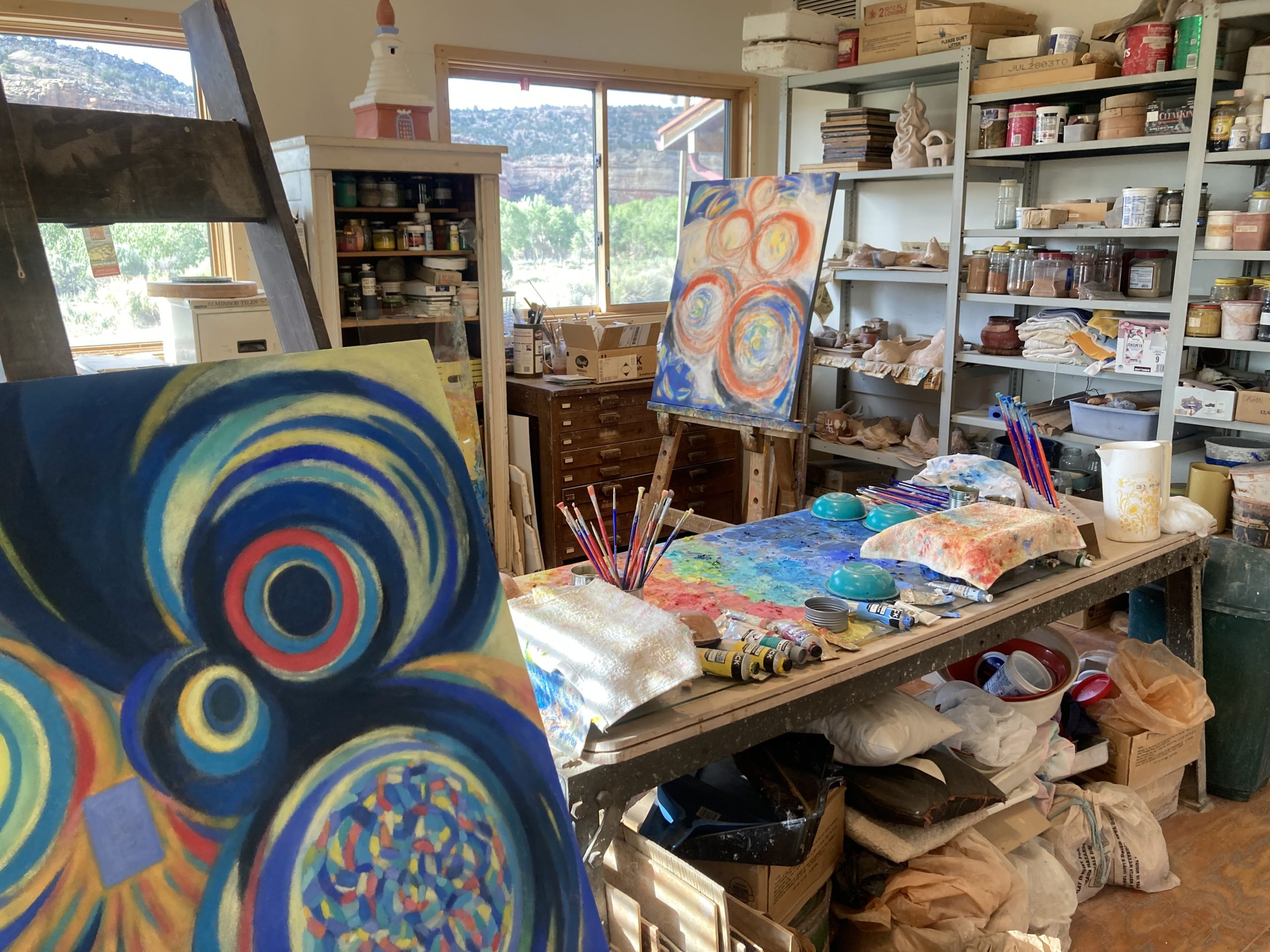
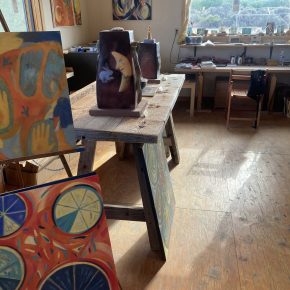
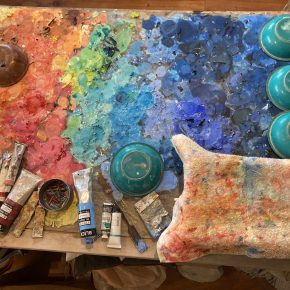
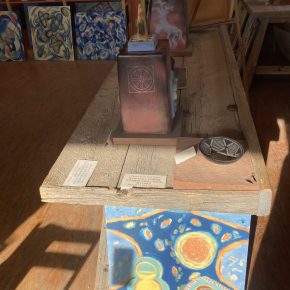
Two trips to Sri Lanka in the years just before the pandemic ignited a change in her work.“When I came back from[Sri Lanka], it touched me really deeply,” she says. She had painted in Germany, but ceramics demanded a nearly complete commitment of her studio time in Utah. “After the trip, I started to paint,” she says, “which is what I always wanted to do.” She still has oil paints from her German studio. “Honestly,” she says, “they still work.”
Brigitte would like to make ceramics but finds it difficult to maintain both practices simultaneously. “I’m in a stage of life where I can really—I don’t need to think about selling,” she says. “It’s more really what I really wanted to express.”
During the spring and fall tourist seasons, perhaps two or three visitors stop at their studio each day. “So that’s enough,” David says. Some have been there before and return years later—recently, one came back after 15 years. Others simply see the signs while traveling Highway 12 and wander in. In a good year, David estimates, perhaps eight out of ten orders originate with people who simply stopped at the property. European travelers seem particularly inclined to investigate. “They’re traveling,” he says. “They want to see something.”
Beyond their property, Escalante has changed, if incrementally. Its population has remained relatively small, about 800 people. But the Delthonys have watched younger members of some longtime families leave in search of work, while newcomers—less rural, less Mormon, less conservative—have arrived. Many are seasonal or second-home residents, from California. For Brigitte especially, the demographic shift has changed the social character of the place. “Now it’s a nice place,” she says. “There are friends, connections.”
She doesn’t look on those early years with regret, however. “It’s just you have to accept where life brings [you] and make the best out of the situation.” And over three decades, they have. Between long hours in their studios, tending the garden and wandering the rugged country beyond their property, the Delthonys have made a life in Escalante that neither could have imagined when they first bought the old sawmill.
For the first time in years, the Delthonys won’t be there for this year’s Escalante Canyons Art Festival, September 18–27. They’ll be in Germany visiting family. But you might take the drive west of town to look at the property. David and Brigitte are thinking of returning to Germany for good and they are hoping to find another artist—or artists—to take over what they have built, someone who will see in the workshops, studio, gallery, garden and land not simply a piece of real estate but a place where an artistic life can continue.
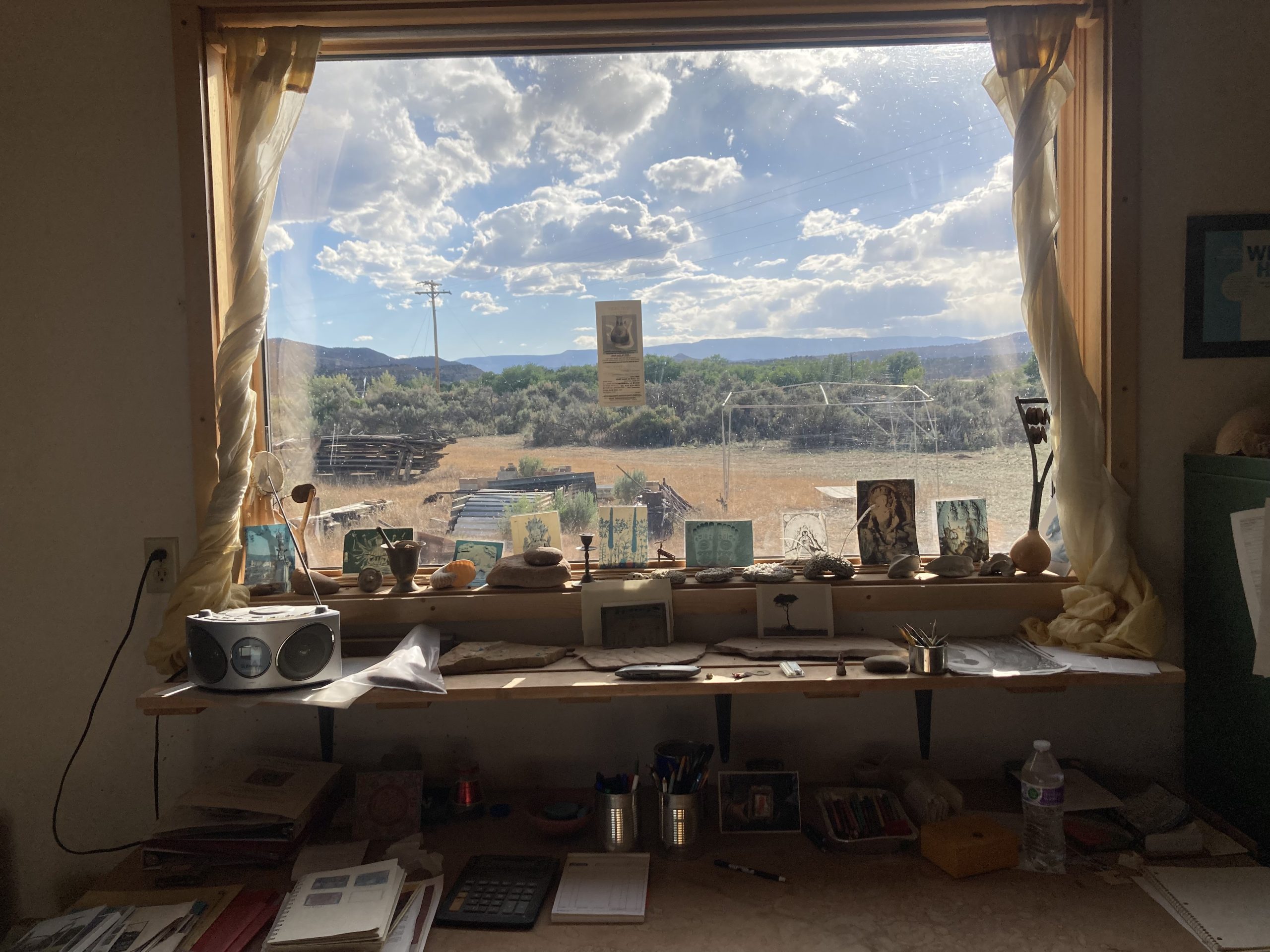
You can view more of Brigitte and David Delthony’s work at sculpturedfurnitureartandceramics.com.
The founder of Artists of Utah and editor of its online magazine, 15 Bytes, Shawn Rossiter has undergraduate degrees in English, French and Italian Literature and studied Comparative Literature in graduate school before pursuing a career in art.
Categories: Artist Profiles | Visual Arts