Cedar City was always an improbable place. If it hadn’t been for the iron ore deposits in the hills nearby—deposits that Brigham Young wanted to exploit for the fledgling Utah Territory—Mormon settlers might never have come to this particular stretch of the high desert at all. As recent reporting on the area’s dwindling aquifer makes plain, there is no natural water source here: the land has no river, no reservoir. Cedar Valley sits on a closed basin and depends entirely on wells drawing from groundwater that, for decades, has been going down faster than it can recharge.
The settlers came anyway, in November 1851, drawn by that promise of iron. They named the place after the juniper trees on the hillsides—mistaking them for cedars—and set about building a furnace. The Iron Mission, as it came to be known, was never much of a success. The ore was stubborn, skilled ironworkers were scarce, and floods repeatedly damaged the equipment. By the late 1850s the smelter was essentially abandoned.
But the settlement stayed. It grew first as an agricultural and ranching community and then was transformed when The Branch Normal School—which would eventually become Southern Utah University—arrived in 1897, making Cedar City a place people came to for education as well as land. The designation as a gateway to what would become Zion, Bryce Canyon, and Cedar Breaks National Monument brought visitors, and visitors brought the logic of tourism infrastructure: hotels, restaurants, and eventually, a sense of the city as a destination rather than merely a stop.
Then, in 1962, the Utah Shakespeare Festival was founded on the SUU campus. What had been a regional hub became a genuine cultural destination for the entire state. People drove hours to sit in an outdoor amphitheater in the high desert and watch Henry V. The festival gave Cedar City a self-image, a story it could tell about itself. The city leaned into it, calling itself “Festival City” and later “Festival City USA,” accumulating other annual events around the Shakespearean anchor.
It is that civic pride in culture—combined with a wave of growth that has brought new residents, new businesses, and a younger generation of artists connected to the university—that has produced Cedar City’s most recent and perhaps most visible creative development: a sprawling, organic, entirely walkable collection of public murals and sculptures that has been assembling across the downtown core and beyond.
None of it emerged from a single master plan. The collection has grown through an accumulation of decisions: a local winery commissioning a mural for its wall, a nonprofit arts center decorating its outdoor stage, a railroad centennial prompting a painted tribute, a Paiute artist rendering his people’s stories on the side of an outdoor goods store. It’s a reflection of a city still in the middle of figuring out what it is, and putting that process on its walls for anyone walking by to see.
The current concentration of public art in Cedar City is a relatively recent phenomenon, though its roots go back to 2019 when a statewide Spike 150 event—celebrating 150 years since the driving of the transcontinental railroad’s golden spike—brought new murals to several Utah communities. Cedar City’s downtown received two pieces from that effort, both by artist Katie Beckstead, that remain among the more historically resonant works in the collection.
What followed was partly pandemic-era momentum: artists with time, building owners with blank walls, and a community looking for something to take pride in while everything else was shut. Rian Kasner, then a senior at Southern Utah University who had stumbled into muralism after painting a weight room for a coach, emerged as a defining figure. Kasner’s work now appears on at least four surfaces in the city, each piece identifiable by its bold colors and confident line work.
The Cedar City Arts Council, the Johnson Center for Community Arts & Education, and the city’s tourism bureau have all played supporting roles—cataloguing pieces, promoting the collection to visitors, and occasionally providing funding. But the scene remains genuinely decentralized. Significant work appears behind pawn shops and wineries as readily as in officially designated arts spaces. None of it requires a ticket or an appointment. All of it is free.
The murals documented below are all publicly viewable on foot, by bike, or by car, concentrated primarily along Center Street and 100 West in Historic Downtown, with additional pieces along the Coal Creek trail corridor to the north. Together they represent the current state of a collection that is still growing—and that tells, in fragments and color, the story of a city that arrived by accident and decided to stay.

The mural at Suds & Duds Laundromat at 696 W 200 North will probably be the first mural you’ll see if you enter town from the 200 North highway entrance.

#Utawesome Mural by @utawesome crew, 59 W Center Street (behind IG Winery) One of the earlier additions to Cedar City’s downtown mural scene, this piece was installed by the Utah-based @utawesome collective, who documented its creation on Instagram. Their account offers a behind-the-scenes look at the mural’s making alongside broader trip-planning content celebrating Utah’s public art.

IG Winery Mural Artist: Rian Kasner Location: 59 W Center Street A hand-painted work where elegant dancers swirl and emerge from splashing wine, capturing the sensory richness of each IG Winery blend. Kasner’s bold use of color and fluid line work have made this one of the most photographed murals in the downtown corridor.

“You Belong” by Rian Kasner, 67 W Center Street (south side of the Bristlecone building). Commissioned by the Bristlecone Company, this large-scale mural is a statement of values as much as a work of art.
-

- Cedar Breaks National Monument by Lone Coyote Location: 97 W Center Street (west side of Home on the Desert Range building)
-
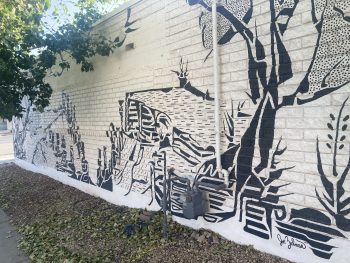
- A striking black-and-white depiction of one of the region’s most dramatic geological landscapes, this 450-square-foot mural was entirely hand-painted.

Johnson Arts Center Mural by Zoë Petersen, 59 N 100 West (Johnson Center for Community Arts & Education) Painted by local artist Zoë Petersen, this bright, musical mural adorns the side of the Johnson Center — a nonprofit arts and education hub.


“CREATE” by Rian Kasner, 59 N 100 West (outdoor stage backdrop, Johnson Arts Center).

Paulina Phelps Lyman — “Aunt Pliney,” by Brooke Smart. Location: 121 N Main Street (behind the Prestige Realty office) Tucked behind a realty office, this mural brings to life one of Iron County’s most remarkable but under-celebrated historical figures. Paulina Phelps Lyman was a midwife who delivered hundreds of babies in the 1800s, a practicing doctor, and an ardent suffragist.

“Suh’dusting, The Cedar People” by Daniel Growler, 97 W Center Street (east side of Home on the Desert Range building). Unveiled on Veterans Day, this mural stands apart for its deep cultural roots. Daniel Growler, a member of the Cedar Band of Paiutes and a Cedar City native, describes himself as an “Indian Graphic Artist” who specializes in Native storytelling.

“Iron Ties of Prosperity” by Randy Seely and Stacey Johnson, 221 N 100 West (Cedar Post Pawn Shop building). Unveiled in 2023 as part of Cedar City’s Railroad Centennial celebration, this mural occupies a building that once housed the offices of the Utah Parks Company — the organization most responsible for opening southern Utah’s national parks to early tourism.

“Spike 150” mural by Katie Beckstead, Location: 16 N 100 West. A three-panel work commemorating the 150th anniversary of the transcontinental railroad’s completion, this mural highlights three nearby national park attractions and reflects on the moment the railroad connected Cedar City to the wider world.

“Bee-UTAH-ful” by Patti Gillespie. Location: 581 N Main Street (Coal Creek Walking Trail, behind the Cedar City Visitor Center) Located along the Coal Creek trail corridor, this mural greets walkers and cyclists with a burst of color rooted in the surrounding landscape. Look closely and you’ll find the red rock formations of Cedar Breaks, the flat expanse of the Markagunt Plateau, and cheerful bees — a nod to Utah’s state insect and its role in the high-desert ecosystem.

“Let Wonder BEE Your Guide” by Kylee Orton, 581 N Main Street (south side, Cedar City Visitor Center) On the south face of the Visitor Center, Orton’s mural offers a gentle environmental message: discover the wonder around you, and be kind to the wildlife, trails, and landscapes that make southern Utah extraordinary.

You’ll find installations like these along the trail.

Annie Apartments mural by @bohemiandesertdweller, 840 S Main Street (The Annie Apartments, end gable wall). Painted in spring 2024 on the prominent end wall of The Annie Apartments, this large-scale mural takes the building’s entire gable face as its canvas and transforms it into something closer to an atmospheric painting than a traditional mural.
Beyond the Murals: Sculptures & Other Public Works
Cedar City’s public art extends well beyond its murals. The Beverley Center for the Arts — home to the Utah Shakespeare Festival and the Southern Utah Museum of Art — houses two sculpture gardens that are among the finest collections of outdoor sculpture in the region.
The Stillman Sculpture Court presents seven contemporary works from different artists, assembled with the intent of representing a wide range of emotion, age, culture, and form. Nearby, the Pedersen Character Garden brings nine bronze figures from Shakespeare’s plays into the open air — including The Bard himself — with quotes from each character inscribed on benches throughout the garden. Visitors can pose with Cleopatra, share a moment with Bottom the Weaver, and read the lines that animate each figure. Both gardens are open to the public during regular hours.
Elsewhere in Historic Downtown, bronze statues honor four prominent Cedar City citizens whose contributions shaped the region and the wider world. The Veterans Memorial, located at 200 North (Freedom Boulevard) and 200 East along the Coal Creek Trail, includes large-scale memorials and sculptures honoring veterans of every American conflict from World War I through Iraq and Afghanistan. It is free and open to the public during daylight hours.
The Southern Utah University campus is also worth a dedicated visit for sculpture alone. The collection spans classical and modern forms and is described by the Cedar City Arts Council as one of the finest displays of its kind in Utah. A walking map of the campus art stroll is available through SUU’s website.

With our In Plain Site byline we feature publicly viewable art, both official and street art, throughout the state of Utah.
Categories: In Plain Site | Visual Arts



The Frontier Museum in Cedar City hosts art shows and creative art from the past. A Native woman sells her unique jewelry there on Friday nights. My husband and I will be showing our To Live is to Dance photography and painting show in April. A free Open House is on Fri. April 3 at 6 pm at the museum. We’re on Instagram at Cerulean_hue and eurekachuck