
Earlier this year, Elizabeth Julian began as the first Executive Director of the Boulder Arts Council.
Imagine if Salt Lake City gave $4.4 million in artist grants every year. And if you really want to get crazy, imagine all of it going to just two artists.
A pipe dream, certainly. But on a per-capita basis, that’s roughly what happens in Boulder, Utah. For the past two years, the Boulder Arts Council has awarded two local artists unrestricted grants of $2,500 apiece. In a town of fewer than 250 people, that works out to more than $20 per resident devoted just to individual artist grants. And the grants are only a small part of what the Boulder Arts Council does. It mounts exhibitions and concerts, brings in dance companies and chamber musicians, organizes workshops and writing programs, hosts storytelling nights, works with children and older adults, and maintains an online directory of local artists. After 16 years of doing all this without paid staff, the organization took a significant step this year: it hired its first executive director, Elizabeth Julian.
For much of its history, Boulder’s economy revolved around ranching and small-scale agriculture, shaped in part by the town’s extraordinary isolation. It was the last town in the United States to receive its mail by mule train, carried over a route so difficult that one stretch became known as Death Hollow. Today you’re more likely to arrive on Scenic Byway 12, the spectacular highway connecting Boulder to Escalante. For one memorable stretch, the road runs along a narrow ridge, with cream-colored slopes falling away on both sides. Watching a tour bus negotiate it—or being on the bus—is, in more ways than one, a trip.
Cattle still graze the surrounding country, but tourism has become an increasingly important part of the local economy. Visitors drawn to Grand Staircase–Escalante National Monument, the Burr Trail and Highway 12 support lodging, restaurants and outdoor recreation, while the town has attracted artists, retirees, second-home owners and others drawn to its remoteness. Not that the town is booming. It just isn’t shrinking, as it did for many decades in the late 20th century. Its population fell below 100 in 1970. Boulder has become a rural community where old ranching families overlap with a newer population oriented toward wilderness, tourism and the arts. As you might imagine, there are some divides.

Boulder’s community center is home to the Boulder’s Arts Council exhibitions.
-
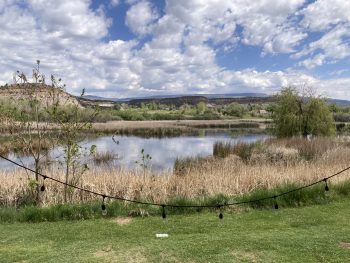
- View from the Boulder Mountain Lodge.
-

- An outdoor stage at the Boulder Mountain Lodge.
There is an official center of Boulder, with the town offices, community center and the gallery where the Arts Council mounts exhibitions. And then there is the center visitors are more likely to recognize, at the bend in Route 12 where the Burr Trail meets it. Here are Boulder Mountain Lodge and Hell’s Backbone Grill, a destination restaurant that has helped put the town on the map for visitors.
On a Saturday morning, a farmers market fills the lodge’s green space. Julian can’t make it far before she finds someone to talk to. One of them is Cheryl Cox, until recently president of the Boulder Arts Council and now Boulder’s mayor. With Julian moving from vice president to executive director, Cox has shifted to serving as the town’s liaison to the Arts Council. In a community this size, institutional relationships can also be personal ones.
Julian, who grew up in Baltimore and worked as a guide in Vermont, arrived here with her partner in early 2008. Asked what brought her to a remote town in southern Utah, her answer is simple: “The land and the people.” She wouldn’t call the town demographically diverse, but she values the mixing that occurs in such a small place. “You can be really good friends with people that have very different political and religious and economic backgrounds,” she says.
In a town like Boulder, everyone wears a few hats. For years, Julian was head teacher and principal at Boulder Elementary. At times that meant being the school’s only licensed teacher and administrator. It also meant being the secretary and, some winters, the custodian. She left that job two years ago and now works as Boulder’s town clerk, picks up occasional hours at the lodge and, as of January, is the Arts Council’s executive director.
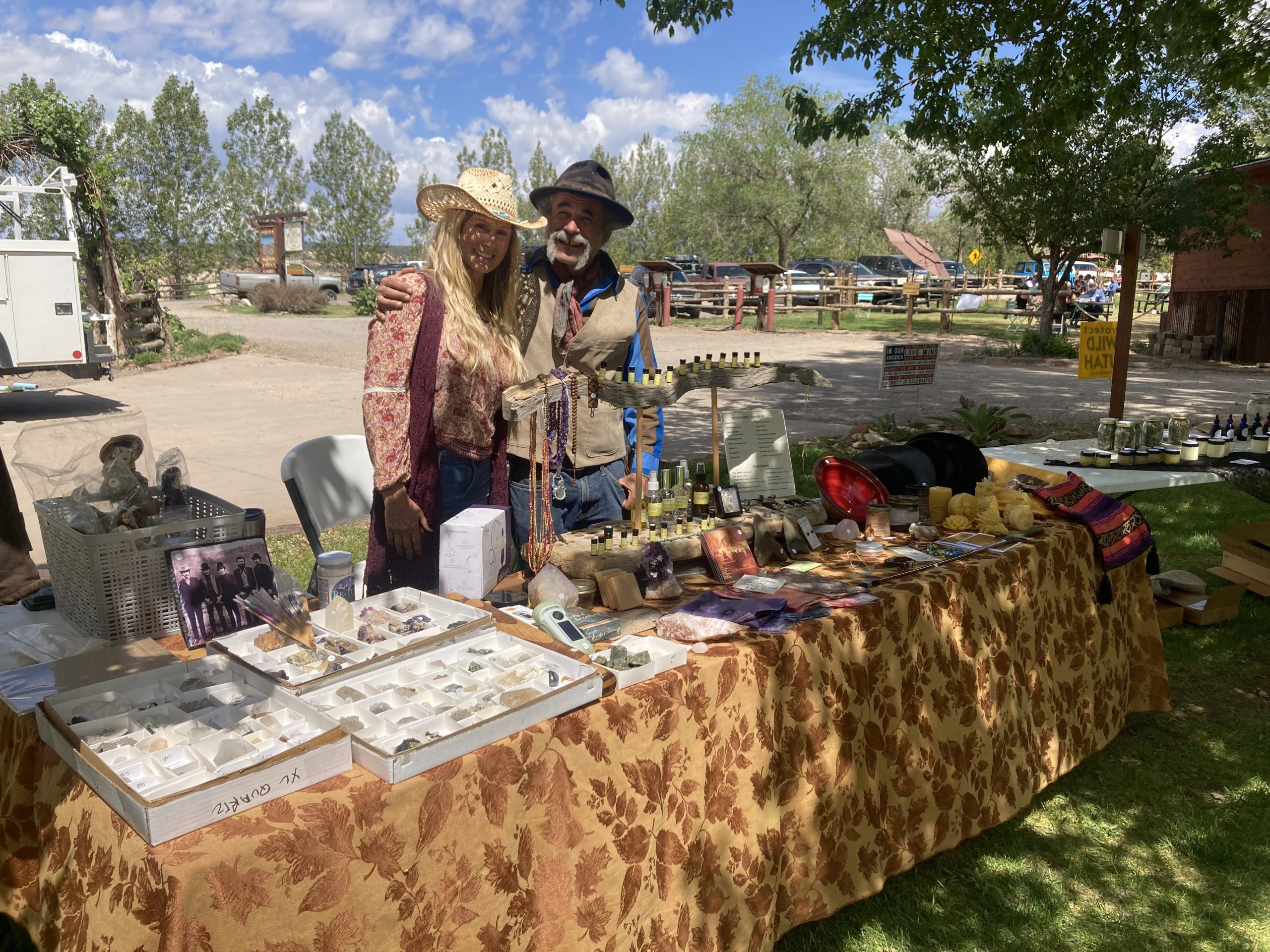
Vendors at the Saturday Market at Boulder Mountain Lodge.
The Boulder Arts Council dates to 2010, with Julian among its founding board members. Unlike a municipal arts council, which ultimately answers to elected officials and public budgets, it is an independent nonprofit, with considerably more latitude in deciding what—and whom—to support. But it also pays attention to partnerships and works closely with the town and other organizations and businesses throughout the area. For most of its existence, the Council has run on volunteer labor.
What that relatively modest infrastructure has produced is surprising. There is music in the park and dance from companies such as SB Dance and Ririe-Woodbury. The Arts Council partners with the Torrey Chamber Music Festival to bring professional musicians over the mountain. Its Cliff Notes Writing Workshop has brought writers including Utah’s first poet laureate, David Lee, and Craig Childs to town. It has organized pottery, painting and songwriting workshops, and recently completed an eight-week bookmaking program for older adults through Utah Arts & Museums’ Creative Aging program.
This past winter, the Council held monthly storytelling gatherings, each organized around a different theme. And then there was something that might best be described as live-band karaoke. The Council brought in a band, but instead of leaving all the performing to the professionals, locals were invited onstage to sing with them. Julian remembers people who didn’t think of themselves as singers getting up anyway, simply for the experience of having a live band behind them.
It gets at something fundamental about the Arts Council’s approach. Art isn’t simply something to bring to Boulder for people to consume. The Council wants people making it.

Tony Jacobsen’s exhibition in the Boulder Community Center, May 2026.
That helps explain the Boulder Artist Grant. The grants are unrestricted and aren’t tied to a particular medium or stage of a career. The question, Julian says, is what $2,500 might allow someone to do to grow as an artist. Recipients are asked eventually to share something with the community, in a form determined by the artist. One of the 2025 recipients was Tony Jacobsen, a longtime Boulder resident and farmer whose paintings were recently exhibited in the Arts Council’s community gallery. The other, literary artist Eric Sheffield, has been assembling a book that incorporates writing by other people in town, with help from local Five Sisters Press. Both were selected by a panel of jurors from outside Boulder.
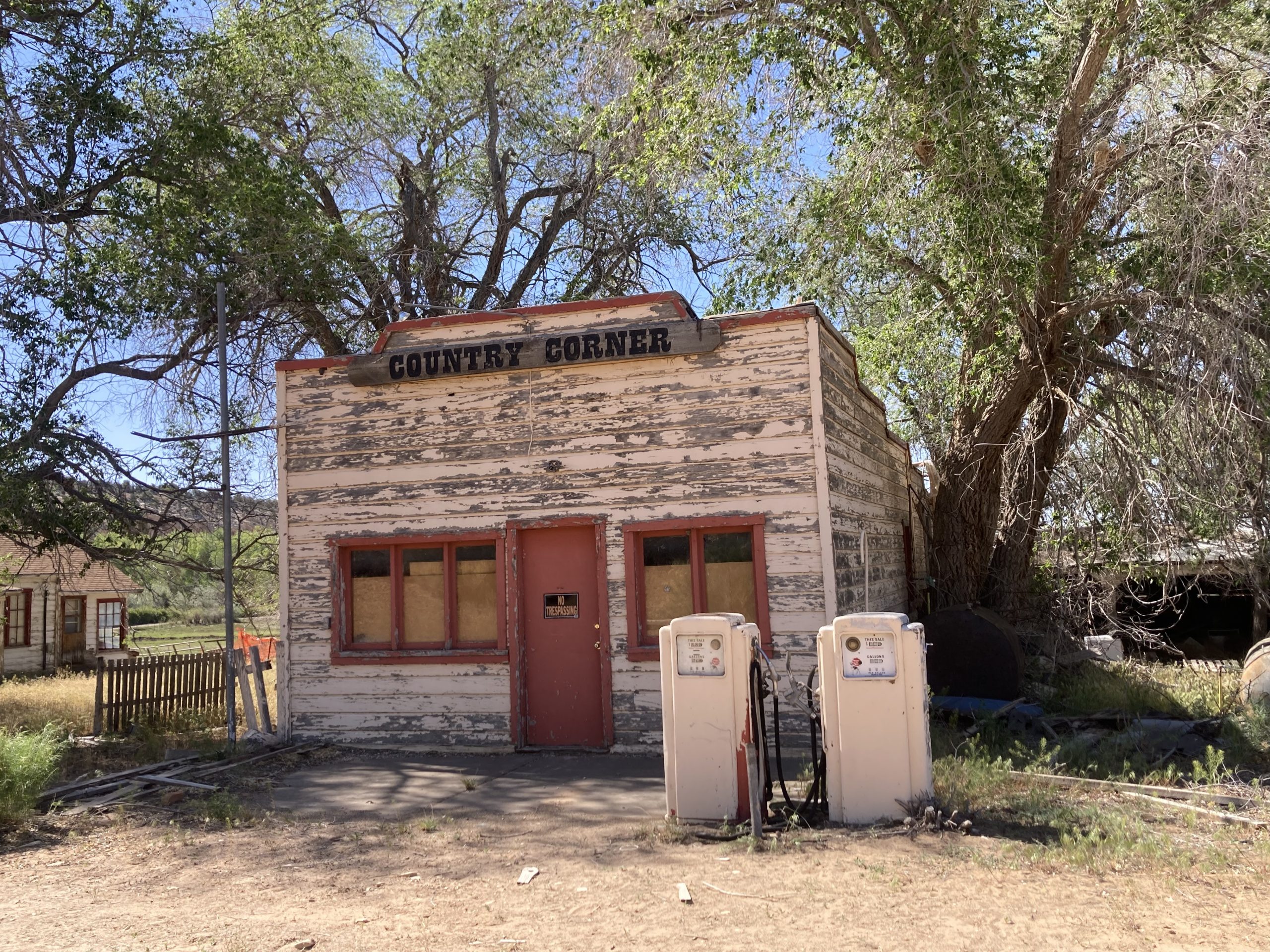
The outside jury is one way the Council guards against the appearance of favoritism, a constant hazard in a town where everyone knows everyone. The same concern shows up in smaller decisions. When the Council ran the Saturday farmers market, it moved it among the town park, the state park museum and, for a couple of years, the gas station. When it brings in performers, it rotates which local lodgings put them up.
The grants also provide an intriguing measure of just how much artistic activity exists in Boulder. Eighteen people applied the first year and 15 the second. Julian says there was relatively little overlap between the two groups. In a town of fewer than 250, that’s a lot of artists.
The Arts Council maintains a page on its website devoted to them. Some have their own websites; others have little more than an Instagram account, so the directory provides them with a basic public presence. Supporting individual artists, though, is only part of what Julian thinks the Arts Council can do. “One of our biggest things that we’ve been focusing on is using the arts as a bridge,” she says.
Boulder includes families who have been ranching in the area for generations and people who arrived only recently. There are conservative religious families and outspoken progressives, retirees and young families, people who depend on tourism and others who would just as soon see fewer tourists. The Arts Council tries to create occasions where they overlap.
Sometimes that happens through an exhibition. Jacobsen, for example, is both an artist and a farmer with longstanding relationships among local ranching families. Sometimes it happens through children: bring an artist into the school, get the kids excited, and parents who might never attend a contemporary dance performance on their own suddenly have a reason to come. And sometimes it happens over food. Julian remembers an inexpensive Thai cooking workshop that attracted what she calls an eclectic group: conservative Mormons cooking alongside liberal activists.

Private-public partnerships: The town of Boulder built the stage, the Boulder Arts Council got it painted, and a private party donated sound equipment.
Julian has felt the lack of an indoor stage for years. When she ran the elementary school, she brought in week-long residencies from the Utah Shakespeare Festival and a Salt Lake–area children’s theater, and every day the students had to be driven to Escalante to rehearse in the high school’s theater. “It would be so nice to have something here,” she says, “to give kids that experience to perform on a stage with lights and a backstage and a huge auditorium, and to fill it.”
Some board members want a performing arts center outright. Julian’s own wish list is more modest. The community center is the only space the council has, and when it held a clay class there, it had no place for wheels. She would like classroom space outside the community center and an open studio with set hours, a place where printmakers, whether established or just curious, could come in and work. A few years ago, someone donated pottery wheels to the council, with the possibility of a kiln, but there was nowhere to put one. The wheels are rented out for now, so at least they have a home.
But Julian is cautious about what growth should mean. Bigger facilities, bigger programs and more visitors aren’t universally viewed as improvements.
Accessibility is part of the equation. The Council tries to keep most activities free or inexpensive, though it learned that completely free workshops presented their own problem: people enthusiastically reserved one of a limited number of spaces and then didn’t show up. Charging even $10 created enough investment to get people through the door without putting the workshops beyond most people’s reach.
The chamber concert shows how the Council handles those trade-offs. For several years it has partnered with the Entrada Institute to bring a Torrey Chamber Music Festival concert over Boulder Mountain. The concerts used to take place in a local barn until new owners ended the arrangement, and the musicians won’t play outdoors. Last year the concert moved to Boulder Mountain Guest Ranch, which liked the result enough to advertise it this year. The musicians, who come from orchestras around the country, asked for an earlier start so they could stay and eat with the audience, and the ranch now offers a $55 three-course dinner with the players. Entrada can’t price the Boulder show below its concerts in Torrey, and at $30 a ticket, Julian says, “it narrows it really quickly” to people who love string music or have money to spare. The Council does it anyway.
It’s all a balancing act. Julian keeps dreaming, but she’s cautious about it. “I don’t want to be the shaker. I want everybody to kind of get along.” As a guiding principle, she doesn’t lean on the traditional economic argument for the arts. Boulder has plenty of tourists already. The Council doesn’t need to sell the town as another reason to visit. Its more interesting challenge is figuring out what the arts can do for the fewer than 250 people who live here.
Queens and Priestesses: Crowning Creation and Guiding Emblems, featuring Lisa DeLong and Kristen Barsch Von Benedikt is at the Boulder Community Center through Sept. 26.
For more information about the arts in Boulder, visit boulderartscouncil.com.
All images courtesy of the author.
The founder of Artists of Utah and editor of its online magazine, 15 Bytes, Shawn Rossiter has undergraduate degrees in English, French and Italian Literature and studied Comparative Literature in graduate school before pursuing a career in art.
Categories: Art Professional Spotlight | Organization Spotlight | Visual Arts


I met Elizabeth when she was the principal of Boulder Elementary. Bonnie Phillips donated art to the public school from her personal collection with the hope of community arts engagement through her Golden Rule Project. Elizabeth was very happy to receive the pieces and I arranged to drive the art to the school and we hung it together. She was lovely to work with and a blessing in that sweet magical town.